Pedal Grasping in the Northern Smooth-Tailed Treeshrew Dendrogale murina (Tupaiidae, Scandentia): Insights for Euarchontan Pedal Evolution
Youlatos, D., Karantanis, N. E., & Panyutina, A. (2016). Pedal grasping in the northern smooth-tailed treeshrew Dendrogale murina (Tupaiidae, Scandentia): Insights for euarchontan pedal evolution. Mammalia, 81(1), 61–70. https://doi.org/10.1515/mammalia-2015-0113
Abstract
Pedal grasping evolution in euarchontan mammals is of great importance as it bears on the adaptive significance of specialized hallucal grasping and arboreal niche use related to the group differentiation. Basally divergent arboreal tupaiid treeshrews are very suitable for testing pedal grasping modes and associated substrate correlates and provide insights on euarchontan pedal evolution. For these purposes we filmed wild-caught Dendrogale murina from Vietnam and analyzed their foot mechanisms. Our observations showed that hallucal grasp was moderately used and was mainly associated with small and horizontal substrates. Convergent grasp was frequently used on medium-sized and horizontal substrates whereas claws were related to large and vertical substrates. In addition, the foot was frequently inverted and mainly placed in a semiplantigrade position. Inversion and semiplantigrady dominated on small, medium-sized and horizontal substrates but decreased on larger substrates with increased inclinations. The observed pedal mechanism probably represents a derived condition, where hallucal grasping tends to become slightly restrained, compared to the primitive euarchontan (and scandentian) pedal grasping mechanism. Furthermore, it hallmarks an early stage in tupaiid evolution towards a more constrained pedal grasping. This further substantiates pedal grasping plasticity within euarchontan mammals and highlights the strong relation between a hallucal grasping mechanism and the frequent and primary use of small slender substrates.
Introduction
Grasping extremities are among the defining features of Primates and are central for understanding their origins and early evolution within euarchontan (treeshrews, colugos, primates) mammals (Le Gros Clark 1959, Martin 1990). More particularly, a key feature of primates is a foot specialized for powerful grasping, by opposing and simultaneously flexing the lateral digits against a divergent, adducted and medially rotated hallux (Szalay and Dagosto 1988, Boyer et al. 2007, Sargis et al. 2007). This functional mechanism is particularly important as it facilitates fine branch use in tree crown peripheries and/or the shrub layer, enabling foraging for angiosperm products and/or invertebrates (Cartmill 1972, Sussman 1991, Bloch and Boyer 2002).
Materials and Methods
Study Animals and Experimental Setting
The present data derive from the analysis of video recordings of three male (two adult and one subadult) wild-caught Northern smooth-tailed treeshrews Dendrogale murina (Schlegel and Müller 1843) from Cat Tien National Park, Vietnam. Both animals were captured at different dates with arboreal live traps and were housed for a week in relatively large outdoor enclosures.
Filming and Data Collection
For the experimental procedure, we filmed each treeshrew intermittently for 3 h a day during 2 days. During video recording sessions we simultaneously used a digital Casio EX-F1 high-speed camera (300 fps) and a digital Panasonic HDC-SDT750 camera (50 fps). After the filming sessions, the animals were returned to their original enclosure and were subsequently released at the place where they were originally captured.
Results
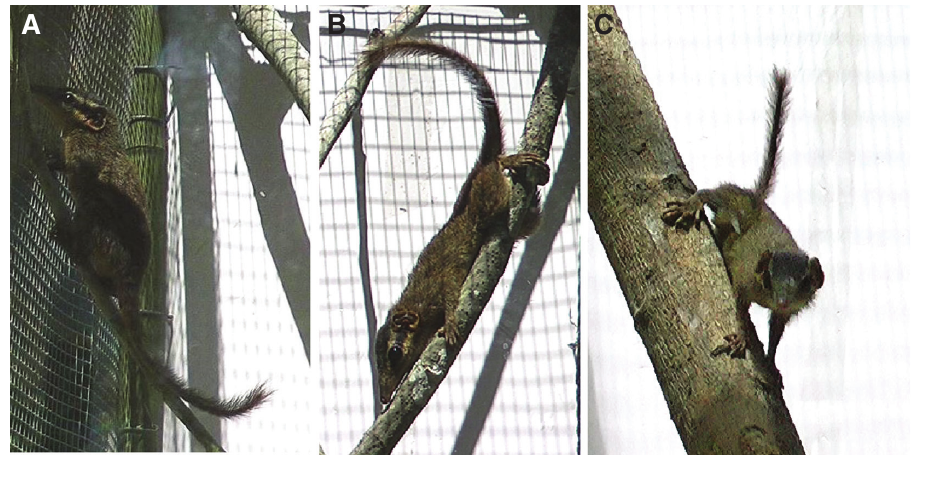
The wild-caught smooth-tailed treeshrews moved freely and used all the available substrates within the filming enclosures. Quadrupedal walk/bound and climb were the more common locomotor modes, followed by leaping and clambering, whereas cling and stand were the main postures. During these activities, the foot mechanisms of Dendrogale murina showed significant variation related to substrate size and inclination (Table 1, Figures 2 and 3).
Table 1. Percentages of use of different foot positions on different substrate size and inclination categories of Dendrogale murina (total n = 1542).
| Foot position | Small | Medium | Large | Very large | Horizontal | Oblique | Vertical |
|---|---|---|---|---|---|---|---|
| Plantigrade | 0.0 | 5.4 | 33.5 | 27.3 | 3.6 | 28.9 | 22.5 |
| Semiplantigrade | 100.0 | 94.6 | 66.5 | 72.7 | 96.4 | 77.5 | 71.1 |
| Digitigrade | 0.0 | 0.0 | 0.0 | 0.0 | 0.0 | 0.0 | 0.0 |
| n | 433 | 441 | 418 | 250 | 484 | 363 | 695 |
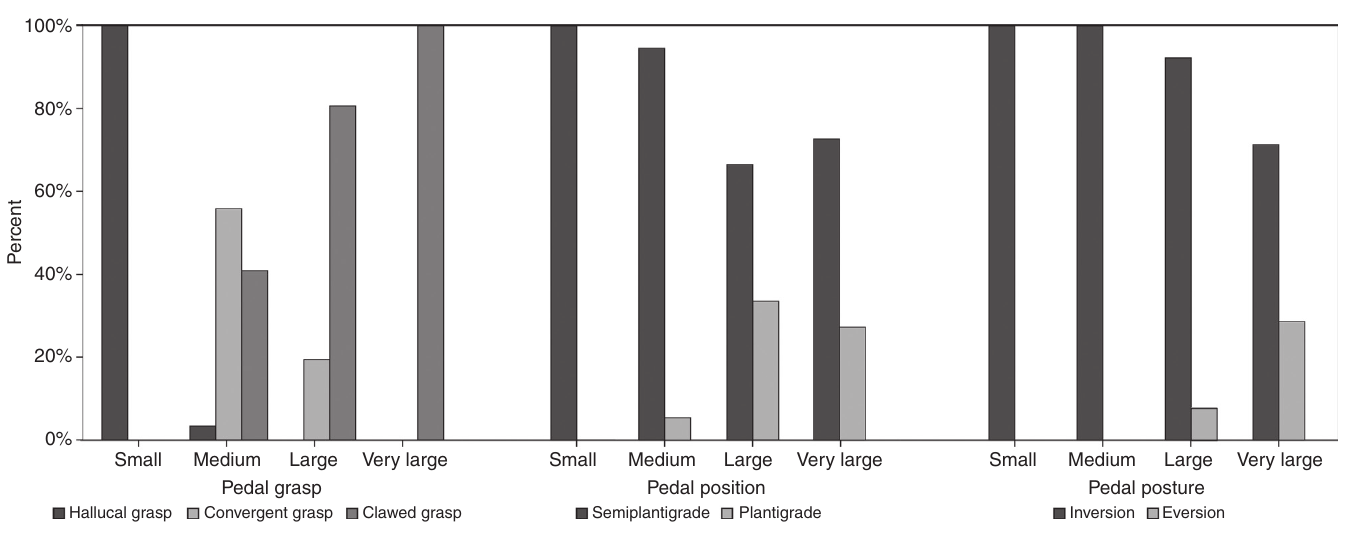
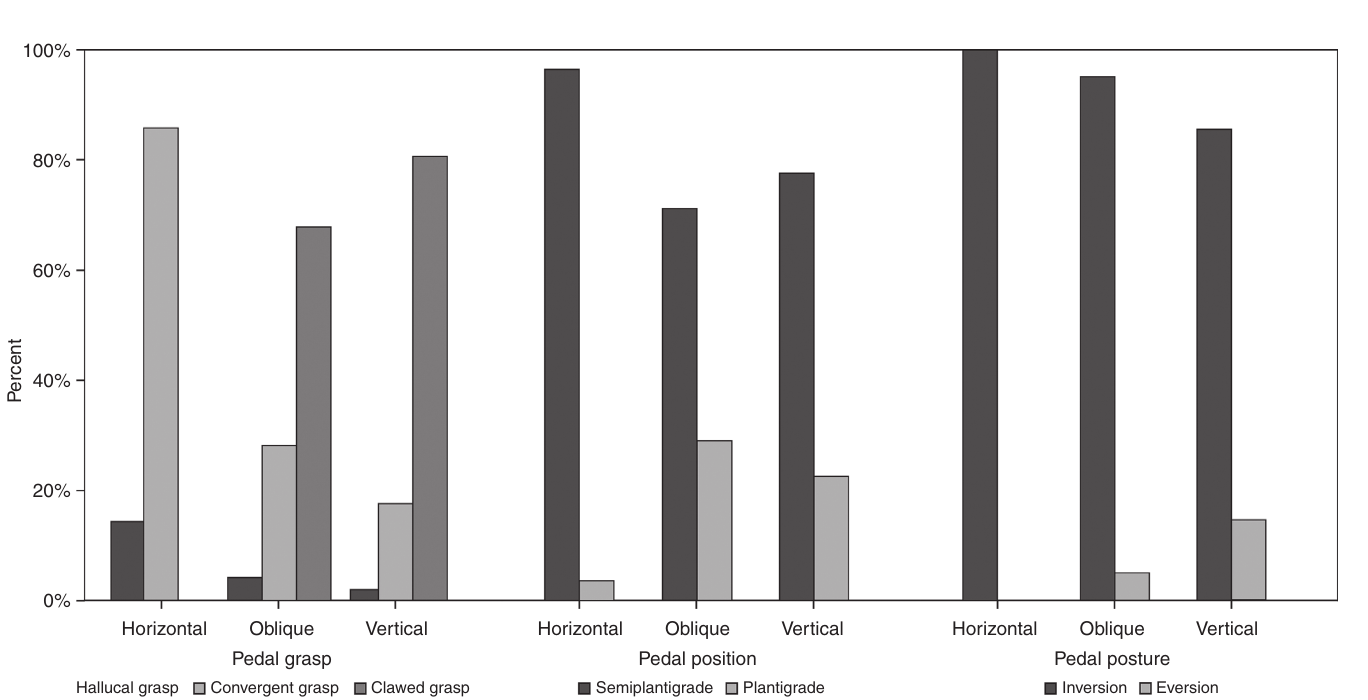
Table 2. Percentages of use of foot postures on different substrate size and inclination categories of Dendrogale murina (total n = 1542).
| Foot posture | Small | Medium | Large | Very large | Horizontal | Oblique | Vertical |
|---|---|---|---|---|---|---|---|
| Inversion | 100.0 | 100.0 | 92.2 | 71.3 | 100.0 | 95.1 | 85.5 |
| Eversion | 0.0 | 0.0 | 7.8 | 28.7 | 0.0 | 4.9 | 14.5 |
| n | 433 | 441 | 418 | 250 | 484 | 363 | 695 |
Table 3. Percentages of use of different pedal grasp modes on different substrate size and inclination categories of Dendrogale murina (total n = 1542).
| Pedal grasp | Small | Medium | Large | Very large | Horizontal | Oblique | Vertical |
|---|---|---|---|---|---|---|---|
| Hallucal | 100.0 | 3.4 | 0.0 | 0.0 | 14.3 | 4.1 | 1.9 |
| Convergent | 0.0 | 55.8 | 19.4 | 0.0 | 85.7 | 28.1 | 17.5 |
| Clawed | 0.0 | 40.8 | 80.6 | 100.0 | 0.0 | 67.8 | 80.6 |
| n | 433 | 441 | 418 | 250 | 484 | 363 | 695 |
Discussion and Conclusions
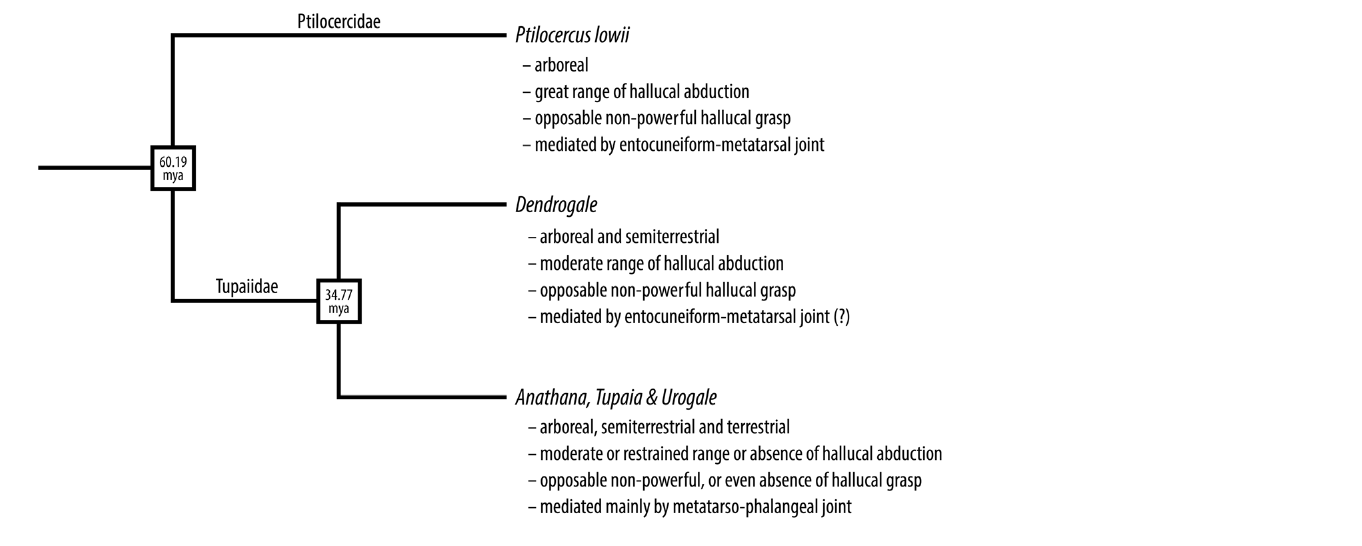
Smooth-tailed treeshrews, Dendrogale, are considered the most basally divergent tupaiids, having diverged from the rest of the family at 34.77 mya (Butler 1980, Luckett 1980, Olson et al. 2004, 2005, Roberts et al. 2011). Their small body mass (~45 g), in combination with several cranial, dental, postcranial characters and mainly arboreal adaptations and behavior indicate their primitive nature (Davis 1938, Butler 1980, Luckett 1980, Szalay and Drawhorn 1980, Szalay and Dagosto 1988, Endo et al. 1999, Sargis 2002a,b,c, Kvartalnov 2009). Therefore, their phylogenetic position is very important for understanding pedal grasping evolution within euarchontan mammals. Our analysis of pedal grasping, position and posture of small-bodied diurnal arboreal Northern smooth-tailed treeshrews (Dendrogale murina) showed that the species mainly used a semiplantigrade inverted foot on most substrate categories and displayed a variety of grasping modes in relation to substrate features.
Comments