Comparing the Arboreal Gaits of Muscardinus avellanarius and Glis glis (Gliridae, Rodentia): A First Quantitative Analysis
Karantanis, N.-E., Rychlik, L., Herrel, A., & Youlatos, D. (2017). Comparing the arboreal gaits of Muscardinus avellanarius and Glis glis (Gliridae, Rodentia): A first quantitative analysis. Mammal Study, 42(3), 161–172. https://doi.org/10.3106/041.042.0306
Abstract
Body size may have a significant impact on arboreal locomotion, as small animals are more capable of navigating on smaller branches, acquire increased stability due to the lower position of the center of mass, and small substrates appear larger to them, compared to larger animals. To determine whether gaits are also affected by body size in relation to substrate size, we conducted a study on two sympatric arboreal glirid rodents of different size on simulated arboreal substrates. Our preliminary results showed that the smaller Muscardinus avellanarius used symmetrical walking gaits on the narrowest substrates (2 mm), moved significantly faster using asymmetrical bounding gaits with increased aerial phases on larger substrates, and regulated velocity via stride length. On the other hand, the larger Glis glis failed to move on 2 mm and 5 mm substrates, used asymmetrical gaits at lower velocities and decreased aerial phases on larger substrates, and regulated velocity mainly via stride frequency. We suggest that the observed differences in gait metrics may be related to body size and to the utilization of different microhabitats, reducing potential interspecific competition.
Introduction
Throughout mammalian history, a great number of taxa have evolved an arboreal lifestyle (Cartmill 1974; Jenkins 1974). The exploitation of the arboreal milieu, despite its constant risk of lethal falling, provides access to diverse resources, minimizes risk from mainly terrestrial predators, and induces various locomotor solutions to its constraints (Cartmill 1974), which ultimately contribute to significant evolutionary advantages, such as a reduction in extrinsic mortality, delay in senescence, and overall increased longevity (Shattuck & Williams 2010). The diversity of available arboreal substrates (i.e., variable size, inclination, length, fragility, etc.) composes a demanding, discontinuous, and unpredictable three-dimensional environment that imposes important and differing constraints to arboreal mammals of different sizes. Larger and heavier animals are challenged in staying on top of substrates, and are faced with branch bending or breakage (Grand 1972). On the other hand, smaller mammals perceive smaller substrates as wider, longer, and flatter (Jenkins 1974), but have difficulty in crossing gaps in the canopy (Cartmill 1974).
In order to overcome locomotor challenges, mammals have developed both behavioral and morphological adaptations, which contribute to stability and safety on arboreal substrates (Cartmill 1974, 1985). Towards this end, arboreal gaits serve as a behavioral mechanism to promote safe and continuous navigation (Cartmill et al. 2002; Lammers & Zurcher 2011). These gaits can be either symmetrical, when the left and right limbs of a pair alternate, or asymmetrical, when the left and right limbs move more synchronously (Figure 1). Both symmetrical and asymmetrical gaits can be described by duty factor (DF) and the duty factor index (DFI). The DF represents the percentage of the total cycle during which a foot (fore or hind) is in contact (in stance phase) with the substrate (Hildebrand 1967), and separates walks (DF > 50) from runs (DF < 50). The DFI is the hundredfold ratio of the duty factor of the hindlimbs divided by that of the forelimbs. If the DF of the hindlimbs is larger than that of the forelimbs, DFI is larger than 100 (DFI > 100). The opposite is true (DFI < 100), when the DF of the forelimbs exceeds that of the hindlimbs (Cartmill et al. 2007). Symmetrical gaits are further characterized by diagonality (D) or forelimb-hindlimb phase (Hildebrand 1967; Cartmill et al. 2007), which represents the percentage of the stride cycle interval after which the footfall of a forelimb follows the footfall of the ipsilateral hindlimb. Diagonality separates diagonal-sequence (DS) gaits (D > 50), in which the next foot to come down after a hind footfall is the contralateral forelimb, from lateral-sequence (LS) gaits (D < 50), in which the next foot to come down after a hind footfall is the ipsilateral forelimb (Figure 1). All these parameters are of high interest, as they may reflect behavioral adaptations for locomotion on arboreal substrates (Cartmill et al. 2002, 2007).
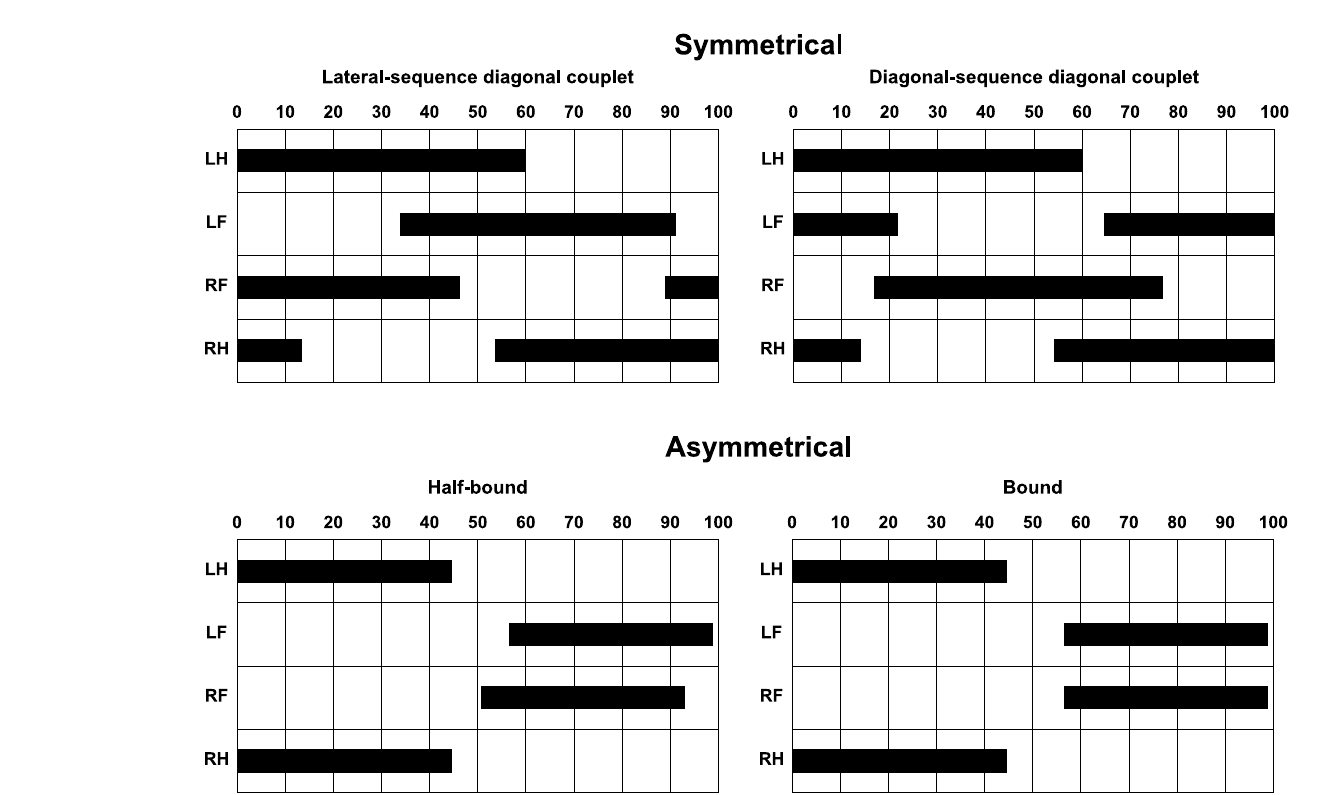
Mammals adjust gait parameters according to substrate properties, especially substrate size (Lammers & Biknevicius 2004; Stevens 2008; Lemelin & Cartmill 2010; Nyakatura & Heymann 2010; Karantanis et al. 2015). Narrower substrates are more prone to bending or breakage (Jenkins 1974), and impose a more midsagittal limb placement resulting in narrower support polygons, compromising stability (Lammers & Zurcher 2011). Arboreal mammals either increase (Lemelin & Cartmill 2010; Karantanis et al. 2015), decrease (Nyakatura et al. 2008; Nyakatura & Heymann 2010; Shapiro & Young 2010; Shapiro et al. 2014), or do not modify (Nyakatura & Heymann 2010) diagonality upon such narrow substrates. Diagonal-sequence gaits contribute to dynamic stability in arboreal substrate navigation, whereas LS gaits may be functionally linked to static stability in substrate negotiation (Lammers & Zurcher 2011). On the other hand, the duty factor index does not seem to be influenced by substrate size (Nyakatura & Heymann 2010; Karantanis et al. 2015). Finally, the duty factor usually decreases on larger substrates (i.e., more swing phases) along with an increase in the frequency of asymmetrical gaits (Young 2009; Shapiro et al. 2016).
It has been proposed that asymmetrical gaits may be preferable over symmetrical gaits during faster locomotion as they confer a reduction in the peak reaction forces, decrease the strain on the musculoskeletal system (Farley & Taylor 1991), and may optimize metabolic costs, at least at the trot-gallop transition (Hoyt & Taylor 1981). For small arboreal mammals, asymmetrical gaits further confer advantages in stability by limiting center of mass oscillations (Young 2009; Schmidt & Fischer 2011; Shapiro et al. 2016). However, data on the use of asymmetrical gaits during arboreal locomotion in small mammals are limited.
Apart from diagonality, duty factor, and duty factor index, gaits are also characterized by velocity (Delciellos & Vieira 2006; Camargo et al. 2016), which is a function of stride frequency (i.e., number of strides per second) and stride length (i.e., the distance covered within a single stride) (Alexander 1992). Arboreal neotropical rodents and metatherians exhibit overall higher velocities than terrestrial species (Delciellos & Vieira 2006; Camargo et al. 2016) as a mechanism to maintain dynamic stability (Schmidt & Fischer 2010). Increased velocity during arboreal locomotion can be achieved either by increasing stride frequency, and decreasing stride length (Delciellos & Vieira 2006; Camargo et al. 2016), by increasing primarily stride frequency and, at a lesser rate, stride length (Nyakatura et al. 2008; Karantanis et al. 2015), or by reducing stride frequency while increasing stride length (Delciellos & Vieira 2006; Camargo et al. 2016). Increasing velocity through increased stride length is often encountered in medium-sized and larger arboreal mammals (Larson et al. 2000, 2001; Delciellos & Vieira 2006) and enhances safety during arboreal locomotion as the longer reach of the forelimbs minimizes branch sway (Demes et al. 1994). On the other hand, increasing velocity by stride frequency may be better suited for smaller arboreal mammals, which are subject to insignificant branch sway, as it decreases body oscillations at limb touchdowns (Strang & Steudel 1990; Delciellos & Vieira 2006).
Regarding arboreal behavioral adaptations, small-sized mammals tend to convergently use similar gaits and kinematics (Biewener 1989a, 1989b, 1990; McAdam & Kramer 1998; Fischer et al. 2002; Iriarte-Díaz 2002). Consequently, the study of arboreal locomotor behavior in related mammals differing in body size may be especially insightful. In this context, we examined arboreal gaits in two dormice (Rodentia: Gliridae), the hazel dormouse (Muscardinus avellanarius; Linnaeus 1758: subfamily Leithiinae) and the edible or fat dormouse (Glis glis; Linnaeus 1766; subfamily Glirinae) (Numone et al. 2007). Muscardinus avellanarius are the smallest European dormice (head-body length: 60–90 mm; body weight: 15–30 g) (Corbet & Ovenden 1980), and heavily depend on trees and bushes, except during torpor, when they descend into burrows (Juškaitis 2008). The hazel dormice are a woodland species, primarily encountered in deciduous or mixed deciduous coniferous forests with a well-developed understory (Juškaitis & Šiožinyte 2008). Glis glis, on the other hand, are the largest dormice [mean head-body length: 152 mm; body weight: 120–150 g to 250 g (prior to hibernation)] (Kryštufek 2010). Their ecology and microhabitats are similar to those of M. avellanarius, but they can be also found in more open or scarcely wooded environments, although in terms of microhabitat utilization they prefer tree canopies (Kryštufek 2010). Both species appear well adapted to an arboreal lifestyle possessing relatively long hairy tails, short forelimbs, long tibiae, relatively long manual and pedal digits, well-padded extremities with an abundance of glands, as well as well-developed claws and relevant flexing tendons which enable effective balancing and climbing on arboreal substrates (Haffner 1996, 1998; Zefferer 2002; Storch & Seiffert 2007; Juškaitis 2008; Kryštufek 2010). However, data on substrate use and arboreal locomotor behavior for these species are lacking. Therefore, considering their morphological adaptations to arboreality, body mass difference, and comparable ecologies, we expect differences in their ability to negotiate arboreal substrates of different diameters. For these purposes, we investigated the differential responses of wild-caught specimens of both species on simulated arboreal substrates of different sizes. We expect M. avellanarius to be more effective in navigating on narrower substrates compared to G. glis. We anticipate that both species would go faster, with significantly shorter stance phases, as substrate size increases, and that they would shift to more asymmetrical gaits on larger substrates. Finally, we hypothesize that velocity would most probably be regulated by stride frequency in both species, but as G. glis is larger, we would further expect a greater contribution of stride length to the overall velocity increase.
Materials and Methods
Specimens
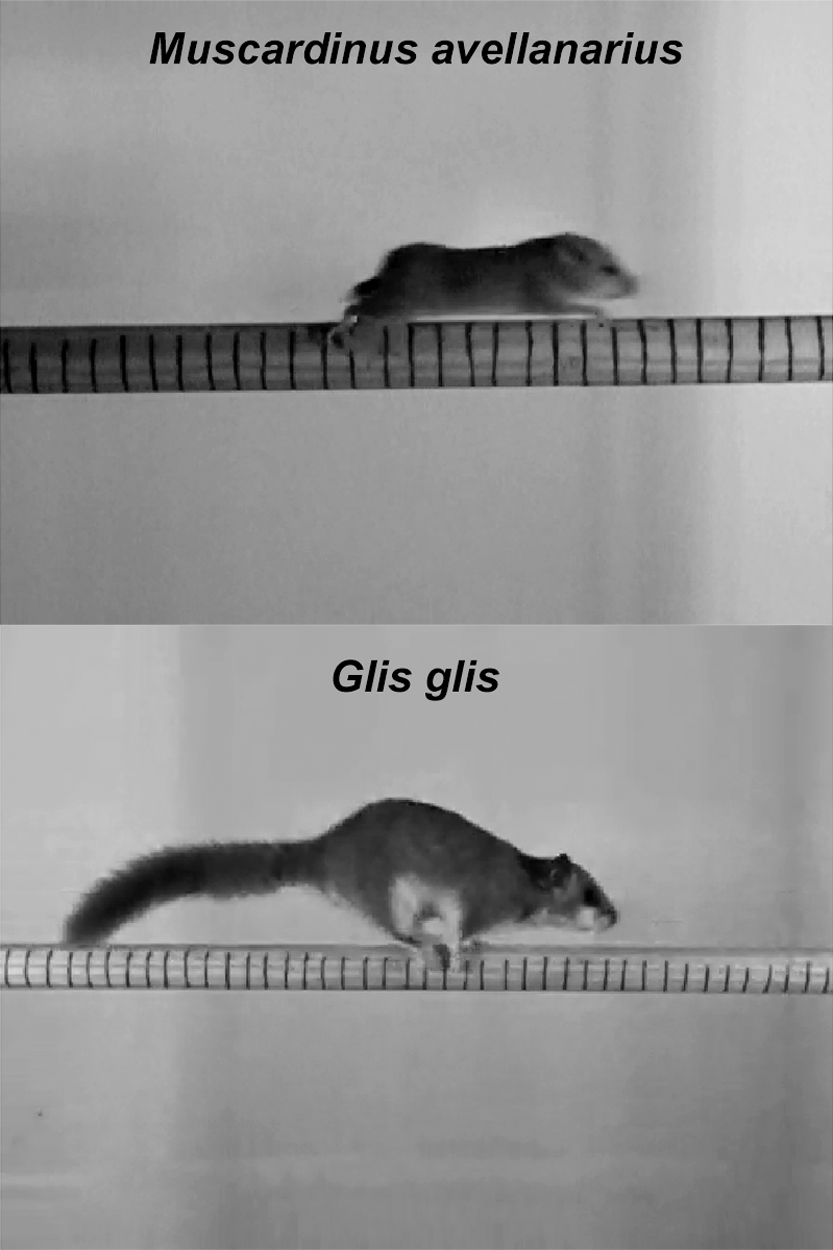
For the purposes of the current study, we tested one male adult hazel dormouse [Figure 2; Muscardinus avellanarius, HBL: 87 mm, BW: 17 g, effective hindlimb length (Pontzer 2007): 23 mm], and one male adult edible dormouse [Figure 2; Glis glis, HBL: 178 mm, BW: 132 g, effective hindlimb length (Pontzer 2007): 55 mm]. Both specimens were originally wild-caught individuals, captured in October 2012 in the Sudety Mts., Southern Poland, and were transported to overwinter in specially designed group enclosures at the Adam Mickiewicz University Field Station at Jeziory, Wielkopolski National Park.
In May 2013, we transferred the specimens to the laboratory of the Institute of Environmental Biology of the Faculty of Biology AMU (Poznań), where they were housed in individual temporary enclosures under inverted day-night conditions. Prior to any experimental procedure, both specimens were habituated to human presence, and did not display any stereotypical or other stress-related behavior. After our tests, the animals were transferred back to the enclosures of the Jeziory Field Station, used for another study, and finally returned to the wild. Unfortunately, because of technical and logistic limitations, we were not able to test more animals.
Experimental Setup
A specially configured, filming terrarium (L: 90 cm × H: 40 cm × W: 40 cm) was used for the experiments. Its sides and base were transparent glass windows, and was topped by a removable wooden lid. Within the terrarium, we established two wooden vertical stands to support the poles. The poles were 80 cm long, cylindrical, and semi-hardwood rods. They were marked with vertical blue lines every 1 cm for a reliable estimation of absolute lengths. During the recordings, the visible length of the rod was approximately 30 cm for M. avellanarius and 50 cm for G. glis. Four different diameter substrates (2 mm, 5 mm, 10 mm, and 25 mm) were set horizontally, and the animals were allowed to move freely on them.
Data collection was carried out during June 2013. During each recording session, the individuals were transferred from their enclosure to the experimental terrarium. Free movement was allowed for each individual within the filming terrarium for habituation. Minimal or no stimulation was required for the subjects to walk on the poles.
For the video recordings we used a Sanyo digital camcorder (VPC-HD 2000, Sanyo, Osaka, Japan) filming at 240 fps, which was positioned at 1 m from the filming terrarium to reduce image distortion. For the analyses, we considered only complete gaits (symmetrical or asymmetrical), initiating with the touchdown of the left hindlimb, and ending at the subsequent touchdown of the same limb, including both lift offs and touchdowns of all limbs. Cycles involving beginnings or endings of locomotor bouts or loss of balance were discarded, due to irregularities in footfalls (e.g., multiple consequent lift offs and touch downs of the same limb). Overall, only cycles of uninterrupted locomotion, without acceleration/deceleration or loss of balance, were retained regardless of velocity and regarded as indicative of natural and unbiased behavior. The present research followed the guidelines for the treatment of animals in behavioral research and teaching (ASAB/ABS 2012), and complied with relevant regulations and legislations of the Adam Mickiewicz University in Poznań, and the relevant legislation of the Aristotle University of Thessaloniki. Handling, housing of animals, and behavioral tests were done with permission from the Local Ethical Commission for the Animal Experiments in Poznań.
Gait Analyses
Video analysis and data collection, distance, and time calculations were made by importing videos, and calibrating time and distance measurements using Tracker 4.87 (Brown 2009). Microsoft Excel 2010 (Redmond WA, USA) and SPSS 20 (SPSS Inc., Chicago, IL, USA) were used for all statistical analyses.
For the analyses, we considered the following gait parameters:
(i) Diagonality (D) (Cartmill et al. 2007), the percentage of the stride cycle interval between the footfall of a hindlimb and the footfall of its ipsilateral forelimb. Although it was measured as a scale variable, it was also divided into two ordinal classes (following Cartmill et al. 2002): (a) Lateral Sequence (LS) gaits (D < 50), either lateral-sequence lateral couplets (LSLC; 0 < D < 25) or lateral-sequence diagonal couplets (LSDC; 25 < D < 50), and (b) Diagonal Sequence gaits (D > 50), either diagonal-sequence diagonal couplets (DSDC; 50 < D < 75) or diagonal-sequence lateral couplets (DSLC; 75 < D < 100);
(ii) Duty Factor (DF), the mean of duty factors of all limbs, defined as the percentage of a cycle during which a limb is in contact with the substrate (a gait cycle encompasses a sequence of fore- and hindlimb swing [moving] and stance [contact] phases that occur within a stride period, beginning and ending with the touchdown of a reference hindlimb, often the left);
(iii) Duty Factor Index (DFI), the ratio of forelimb duty factor (DFf) and hindlimb duty factor (DFh), calculated as 100 × DFh / DFf (Cartmill et al. 2007). DFI > 100 indicate longer hindlimb than forelimb relative stance durations, whereas DFI < 100 specify shorter hindlimb than forelimb relative stance durations;
(iv) Stride Duration (t), total duration of a single stride in seconds, measured from the frame where a stride cycle began until the frame in which the same stride cycle ended;
(v) Stride Length (l), the corresponding distance covered during a single stride cycle, in meters;
(vi) Velocity (v), the speed in which the subjects moved, calculated by dividing stride length with stride duration, and measured in meters/second (m/s);
(vii) Stride Frequency (f), the number of strides per second;
As these parameters are size-dependent, we used the effective hindlimb length, as in the length of the hindlimb as a strut (Pontzer 2007), of each specimen to calculate the dimensionless measures of stride duration, stride length, velocity and stride frequency. These calibrated relative measurements are useful for estimating efficiency during locomotion (Alexander 1977; Alexander & Jayes 1983; Hof 1996):
Dimensionless Stride Duration (tD) = t / √(l0/g)
Dimensionless Stride Length (lD) = l / l0
Dimensionless Velocity (vD) = v / √(g × l0)
Dimensionless Stride Frequency (fD) = f / √(g/l0)
where l0 is effective hindlimb length of each animal and g is the acceleration of gravity (g = 9.81 m/s2). Asymmetrical gaits were defined as those in which the two limbs of a pair function more or less together, touching the substrate at the same time or in couplets. During our experiments we only observed half bounds, where the hindlimbs move together and in phase, but the forelimbs are slightly out of phase with one another (Figure 1; Gambaryan 1974).
Analyses of covariance (ANCOVA) were selected in order to explore the relationships between variables, including individual as a random factor, while controlling for other possible covariates. When needed, a Bonferroni Post-Hoc test (BMD) was used for pair-wise category comparisons, using estimates of means, as calculated by the ANCOVA. Stepwise regression models were constructed to examine the impact of both stride frequency and stride length on velocity, using their dimensionless counterparts. The impact of each parameter was calculated using the partial correlation coefficient, i.e., the correlation between a dependent variable and its covariate, after the impact of other covariates is removed (Harrell 2001).
Results
Muscardinus avellanarius used all provided substrate size categories (n = 38 gait cycles), whereas G. glis was able to navigate only on the 10 mm and 25 mm substrates (n = 29 gait cycles) (Table 1). Only the hazel dormouse used symmetrical gaits, which took place exclusively on the 2 mm category, excluding any comparisons thereof between individuals. All other gaits for both species were asymmetrical, and all were half-bounds, in which the hindlimbs touched down simultaneously, while one forelimb lagged behind the other.
Table 1. Summary of means and standard deviations (in brackets) of gait statistics for Muscardinus avellanarius and Glis glis (Gliridae: Rodentia).
| Species | Substrate size | N | Diagonality | Duty Factor | Hindlimb Duty Factor | Forelimb Duty Factor | Duty Factor Index | Velocity (m s⁻¹) | Stride Length (m) | Stride Frequency (s⁻¹) | Stride Duration (s) | Dimensionless Velocity | Dimensionless Stride Length | Dimensionless Stride Frequency | Dimensionless Stride Duration |
|---|---|---|---|---|---|---|---|---|---|---|---|---|---|---|---|
| M. avellanarius | 2 mm | 10 | 36.74 (8.45) | 66.48 (8.43) | 64.25 (7.90) | 68.71 (9.25) | 93.76 (4.90) | 0.491 (0.251) | 0.055 (0.010) | 8.401 (3.274) | 0.145 (0.081) | 1.033 (0.529) | 2.400 (0.419) | 0.407 (0.159) | 3.001 (1.665) |
| 5 mm | 10 | – | 39.06 (3.16) | 40.87 (4.61) | 37.26 (5.80) | 112.51 (23.19) | 1.095 (0.391) | 0.081 (0.402) | 13.441 (0.186) | 0.075 (0.009) | 2.306 (1.269) | 3.535 (0.007) | 0.651 (0.061) | 1.549 (0.146) | |
| 10 mm | 12 | – | 35.22 (4.57) | 37.30 (3.40) | 33.13 (8.84) | 119.50 (31.84) | 1.237 (0.223) | 0.091 (0.015) | 13.571 (1.365) | 0.074 (0.008) | 2.605 (0.469) | 3.978 (0.666) | 0.657 (0.066) | 1.537 (0.165) | |
| 25 mm | 6 | – | 35.56 (4.44) | 35.99 (4.23) | 35.13 (9.74) | 110.28 (36.61) | 1.167 (0.201) | 0.084 (0.022) | 14.297 (1.887) | 0.071 (0.010) | 2.457 (0.423) | 3.645 (0.977) | 0.692 (0.091) | 1.466 (0.201) | |
| Overall | – | 44.08 (5.15) | 44.60 (5.04) | 43.56 (8.41) | 109.01 (24.13) | 0.998 (0.215) | 0.078 (0.014) | 12.427 (1.949) | 0.091 (0.026) | 2.100 (0.453) | 3.390 (0.616) | 0.602 (0.094) | 1.888 (0.544) | ||
| G. glis | 10 mm | 22 | – | 58.04 (3.85) | 60.62 (3.65) | 55.46 (6.39) | 110.68 (14.73) | 0.492 (0.254) | 0.100 (0.013) | 4.705 (2.175) | 0.325 (0.263) | 0.670 (0.346) | 1.826 (0.231) | 0.352 (0.163) | 4.345 (3.509) |
| 25 mm | 7 | – | 54.19 (8.52) | 56.46 (6.13) | 51.93 (11.51) | 111.10 (13.96) | 0.673 (0.168) | 0.111 (0.022) | 6.014 (0.639) | 0.168 (0.019) | 0.916 (0.229) | 2.018 (0.405) | 0.450 (0.048) | 2.244 (0.252) | |
| Overall | – | 56.12 (6.18) | 58.54 (4.89) | 53.70 (8.95) | 110.89 (14.35) | 0.582 (0.211) | 0.106 (0.017) | 5.359 (1.407) | 0.247 (0.141) | 0.793 (0.287) | 1.922 (0.318) | 0.401 (0.105) | 3.295 (1.881) |
Gaits with diagonality values correspond to symmetrical gaits, whereas gaits without diagonality values correspond to asymmetrical gaits, which in the case of both glirids were half-bounds; N indicates the number of analyzed gait cycles for each substrate size.
Gait Metrics, Their Interaction, and Comparisons Between Specimens
The symmetrical gaits of M. avellanarius on 2 mm substrates scored an overall diagonality (D) of 36.74 (Table 1; n = 10, SD = 8.45), with moderately high duty factors (DF) (Table 1; Mean = 66.48, SD = 8.43), and higher forelimb than hindlimb relative stance durations (Table 1; Mean = 93.76, SD = 4.90). These gaits fall in the lateral-sequence diagonal couplet (LSDC) walks category. Otherwise, all the other gaits of the hazel dormouse were asymmetrical half-bounds, with increased aerial phases (Table 1). Overall the DF was 44.08 (SD = 5.15), implying frequent total body aerial phases among recorded gaits and DFI was 109.01 (SD = 24.13), suggesting longer hindlimb contact times compared to those of the forelimbs.
No symmetrical gaits were recorded for G. glis, which was also unable to move on the smaller substrate categories (2 mm and 5 mm). In the remaining categories (10 mm and 25 mm), all gaits were half-bounds, with mean DF = 56.12 (SD = 6.18), and mean DFI = 110.89 (SD = 14.35). Although the edible dormouse used gaits with whole-body aerial phases on the 25 mm substrates, its locomotion was not overall characterized by these whole-body aerial phases (Table 1).
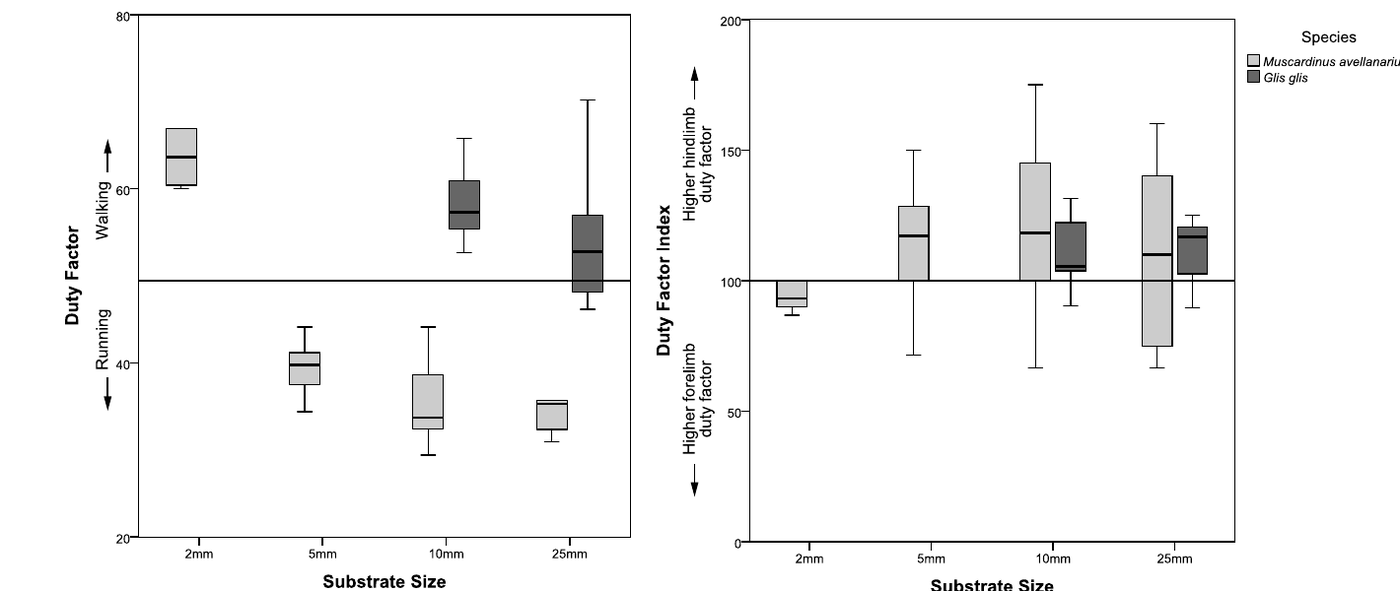
Duty factor was significantly lower in M. avellanarius than in G. glis (Table 1, Figure 4; n = 67, BMD = 21.284, F(1,66) = 94.784, P < 0.001; controlling for substrate size), hence aerial phases were more prolonged and more frequent in the hazel dormouse than in the edible dormouse. However, when DF was controlled for dimensionless velocity, there were no differences between the two species (n = 67, BMD = 1.649, F(1,66) = 0.402, P = 0.529). This likely indicates that, if they moved with the same velocity on proportionally similar substrates, their stance phases relative to swing phases would be very similar. On the other hand, there were no significant differences in DFI between the two species (Table 1, Figure 4; n = 67, BMD = 4.135, F(1,66) = 0.463, P = 0.499; controlling for substrate size), implying a comparable use of forelimbs and hindlimbs.
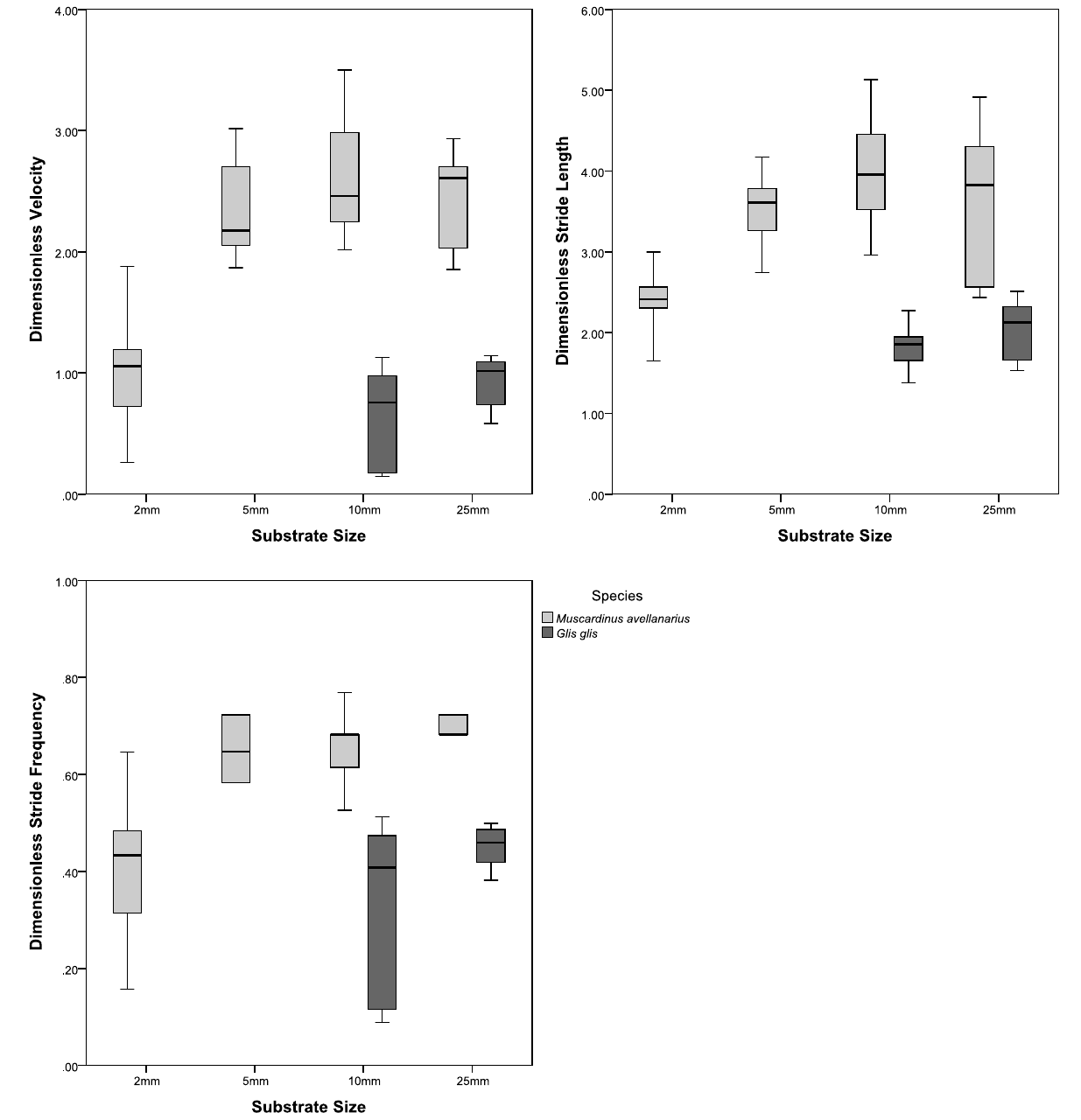
Muscardinus avellanarius displayed a higher overall dimensionless velocity (Table 1, Figure 3; n = 67, BMD = 1.785, F(1,66) = 175.437, P < 0.001), dimensionless stride length (Table 1, Figure 3; n = 67, BMD = 1.919, F(1,66) = 152.374, P < 0.001), and dimensionless stride frequency (Table 1, Figure 3; n = 67, BMD = 0.301, F(1,66) = 70.841, P < 0.001) than G. glis, when controlling for the effect of substrate size. When dimensionless velocity was added as a covariate, the applied ANCOVA displayed no significant differences between the two species in either dimensionless stride frequency (n = 67, BMD = −0.037, F(1,66) = 0.562, P = 0.456), or dimensionless stride length (n = 67, BMD = 0.163, F(1,66) = 1.061, P = 0.307). These results suggest that if the two specimens moved at similar velocities, dimensionless stride frequency and stride length would be very similar.
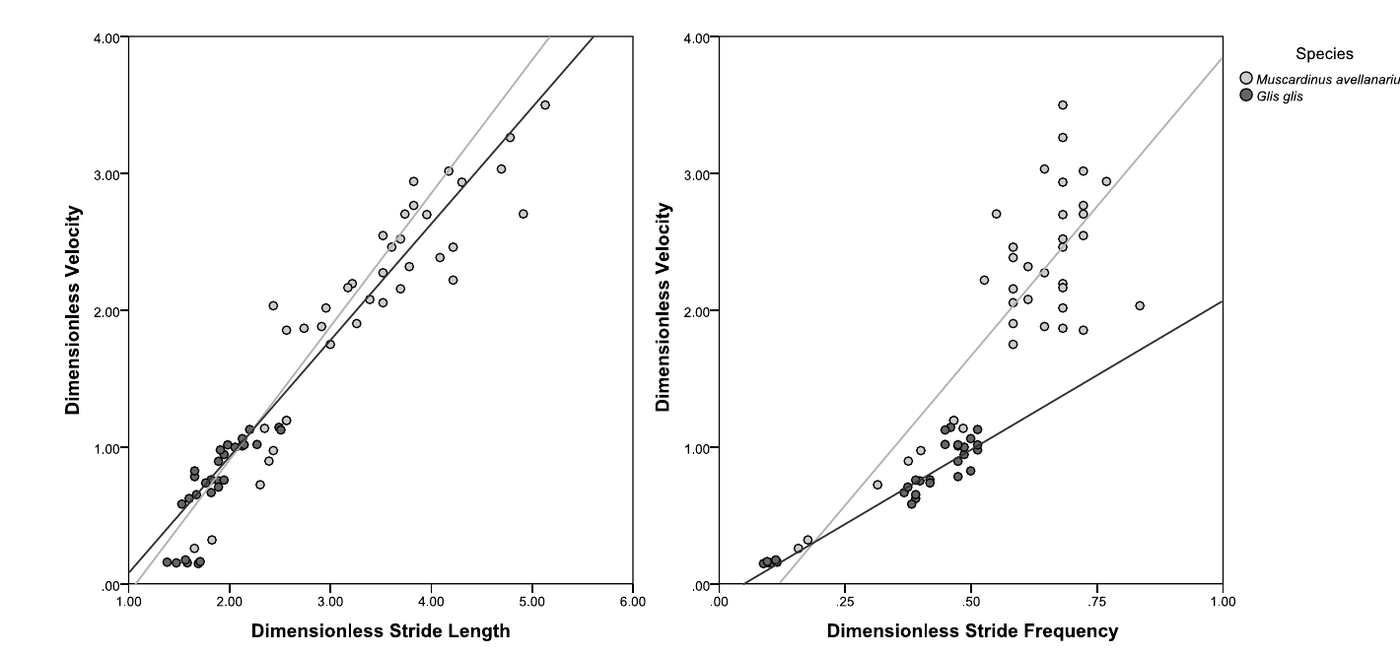
As shown by the constructed step-wise regression model (Figure 3), velocity was regulated primarily by stride length (n = 38, F(1,37) = 183.166, Rpart = 0.549, P < 0.001) followed by stride frequency (n = 38, F(1,37) = 288.752, Rpart = 0.383, P < 0.001) in M. avellanarius. On the other hand, a step-wise regression model in G. glis showed that variation in velocity was mainly due to stride frequency (n = 29, F(1,28) = 268.605, Rpart = 0.568, P < 0.001) and less, though significantly, by stride length (n = 29, F(1,28) = 489.654, Rpart = 0.295, P < 0.001), suggesting a differing pattern in the two specimens (Figure 3).
The Effect of Substrate Size
In the hazel dormouse, DF decreased significantly on larger substrates (Figure 4; n = 38, F(3,37) = 71.142, P < 0.001), but substrate size had no impact on DFI (Figure 4; n = 38, F(3,37) = 1.866, P = 0.154). On the other hand, substrate size had no impact on DF (n = 29, F(1,28) = 2.848, P = 0.103) or DFI (n = 29, F(1,28) = 0.005, P = 0.947) in G. glis. However, the overall lack of statistical significance should be treated with caution, considering that observations in the edible dormouse derived from only two substrate sizes, one of which had a low sample size (Table 1).
In M. avellanarius, velocity (n = 38, F(3,37) = 24.560, P < 0.001), stride length (n = 38, F(3,37) = 13.000, P < 0.001), and stride frequency (n = 38, F(3,37) = 15.822, P < 0.001) increased significantly on larger substrates (Figure 5). This was not the case in G. glis (Figure 5; Velocity: n = 29, F(1,28) = 3.065, P = 0.091; Stride length: n = 29, F(1,28) = 2.524, P = 0.124; Stride frequency: n = 29, F(1,28) = 2.412, P = 0.132). Nevertheless, as in DF, the low sample for the edible dormouse may be responsible for possible false-negative statistical results (Figure 5).
Discussion
The examination of only one specimen from each species imposes significant restrictions on the present research, especially regarding the statistical significance of trends and differences of the examined variables between species. This may lead to less robust conclusions, and therefore, our results should be treated with caution. However, given the lack of existing data on the locomotion of these dormice species, this study aims to serve as a first report providing important quantitative data, rather than a thorough and conclusive analysis. Restrictions aside, the current preliminary study suggests some apparent trends. The small M. avellanarius was able to use the smallest substrates provided (2 mm), whereas the much larger G. glis failed to move on 2 mm and 5 mm substrates. Moreover, M. avellanarius moved significantly faster on larger substrates, and exhibited increased aerial phases. However, no similar trends were found for G. glis, although this may be due to sample size limitations. On the other hand, both species were similar in using primarily asymmetrical gaits (although M. avellanarius used symmetrical gaits in the narrowest substrates) and in mean gait metrics.
Despite an overall preference for asymmetrical gaits, M. avellanarius exclusively used lateral-sequence diagonal couplets (LSDC) symmetrical gaits on 2 mm substrates, with a high DF (i.e., shorter swing phases relative to stance phases) that was accompanied by a lower dimensionless velocity compared to that on larger substrates. These LSDC slow walks, where the limbs are anchored on the substrate for extensive parts of the gait cycle, assist in enhancing static stability by securing the placement of the center of mass within the support polygons (Lammers & Zurcher 2011). Although DSDC gaits have been often discussed as advantageous in arboreal locomotion, in terms of dynamic stability (Cartmill et al. 2007), LSDC gaits may be favorable for arboreal mammals without strongly prehensile forelimbs (Lammers & Biknevicius 2004). As such, they have been observed in many scansorial rodents (Schmidt & Fischer 2010, 2011; Karantanis et al. 2017). This is critical in a fine-branch setting, where support polygons are especially narrow (Cartmill et al. 2007; Lammers & Zurcher 2011). On the other hand, G. glis used exclusively asymmetrical gaits, even on the comparably narrowest substrates (10 mm) for its size. Comparable exclusive use of asymmetrical gaits is also common in other arboreal rodents, such as squirrels (Flaherty et al. 2010; Schmidt & Fischer 2011).
On larger substrates, M. avellanarius used exclusively asymmetrical half-bounding gaits. These asymmetrical gaits were characterized by a low duty factor (DF < 50), with an extended whole-body aerial phase. Additionally, velocity, stride length, and stride frequency of the hazel dormouse progressively increased on larger substrates. Glis glis displayed analogous increases in these parameters on larger substrates, albeit not statistically significant, yet these were significantly lower than those of the hazel dormouse. Moreover, the asymmetrical gaits of the edible dormouse exhibited a high duty factor (DF > 50) indicating the lack of whole-body aerial phases. This is not uncommon, as, at such relatively low velocities, asymmetrical gaits are often characterized by relatively long stance phases (Schmidt & Fischer 2011). Overall, arboreal asymmetrical gaits assist in obtaining higher velocities (Hildebrand 1977; Gasc 2001; Young 2009; Shapiro et al. 2016), may decrease in peak substrate reaction forces, strain reduction on the musculoskeletal system (Farley & Taylor 1991), and optimize metabolic costs (Hoyt & Taylor 1981).
In M. avellanarius, velocity was increased primarily by stride length, although stride frequency also had a significant impact. On the other hand, in the larger G. glis this was reversed, with velocity increased through an increase in stride frequency, while stride length also had a significant input. This finding is opposite to our predictions for both species, as we expected a higher stride length contribution in G. glis, due to its larger size. In this sense, G. glis is similar to some scansorial murid and arvicoline rodents (Karantanis et al. 2017), a few small-bodied arboreal marsupials (Delciellos & Vieira 2006; Karantanis et al. 2015), and cotton-top tamarins (Nyakatura et al. 2008). Stride frequency increase may be more appropriate for small-bodied arboreal mammals, which are subject to disrupting body oscillations, but not branch sway (Delciellos & Vieira 2006). Body oscillations produce moments which interrupt continuous locomotion and can cause loss of stability, but frequent strides reduce involuntary body oscillations and contribute to required stability and agility for successful branch navigation (Delciellos & Vieira 2007). Even though smaller, M. avellanarius had a larger contribution of stride length in velocity increase, which may be related to the extended aerial phases observed during its use of asymmetrical gaits. A stride length increase allows for a longer reach, and may reduce involuntary branch swaying (Demes et al. 1994). This pattern is similar to most arboreal primates, larger arboreal marsupials (Larson et al. 2001; Delciellos & Vieira 2006), and some arboreal and terrestrial neotropical rodents (Camargo et al. 2016), which increase velocity by increasing stride length, instead of frequency.
Essentially, G. glis and M. avellanarius differed in most gait metrics, as the latter utilized symmetrical gaits on narrow substrates, was overall faster, and used asymmetrical gaits with an aerial phase. These differences could be possibly related to the lower mass of the hazel dormouse (17 g) compared to that of the edible dormouse (132 g). Body mass does bear a significant impact on gait metrics, such as velocity (Alexander 1977; Heglund & Taylor 1988), stride frequency (Heglund et al. 1974; Heglund & Taylor 1988), and stride length (Heglund & Taylor 1988). Furthermore, body mass also relates to differential substrate use, as a small mass reduces the possibility for smaller branches to bend or break, decreases the body size-branch size ratio, lowers the center of mass increasing stability, and allows movement through more cluttered habitats (Cartmill 1985). In this context, the present results, despite their limitations, may provide a preliminary insight into the ecological interactions between M. avellanarius and G. glis. Both species are often encountered sympatrically, where they exploit similar food sources and use similar nesting sites (Juškaitis 2002, 2008; Juškaitis & Šiožinyte 2008; Kryštufek 2010), probably engaging in significant interspecific competition. The larger size and cautious movement on larger substrates of G. glis, probably enables edible dormice to exploit successfully the architectural network of mature forests and top canopy layers (Juškaitis & Šiožinyte 2008). This could eventually provide edible dormice with an ecological advantage over M. avellanarius (Smith & Brown 1986), compelling the latter to confine their activities in the shrubby layer of the understory, characterized by a lush network of finer branches (Juškaitis & Šiožinyte 2008). The small size of hazel dormice, along with the LSDC symmetrical walks, higher velocities, and whole-body aerial phase asymmetrical gait adaptations, would probably promote the effective and successful use of this environment. Potentially, this would decrease interspecific competition by partial separation of microhabitat niches.
Even though the present report provides some preliminary results and information on G. glis and M. avellanarius, the statistical limitations of this study do not allow for definitive conclusions, or species-wide generalizations. However, the obtained results hint at possible interactions between body size and arboreal gaits, and their consequent effect on mammalian locomotor ecology. More extensive research is required for elucidating the effects of body size on gaits and their relation to the locomotor preferences of the two species. We hope that the current study serves as a platform for further investigations towards this end.
Acknowledgments
All authors wish to express their gratitude to the people who helped throughout this project: Mirosław Jurczyszyn who provided us with his animals, Peter Klimant for assistance in experiments, PhD students of the AMU for assistance in trapping, and Doug Brown for essential modifications to the Tracker software, which made data analysis possible. Financial support was provided through funds by the Erasmus studies scholarships to NEK, the School of Biology of the Aristotle University of Thessaloniki, and the Department of Systematic Zoology, Adam Mickiewicz University.
References
- Alexander, R. M. (1977). Terrestrial locomotion. In R. M. Alexander & G. Goldspink (Eds.), Mechanics and energetics of animal locomotion (pp. 168–203). Chapman & Hall.
- Alexander, R. M. (1992). Exploring biomechanics: Animals in motion. Scientific American Library.
- Alexander, R. M., & Jayes, A. S. (1983). A dynamic similarity hypothesis for the gaits of quadrupedal mammals. Journal of Zoology, 201, 135–152.
- Association for the Study of Animal Behaviour/Animal Behavior Society. (2012). Guidelines for the treatment of animals in behavioural research and teaching. Animal Behaviour, 83, 301–309.
- Biewener, A. A. (1989a). Mammalian terrestrial locomotion and size. BioScience, 39, 776–783.
- Biewener, A. A. (1989b). Scaling body support in mammals: Limb posture and muscle mechanics. Science, 245, 45–48.
- Biewener, A. A. (1990). Biomechanics of mammalian terrestrial locomotion. Science, 250, 1097–1103.
- Brown, D. (2009). Tracker video analysis and modeling tool. http://physlets.org/tracker/
- Camargo, N. F., Sano, N. Y., Ribeiro, J. F., & Vieira, E. M. (2016). Contrasting the realized and fundamental niche of the arboreal walking performance of neotropical rodents. Journal of Mammalogy, 97, 155–166.
- Cartmill, M. (1974). Pads and claws in arboreal locomotion. In F. A. Jenkins Jr. (Ed.), Primate locomotion (pp. 45–83). Academic Press.
- Cartmill, M. (1985). Climbing. In M. Hildebrand, D. M. Bramble, K. F. Liem, & D. B. Wake (Eds.), Functional vertebrate morphology (pp. 73–88). Belknap Press.
- Cartmill, M., Lemelin, P., & Schmitt, D. (2002). Support polygons and symmetrical gaits in mammals. Zoological Journal of the Linnean Society, 136, 401–420.
- Cartmill, M., Lemelin, P., & Schmitt, D. (2007). Primate gaits and primate origins. In M. Ravosa & M. Dagosto (Eds.), Primate origins: Adaptations and evolution (pp. 403–435). Springer.
- Corbet, G. B., & Ovenden, D. (1980). Mammals of Britain and Europe. Wm Collins Sons & Co Ltd.
- Delciellos, A. C., & Vieira, M. V. (2006). Arboreal walking performance in seven didelphid marsupials as an aspect of their fundamental niche. Austral Ecology, 31, 449–457.
- Delciellos, A. C., & Vieira, M. V. (2007). Stride lengths and frequencies of arboreal walking in seven species of didelphid marsupials. Acta Theriologica, 52, 101–111.
- Demes, B., Larson, S. G., Stern, J. T., Jr., Jungers, W. L., Biknevicius, A. R., & Schmitt, D. (1994). The kinetics of primate quadrupedalism: "Hindlimb drive" reconsidered. Journal of Human Evolution, 26, 353–374.
- Farley, C. T., & Taylor, C. R. (1991). A mechanical trigger for the trot-gallop transition in horses. Science, 253, 306–308.
- Fischer, M. S., Schilling, N., Schmidt, M., Haarhaus, D., & Witte, H. (2002). Basic limb kinematics of small therian mammals. Journal of Experimental Biology, 205, 1315–1338.
- Flaherty, E. A., Ben-David, M., & Smith, W. P. (2010). Quadrupedal locomotor performance in two species of arboreal squirrels: Predicting energy savings of gliding. Journal of Comparative Physiology B, 180, 1067–1078.
- Gambaryan, P. P. (1974). How mammals run: Anatomical adaptations. John Wiley & Sons.
- Gasc, J.-P. (2001). Comparative aspects of gait, scaling and mechanics in mammals. Comparative Biochemistry and Physiology Part A, 131, 121–133.
- Grand, T. I. (1972). A mechanical interpretation of terminal branch feeding. Journal of Mammalogy, 53, 198–201.
- Haffner, M. (1996). A tendon-locking mechanism in two climbing rodents, Muscardinus avellanarius and Micromys minutus. Journal of Morphology, 227, 219–227.
- Haffner, M. (1998). A comparison of the gross morphology and micro-anatomy of the foot pads in two fossorial and two climbing rodents (Mammalia). Journal of Zoology, 244, 287–294.
- Harrell, F. E. (2001). Regression modeling strategies: With applications to linear models, logistic regression, and survival analysis. Springer-Verlag.
- Heglund, N. C., & Taylor, C. R. (1988). Speed, stride frequency and energy cost per stride: How do they change with body size and gait? Journal of Experimental Biology, 138, 301–318.
- Heglund, N. C., Taylor, C. R., & McMahon, T. A. (1974). Scaling stride frequency and gait to animal size: Mice to horses. Science, 186, 1112–1113.
- Hildebrand, M. (1967). Symmetrical gaits of primates. American Journal of Physical Anthropology, 26, 119–130.
- Hildebrand, M. (1977). Analysis of asymmetrical gaits. Journal of Mammalogy, 58, 131–156.
- Hof, A. L. (1996). Scaling gait data to body size. Gait & Posture, 4, 222–223.
- Hoyt, D. F., & Taylor, C. R. (1981). Gait and the energetics of locomotion in horses. Nature, 292, 239–240.
- Iriarte-Díaz, J. (2002). Differential scaling of locomotor performance in small and large terrestrial mammals. Journal of Experimental Biology, 205, 2897–2908.
- Jenkins, F. A. (1974). Tree shrew locomotion and the origins of primate arborealism. In F. A. Jenkins Jr. (Ed.), Primate locomotion (pp. 85–116). Academic Press.
- Juškaitis, R. (2002). Spatial distribution of the yellow-necked mouse (Apodemus flavicollis) in large forest areas and its relation with seed crop of forest trees. Mammalian Biology, 67, 206–211.
- Juškaitis, R. (2008). The common dormouse Muscardinus avellanarius: Ecology, population structure and dynamics. Institute of Ecology of Vilnius University Publishers.
- Juškaitis, R., & Šiožinyte, V. (2008). Habitat requirements of the common dormouse (Muscardinus avellanarius) and the fat dormouse (Glis glis) in mature mixed forest in Lithuania. Ekológia, 27, 143–151.
- Karantanis, N.-E., Youlatos, D., & Rychlik, L. (2015). Diagonal gaits in the feathertail glider Acrobates pygmaeus (Acrobatidae, Diprotodontia): Insights for the evolution of primate quadrupedalism. Journal of Human Evolution, 86, 43–54. https://doi.org/10.1016/j.jhevol.2015.06.007
- Karantanis, N.-E., Rychlik, L., Herrel, A., & Youlatos, D. (2017). Arboreal gaits in three sympatric rodents Apodemus agrarius, Apodemus flavicollis (Rodentia, Muridae) and Myodes glareolus (Rodentia, Cricetidae). Mammalian Biology, 83, 51–63. https://doi.org/10.1016/j.mambio.2016.12.004
- Kryštufek, B. (2010). Glis glis (Rodentia: Gliridae). Mammalian Species, 42, 195–206.
- Lammers, A. R., & Biknevicius, A. R. (2004). The biodynamics of arboreal locomotion: The effects of substrate diameter on locomotor kinetics in the gray short-tailed opossum (Monodelphis domestica). Journal of Experimental Biology, 207, 4325–4336.
- Lammers, A. R., & Zurcher, U. (2011). Stability during arboreal locomotion. In V. Klika (Ed.), Theoretical biomechanics. IntechOpen.
- Larson, S. G., Schmitt, D., Lemelin, P., & Hamrick, M. (2000). Uniqueness of primate forelimb posture during quadrupedal locomotion. American Journal of Physical Anthropology, 112, 87–101.
- Larson, S. G., Schmitt, D., Lemelin, P., & Hamrick, M. (2001). Limb excursion during quadrupedal walking: How do primates compare to other mammals? Journal of Zoology, 255, 353–365.
- Lemelin, P., & Cartmill, M. (2010). The effect of substrate size on the locomotion and gait patterns of the kinkajou (Potos flavus). Journal of Experimental Zoology Part A, 313, 157–168.
- McAdam, A. G., & Kramer, D. L. (1998). Vigilance as a benefit of intermittent locomotion in small mammals. Animal Behaviour, 55, 109–117.
- Numone, M., Yasuda, S. P., Sato, J. J., Vogel, P., & Suzuki, H. (2007). Phylogenetic relationships and divergence times among dormice (Rodentia, Gliridae) based on three nuclear genes. Zoologica Scripta, 36, 537–546.
- Nyakatura, J. A., Fischer, M. S., & Schmidt, M. (2008). Gait parameter adjustments of cotton-top tamarins (Saguinus oedipus, Callitrichidae) to locomotion on inclined arboreal substrates. American Journal of Physical Anthropology, 135, 13–26.
- Nyakatura, J. A., & Heymann, E. W. (2010). Effects of support size and orientation on symmetric gaits in free-ranging tamarins of Amazonian Peru: Implications for the functional significance of primate gait sequence patterns. Journal of Human Evolution, 58, 242–251.
- Pontzer, H. (2007). Effective limb length and the scaling of locomotor cost in terrestrial animals. Journal of Experimental Biology, 210, 1752–1761.
- Schmidt, A., & Fischer, M. S. (2010). Arboreal locomotion in rats—the challenge of maintaining stability. Journal of Experimental Biology, 213, 3615–3624.
- Schmidt, A., & Fischer, M. S. (2011). The kinematic consequences of locomotion on sloped arboreal substrates in a generalized (Rattus norvegicus) and a specialized (Sciurus vulgaris) rodent. Journal of Experimental Biology, 214, 2544–2559.
- Shapiro, L. J., Kemp, A. D., & Young, J. W. (2016). Effects of substrate size and orientation on quadrupedal gait kinematics in mouse lemurs (Microcebus murinus). Journal of Experimental Zoology Part A, 325, 329–343.
- Shapiro, L. J., & Young, J. W. (2010). Is primate-like quadrupedalism necessary for fine-branch locomotion? A test using sugar gliders (Petaurus breviceps). Journal of Human Evolution, 58, 309–319.
- Shapiro, L. J., Young, J. W., & VandeBerg, J. L. (2014). Body size and the small branch niche: Using marsupial ontogeny to model primate locomotor evolution. Journal of Human Evolution, 68, 14–31.
- Shattuck, M. R., & Williams, S. A. (2010). Arboreality has allowed for the evolution of increased longevity in mammals. Proceedings of the National Academy of Sciences, 107, 4635–4639.
- Smith, J. M., & Brown, R. L. W. (1986). Competition and body size. Theoretical Population Biology, 30, 166–179.
- Stevens, N. J. (2008). The effect of branch diameter on primate gait sequence pattern. American Journal of Primatology, 70, 356–362.
- Storch, G., & Seiffert, C. (2007). Extraordinarily preserved specimen of the oldest known glirid from the middle Eocene of Messel (Rodentia). Journal of Vertebrate Paleontology, 27, 189–194.
- Strang, K. T., & Steudel, K. (1990). Explaining the scaling of transport costs: The role of stride frequency and stride length. Journal of Zoology, 221, 343–358.
- Young, J. W. (2009). Substrate determines asymmetrical gait dynamics in marmosets (Callithrix jacchus) and squirrel monkeys (Saimiri boliviensis). American Journal of Physical Anthropology, 138, 403–420.
- Zefferer, M. (2002). Adaptation des terminalen Zehengliedes an die Fortbewegung bei Kleinsäugern (Mammalia) [Bachelor's thesis, University of Zurich].
Comments