Vertical Locomotion in Micromys minutus (Rodentia: Muridae): Insights Into the Evolution of Eutherian Climbing
Karantanis, N.-E., Rychlik, L., Herrel, A., & Youlatos, D. (2018). Vertical locomotion in Micromys minutus (Rodentia: Muridae): Insights into the evolution of eutherian climbing. Journal of Mammalian Evolution, 25(2), 277–289. https://doi.org/10.1007/s10914-016-9374-5
Abstract
Climbing is integral to scansorial and arboreal lifestyles as it enables access to and vertical ranging within the arboreal strata. As early eutherian mammals exhibit osteological correlates for arboreality, it is important to assess the behavioral mechanisms that are related to competent vertical climbing. In this context, we examined climbing gaits in one of the smallest extant rodents, the Eurasian harvest mouse. For these purposes, we filmed six adult Micromys minutus at 240 fps moving on four different substrate sizes (2 mm, 5 mm, 10 mm, 25 mm), during both vertical ascents and descents. All climbing cycles were lateral sequence slow gaits. Upward climbing was characterized by a higher contribution of the hind limbs, longer swing phases, and a significant involvement of stride frequency in velocity modulation. On the other hand, downward climbing was promoted by employing gaits of even lower diagonality, an increased contact with the substrate, enhanced role of the forelimbs, and a subtler modulation of velocity by stride frequency. Eurasian harvest mice effectively negotiate the finest substrates, but their effectiveness decreased significantly on the largest ones. The morphofunctional similarities of M. minutus to Juramaia sinensis and Eomaia scansoria imply analogous behaviors in early eutherians, which apparently contributed to the successful access and exploitation of the fine-branch arboreal milieu. In this way, extant small arboreal mammals can constitute good models for elucidating and comprehending the adaptive significance of behavioral mechanisms that are related to the evolution of arboreality in early mammals.
Introduction
Climbing is the locomotor mode in which an animal moves upwards or downwards on vertical or very steep substrates (Cartmill 1985; Hunt et al. 1996). During climbing, the body is kept orthograde and more or less parallel to the substrate (Hunt et al. 1996). Besides being characteristic of arboreal species, climbing is also particularly important for scansorial species, which exploit both the terrestrial and arboreal habitat. For these animals, vertical climbing enables the entry to the arboreal milieu with significant ecological and evolutionary advantages: timely access to arboreal food sources (e.g., flush leaves, buds, flowers, ripe fruit, arboreal arthropods), enhanced vigilance and predator avoidance, secure resting and nesting sites (Hildebrand 1995), and overall increased longevity (Shattuck and Williams 2010).
It is not surprising that an arboreal lifestyle has played a fundamental role in the evolution of early mammals. Paleontological evidence has traced climbing in the fossil record back to 160 mya (Gaetano and Rougier 2011; Zheng et al. 2013; Bi et al. 2014). Importantly, both oldest known eutherians, Juramaia sinensis (160 mya) and Eomaia scansoria (125 mya), possess postcrania that show possible climbing adaptations, such as the morphology and proportions of manual and pedal proximal, intermediate and ungual phalanges, the morphology of the scapula, the long tail, and the elongation of mid-caudal vertebrae (Ji et al. 2002; Luo et al. 2011; Bonnan et al. 2016). Fossil remains of other early mammalian radiations, such as the Docodonta (Meng et al. 2015), Euharamiyida (Zheng et al. 2013), and Eutriconodonta (Meng et al. 2006), have also been functionally linked to climbing and arboreal activities. This demonstrates that arboreality and climbing are integral patterns of early mammalian evolutionary history. Due to biomechanical, physiological, and energetic constraints, climbing up and down arboreal substrates appears to be more effective at a smaller body size, allowing for the successful transition between the ground and the arboreal milieu (Cartmill 1974a; Jenkins 1974; Preuschoft et al. 1995; Preuschoft 2002; Soligo and Martin 2006; Hanna and Schmitt 2011; Soligo and Smaers 2016). Moreover, all known early eutherians are relatively small, with body mass estimates for Juramaia ranging at 15–17 g (Luo et al. 2011) and for Eomaia at 20–25 g (Ji et al. 2002), and have morphological features predisposing them for a climbing life-style.
Climbing up and down a vertical or sub-vertical substrate can be carried out with gaits similar to those used in above-branch locomotion (Hunt et al. 1996). Therefore, they can be translated into comparable metrics, such as diagonality, duty factor, duty factor index, velocity, stride length, and stride frequency. Diagonality (D), or forelimb-hind limb phase (Hildebrand 1967; Cartmill et al. 2007), is the percentage of the stride cycle interval the footfall of a forelimb follows the footfall of the ipsilateral hind limb. In diagonal sequence (DS) gaits (D > 50), the contralateral limbs move forward more in sync, whereas in lateral sequence (LS) gaits (D < 50), the ipsilateral limbs are more synchronized. The duty factor (DF) represents the percentage of the cycle during which a foot (fore or hind) is in contact with the substrate (Hildebrand 1967) and separates walking (DF > 50) from running (DF < 50). Finally, the duty factor index (DFI), a ratio derived by the DF of the hind limbs and forelimbs (Cartmill et al. 2007), infers the differing role of forelimbs compared to that of the hind limbs. All these parameters are of interest, as they have been linked to locomotor adaptations on different substrates (Cartmill et al. 2002, 2007).
In an arboreal context, gaits are a behavioral mechanism to enhance stability and safety (Cartmill et al. 2002; Lammers and Gauntner 2008; Lemelin and Cartmill 2010; Lammers and Zurcher 2011). Either DS or LS gaits may confer different advantages in the context of arboreal locomotion (Lammers and Zurcher 2011). LS gaits promote static stability (as in slow walking), in relation to the location of the center of mass relative to the support polygon of the limbs (Lammers and Zurcher 2011). They are more often encountered in terrestrial mammals, but are also used by some arboreal specialists, such as sugar gliders Petaurus breviceps (Shapiro and Young 2010), callitrichid primates (Stevens 2006, 2008; Nyakatura et al. 2008; Nyakatura and Heymann 2010) and scansorial rodents (Schmidt and Fischer 2010). On the other hand, DS gaits seem to provide dynamic stability, i.e., secure control and transfer of moments and torques imposed on the body axes in faster locomotion (Lammers and Zurcher 2011). Habitual use of DS gaits is common among primates (Hildebrand 1967; Cartmill et al. 2007), metatherian didelphimorphs and phalangeroids (White 1990; Pridmore 1994; Cartmill et al. 2002; Schmitt and Lemelin 2002; Karantanis et al. 2015), as well as the carnivoran Potos flavus (Lemelin and Cartmill 2010), and are hypothesized to be related to arboreal adaptations (Cartmill et al. 2007).
Velocity on arboreal substrates is also a significant parameter that can be related to arboreal competence (Arnold 1983; Delciellos and Vieira 2006, 2009; Camargo et al. 2016). Increased velocity is a significant mechanism to maintain dynamic stability (Schmidt and Fischer 2010) and has been related to arboreal adaptations (Delciellos and Vieira 2006, 2007; Camargo et al. 2016). Velocity, being a function of stride length by stride frequency, is regulated by variations in these two parameters (Alexander 1992; Hildebrand 1995). Climbing primates typically take longer strides compared to generalized species (Hirasaki et al. 1992, 1993, 2000; Isler 2005; Hanna 2006; Hanna and Schmitt 2011) as it is considered to provide energetic advantages (Isler 2005; Hanna 2006; Hanna and Schmitt 2011). This contrasts with observations for didelphid and acrobatid marsupials, in which velocities are generally determined by the combination of stride length and frequency (Delciellos and Vieira 2009; Karantanis et al. 2015). However, the energetics of force generation at a small scale, along with the crouched limb posture of small mammals may render vertical climbing easier than at a larger body mass (Cartmill 1974a; Demes et al. 1994; Preuschoft et al. 1995; Hanna 2006; Hanna and Schmitt 2011), with consequent implications to velocity regulation.
All gait parameters are not static intrinsic factors, but are adjusted according to properties of the used substrates, such as substrate inclination and size (Schmitt 2003; Franz et al. 2005; Nyakatura et al. 2008; Wallace and Demes 2008; Young 2009; Lemelin and Cartmill 2010; Schmidt and Fischer 2011; Karantanis et al. 2015). Climbing upwards requires the most effort, next to leaping, while in downward climbing less force production is necessary (Preuschoft et al. 1995; Preuschoft 2002). In ascents, upward progression is based on the generation of propulsion by the hind limbs (Hirasaki et al. 1993; Hanna and Schmitt 2011), and is related to increased D (i.e., more DS gaits) and DFI (increased duration of contact of the hind limbs relative to the forelimbs) (Preuschoft et al. 1995; Preuschoft 2002; Isler 2004; Nyakatura et al. 2008; Nyakatura and Heymann 2010; Karantanis et al. 2015). Moreover, in ascents, velocity increases in order to achieve dynamic stability, as in the agile European red squirrels, or decreases in order to maintain static stability as in rats (Schmidt and Fischer 2011). In descents, more frequent LS gaits and increased forelimb contact occur to promote safe and controlled descent by enhancing the regulative and braking role of the forelimbs (Hirasaki et al. 1993; Preuschoft et al. 1995; Preuschoft 2002; Nyakatura et al. 2008; Nyakatura and Heymann 2010; Hesse et al. 2014). Furthermore, in descents, lower velocities are observed in comparison to ascents or horizontal locomotion, at least at intermediate inclinations (Vilensky et al. 1994; Lammers et al. 2006; Lammers 2007; Karantanis et al. 2015) possibly brought about by the enhanced role of the load-bearing forelimbs and the frictional adjustment of the extremities.
Apart from direction of movement, substrate size also imposes constraints on locomotion (Jenkins 1974; Witte et al. 2002). However, behavioral responses vary across taxa. DS gaits, with the contralateral movement of limbs, are supposed to enhance safe progression along unstable, slender branches (Cartmill et al. 2007), and some arboreal mammals tend to increase gait diagonality on smaller substrates (Lemelin and Cartmill 2010; Karantanis et al. 2015). In contrast, many strepsirrhine primates (Stevens 2008), some callitrichids (Nyakatura et al. 2008; Nyakatura and Heymann 2010), and the arboreal metatherian Petaurus breviceps (Shapiro and Young 2010) exhibit negative to no correlation between substrate size and diagonality. Moreover, in both horizontal and vertical locomotion arboreal specialists tend to reduce their velocity on larger substrates, with an opposite pattern observed in terrestrial species (Isler 2004; Delciellos and Vieira 2006, 2009; Camargo et al. 2016).
In mammals, the majority of available data on gait parameters and their relation to the properties of arboreal substrates mainly derive from horizontal and inclined locomotion, but not vertical upwards and downwards climbing. Apart from some primates (i.e., Isler 2004), it is unknown if and how gait parameters are modified during vertical locomotion and how substrate properties could relate to any modifications. This is of particular importance in arboreal locomotion, as one of the major challenges is the effective negotiation of vertical substrates of variable size. This can be even more demanding, when considering that most arboreal mammals lack an increased grasping ability, similar to that of primates. In order to investigate relations between gait parameters and substrate properties during vertical upward and downward climbing in small-bodied arboreal mammals, we experimentally tested the climbing competence of one of the smallest rodents, the Eurasian harvest mice, Micromys minutus. Eurasian harvest mice are known to exploit arboreal and terrestrial substrates alike (Ylönen 1990). Thus they occupy any available low vegetation, such as short trees, shrubs, vines, hedgerows, long grass or even reed beds, making them specialists in climbing and moving on very fine substrates (Harris 1970; Nordvig et al. 2001; Surmacki et al. 2005). The use of arboreal substrates increases during the breeding season, in order to build arboreal nests and avoid interspecific competition (Ylönen 1990), to keep away from potential predators (Jedrzejewska and Jedrzejewski 1990; Jedrzejewski et al. 1993), as well as to forage for fruits, seeds, and invertebrates on terminal twigs and stems (Leach 1990; Nowak 1999). Eurasian harvest mice are adept arborealists and their small size, semi-prehensile tail, grasping extremities, diffuse bowing of the lumbodorsal region, along with a diverse arboreal positional behavior, increased rates of pedal grasping, and significant use of vertical climbing and of vertical substrates (Leach 1990; Ylönen 1990; Haffner 1996, 1998; Ishiwaka and Mori 1999; Krattli 2001; Vazquez-Molinero et al. 2001; Urbani and Youlatos 2013) allow them to efficiently and swiftly move vertically from the ground to arboreal vegetation and back down. While accessing the arboreal niche, they can further acquire novel food sources, such as fruit, seeds, and invertebrates on the terminal twigs and stems increasing their fitness (Leach 1990; Nowak 1999). Moreover, proficient head-first downward climbing allows for constant scanning of the ground, enhancing detection of predators, competitors, and potential food sources (Cartmill 1974b; Preuschoft et al. 1995; Preuschoft 2002).
In this study, we aim to identify the locomotor mechanisms underlying vertical climbing in a small-bodied arboreal mammal, and if and how they differentiate in relation to substrate size and direction of movement (ascending or descending). More precisely, considering that M. minutus are adept climbers, we hypothesize that they should increase D, DFI, and velocity during ascending locomotion. Furthermore, velocity is expected to be regulated mainly by stride length, followed by stride frequency in ascents. As substrate size decreases, we expect D and velocity to increase, DF to decrease, and DFI to remain constant. On the other hand, we expect harvest mice to decrease D, DF, and velocity in descents. Furthermore, as the earliest eutherians were equally small and likely displayed comparable arboreal behaviors, our findings may provide insights into understanding the adaptive context of the successful exploitation of the arboreal habitat.
Methods
Specimens
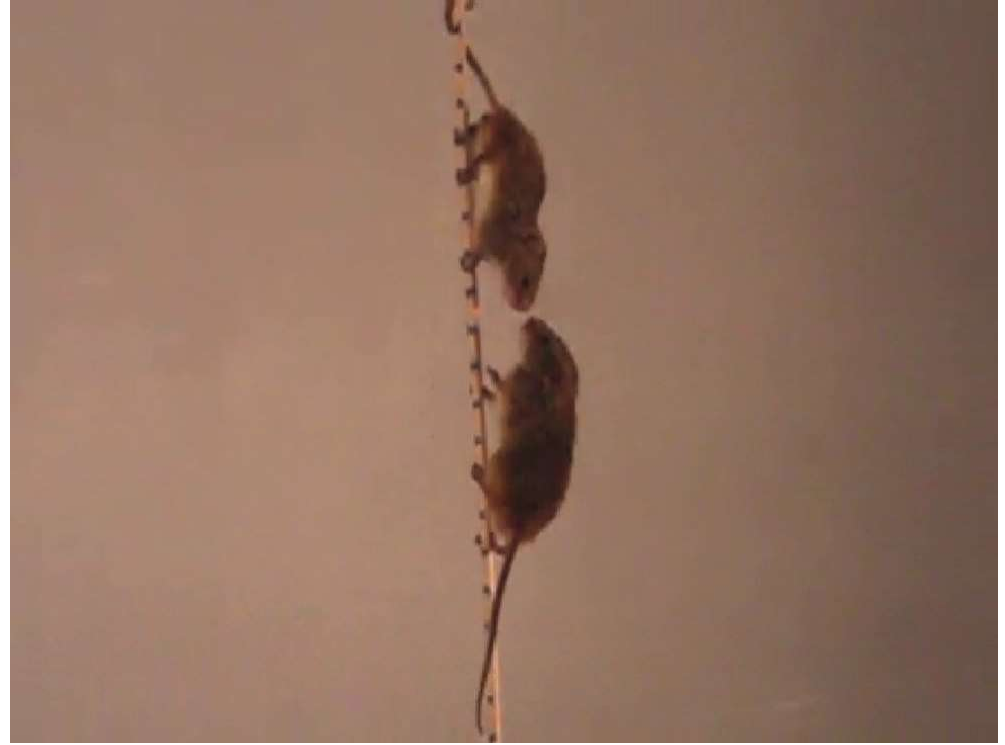
Six adult male Micromys minutus (Figure 1; Muridae, Rodentia) were tested under experimental conditions. All subjects were captive born and permanently housed in large naturalistic enclosures, in the collections of the Nowe Zoo, Poznań, Poland. The original housings contained a large variety of available substrates of diverse sizes and orientations, enabling the harvest mice to move freely both arboreally and terrestrially in an enriched environment. In their regular enclosures, the Eurasian harvest mice made extensive use of any available arboreal substrate inside the enclosures and were also naturally inclined to use the substrates provided during the experimental procedures. Prior to the experiments, all participating Eurasian harvest mice were transported to a laboratory at the Faculty of Biology, Adam Mickiewicz University (AMU), Poznań, Poland where they were jointly housed in a glass terrarium on a reversed day-night regime. The terrarium was completed with natural materials for nesting and climbing, to reduce stress. All specimens were fully habituated to human presence and did not display any stereotypical or stressful behaviors. Mean total head-body length of the subjects was 5.9 cm (SD = 0.12, range = 5.7–6.1 cm, N = 6) and mean body mass was 6.8 g (SD = 1.02, range = 5.8–7.9 g, N = 6). Mean effective hind limb length (see below), i.e., the distance between the hip joint and the substrate, parallel to the axis of gravity (Pontzer 2007), was 1.73 cm (SD = 0.02, range = 1.68–1.74 cm, N = 6).
Experimental Setup
A single, specially configured, filming terrarium (L: 90 cm × H: 40 cm × W: 40 cm) was used for the experiments. Its sides and base were transparent glass windows and it was topped by a wooden frame, with a lid door and wire mesh for ventilation. Within the terrarium, we established a wooden frame to support the poles. The poles were 80 cm long, cylindrical, semi-hardwood rods, set vertically within the terrarium. They were marked with vertical blue lines every 1 cm for a reliable estimation of absolute lengths. During the recordings, the length of the rod in view of the camera was approximately 30 cm. Diameter and the direction of movement accounted for the classification of different substrate categories. Thus, four diameters (2 mm, 5 mm, 10 mm, and 25 mm), and two different directions of movement (descent and ascent) were used to define a total of eight distinct substrate categories.
Data collection was completed in a total of six recording sessions, during June 2013. During each recording session, the individuals were transferred from their enclosure to the experimental terrarium. Each individual was allowed to move freely within the filming terrarium for habituation. Minimal or no stimulation was required for the subjects to walk on the poles. After each filming session, the animal was transported to another accommodation terrarium, to ensure that no individual was tested twice during a particular session.
For video recording, we used a Sanyo digital camcorder (VPC-HD 2000, Sanyo, Osaka, Japan), filming at 240 fps, which was positioned at a distance of 1 m from the filming terrarium to reduce image distortion. For our analyses, we considered only symmetrical gaits (in which the left and right limbs of a pair alternate) as we observed no occurrence of asymmetrical gaits (in which the limbs move together), initiating with the touchdown of the left hind limb and ending at the subsequent touchdown of the same limb, including both lift-offs and touchdowns of all limbs (Hildebrand 1967, 1968, 1976). Cycles involving beginnings or endings of locomotor bouts, in which significant acceleration or deceleration was involved, or loss of balance, in which footfalls were irregular such as continuous lift offs and touchdowns of a single limb, were discarded. Overall, only cycles of stable symmetrical locomotion, regardless of velocity, were retained and regarded as indicative of natural, unbiased behavior. The present research strictly adhered to the guidelines for the treatment of animals in behavioral research and teaching (ASAB/ABS 2012) and complied with relevant regulations and legislations of the Nowe Zoo and the Adam Mickiewicz University in Poznań and the relevant legislation of the Aristotle University of Thessaloniki. Handling, housing of animals and behavioral tests were carried out with permission by the Local Ethical Commission for the Animal Experiments in Poznań.
Gait Analyses
Video analysis and data collection, distance and time calculations were made by importing videos and appropriately calibrating time and distance measurements using Tracker 4.87 (Brown 2009). Microsoft Excel 2016 (Redmond, WA, USA), and SPSS 20 (SPSS Inc., Chicago, IL, USA) were used for all statistical analyses.
For our analyses, we considered the following gait parameters: (i) Diagonality (D) (Cartmill et al. 2007), the percentage of the stride cycle interval the footfall of a forelimb follows behind that of the ipsilateral hind limb. Although it was measured as a scale variable, it was also divided into five ordinal classes (following Cartmill et al. 2002): (a) Lateral Sequence Lateral Couplets (0 < LSLC < 25), (b) Lateral Sequence Diagonal Couplets (25 < LSDC < 50), (c) Trot (=50), (d) Diagonal Sequence Diagonal Couplets (50 < DSDC < 75), (e) Diagonal Sequence Lateral Couplets (75 < DSLC < 100); (ii) Duty Factor (DF), the mean of DFs of all limbs, defined as the percentage of a cycle during which a limb is in contact with the substrate; (iii) Duty Factor Index (DFI), the ratio of hind limb duty factor (DFh) and forelimb duty factor (DFf), calculated as 100 × DFh/DFf (Cartmill et al. 2007). Values >100 indicate higher hind limb than forelimb duty factors, whereas values <100 specify lower hind limb than forelimb duty factors; (iv) Stride Duration (t), total duration of a single stride in seconds, measured from the frame where a stride cycle began until the frame the same stride cycle ended (a stride cycle encompassed all events between two consecutive touchdowns of the left hind limb); (v) Stride Length (l), the corresponding distance covered during a single stride cycle, in meters; (vi) Velocity (v), the speed in which the subjects moved, calculated by dividing stride length with stride duration, and measured in meters/s (m/s); (vii) Stride Frequency (f), the number of strides per second.
As these parameters are size-dependent, we used the effective hind limb length of Eurasian harvest mice to calculate the dimensionless measures of stride duration, stride length, velocity and stride frequency (Hof 1996). These calibrated absolute measurements are useful for estimating competence during locomotion (Alexander 1977; Alexander and Jayes 1983; Hof 1996): Dimensionless Stride Duration (tD) = t / √(l0/g); Dimensionless Stride Length (lD) = l / l0; Dimensionless Velocity (vD) = v / √(g·l0); Dimensionless Stride Frequency (fD) = f / √(g/l0); where l0 is the effective hind limb length of each animal and g is the acceleration of gravity (g = 9.81 m/s²). When overall values for parameters are reported, they represent the sum of means of each category, divided by the number of categories with observations.
We tested for statistically significant discrepancies in the utilization of diagonal and lateral gaits using binomial testing, but also incorporated the trot category into the analysis by using a chi-square test (χ²). These analyses were carried out using two-tailed Monte Carlo procedures for enhanced p estimation accuracy (Kalos and Whitlock 2009). Analysis of covariance (ANCOVA) was selected in order to explore the relationships of variables, including individuals as random factors, while controlling for other possible covariates. When needed, a Bonferroni Post-Hoc test (BMD) was used for pairwise category comparisons, using estimates of means, as calculated by ANCOVA. Stepwise regression models were constructed to examine the impact of both stride frequency and stride length on velocity, using their dimensionless counterparts. The impact of each parameter was calculated using the partial correlation coefficient, i.e. the correlation between a dependent variable and its covariate, after the impact of other covariates is removed (Harrell 2001).
Results
Overall Trends in Gait Parameters
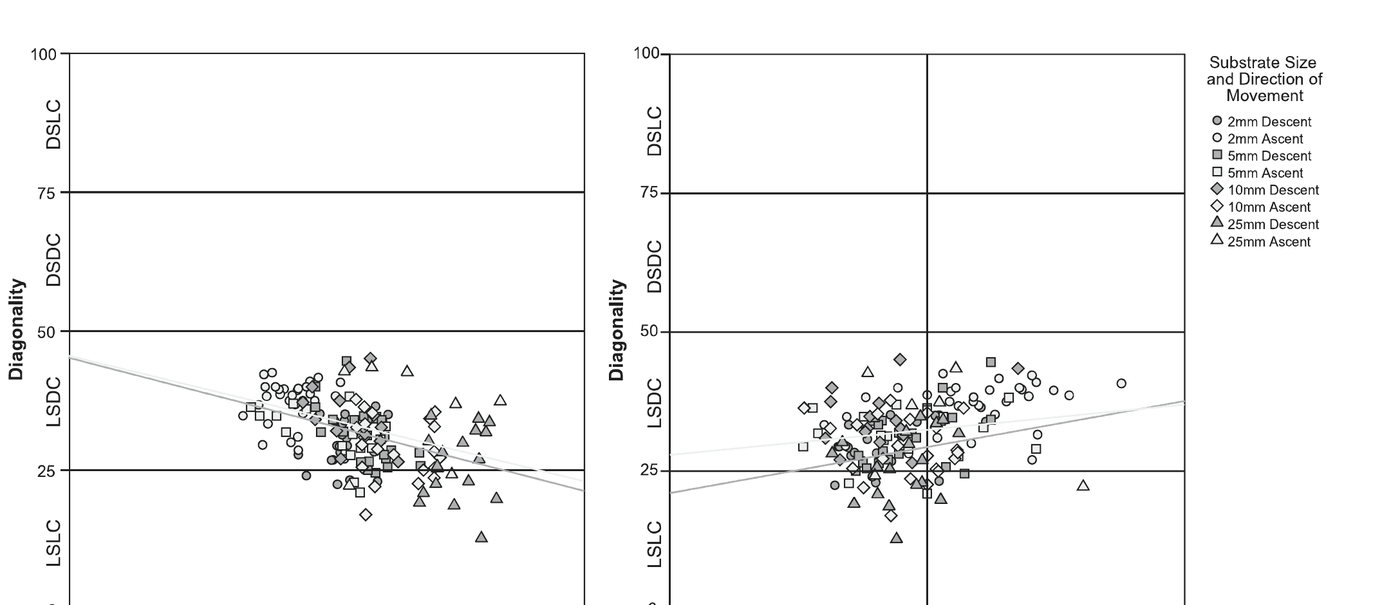
We recorded a total of 157 complete stride cycles across all categories (Table 1). We detected no significant differences between individuals for all parameters (p > 0.05), and therefore their individual results were grouped together. All recorded gaits were symmetrical, lateral-sequence (D < 50) walks (DF > 50), where LSDC gaits dominated (Table 2; n = 135). Overall, D significantly increased as DF increased, controlling for the effect of substrate size (Figure 2) in both descents (N = 79, F(1,78) = 3.818, p = 0.007) and ascents (N = 78, F(1,77) = 2.514, p = 0.037). Moreover, DFI had an overall positive relation with D (Figure 2; Descent: N = 79, F(1,78) = 3.916, p = 0.012; Ascent: N = 78, F(1,77) = 2.742, p = 0.049; controlling for the effect of substrate size). Essentially, as the DF of the hind limbs became higher than those of the forelimbs, gaits became more diagonal (Figure 2).
Table 1. Summary of means and standard deviations (in brackets) of the gait statistics for Micromys minutus (N indicates the number of analyzed cycles for each substrate size and direction).
| Category | N | Diagonality | Duty Factor | Hind limb DF | Forelimb DF | Duty Factor Index | Velocity (m s⁻¹) | Stride Length (m) | Stride Frequency (s⁻¹) | Stride Duration (s) | Dim. Velocity | Dim. Stride Length | Dim. Stride Frequency | Dim. Stride Duration |
|---|---|---|---|---|---|---|---|---|---|---|---|---|---|---|
| 2 mm Ascent | 32 | 36.69 (4.44) | 71.97 (2.69) | 73.39 (4.35) | 70.55 (2.63) | 104.13 (6.81) | 0.164 (0.035) | 0.037 (0.003) | 4.400 (0.748) | 0.234 (0.042) | 0.402 (0.086) | 2.178 (0.161) | 0.183 (0.031) | 5.625 (1.013) |
| 2 mm Descent | 23 | 29.81 (4.30) | 76.75 (2.11) | 75.45 (3.24) | 78.04 (2.21) | 96.74 (4.59) | 0.16 (0.044) | 0.035 (0.003) | 4.520 (1.043) | 0.232 (0.050) | 0.391 (0.109) | 2.064 (0.165) | 0.188 (0.043) | 5.572 (1.195) |
| 5 mm Ascent | 17 | 31.4 (4.75) | 75.51 (4.24) | 74.68 (5.73) | 76.35 (3.94) | 97.86 (6.52) | 0.135 (0.040) | 0.031 (0.004) | 4.249 (0.823) | 0.243 (0.045) | 0.330 (0.099) | 1.837 (0.249) | 0.177 (0.034) | 5.850 (1.082) |
| 5 mm Descent | 23 | 31.31 (5.14) | 78.96 (2.78) | 78.17 (3.08) | 79.74 (3.34) | 98.13 (4.04) | 0.158 (0.028) | 0.034 (0.002) | 4.677 (0.641) | 0.218 (0.033) | 0.386 (0.068) | 1.977 (0.137) | 0.195 (0.027) | 5.241 (0.806) |
| 10 mm Ascent | 22 | 29.29 (5.57) | 81.83 (3.30) | 80.91 (4.52) | 82.75 (2.74) | 97.77 (4.25) | 0.107 (0.026) | 0.025 (0.004) | 4.140 (0.530) | 0.245 (0.031) | 0.262 (0.064) | 1.508 (0.249) | 0.172 (0.022) | 5.892 (0.739) |
| 10 mm Descent | 15 | 34.38 (5.42) | 77.53 (2.71) | 75.73 (3.48) | 79.32 (3.01) | 95.54 (4.61) | 0.157 (0.057) | 0.032 (0.006) | 4.858 (1.108) | 0.217 (0.054) | 0.384 (0.139) | 1.859 (0.365) | 0.202 (0.046) | 5.213 (1.306) |
| 25 mm Ascent | 7 | 35.64 (8.91) | 83.21 (5.80) | 85.81 (5.30) | 80.62 (11.33) | 108.78 (21.42) | 0.09 (0.038) | 0.023 (0.005) | 3.777 (1.097) | 0.284 (0.078) | 0.221 (0.092) | 1.378 (0.315) | 0.157 (0.046) | 6.815 (1.866) |
| 25 mm Descent | 18 | 26.09 (6.31) | 87.65 (2.47) | 86.56 (3.72) | 88.73 (1.73) | 97.54 (3.44) | 0.063 (0.013) | 0.026 (0.002) | 2.477 (0.480) | 0.417 (0.076) | 0.155 (0.032) | 1.500 (0.115) | 0.103 (0.020) | 10.025 (1.823) |
| Overall Ascent | 78 | 33.26 (5.92) | 78.13 (4.01) | 78.70 (4.98) | 77.57 (5.16) | 102.14 (9.75) | 0.124 (0.035) | 0.029 (0.004) | 4.142 (0.800) | 0.252 (0.049) | 0.304 (0.085) | 1.725 (0.244) | 0.172 (0.033) | 6.046 (1.175) |
| Overall Descent | 79 | 30.40 (5.29) | 80.22 (2.52) | 78.98 (3.38) | 81.46 (2.57) | 96.99 (4.17) | 0.135 (0.036) | 0.032 (0.003) | 4.133 (0.818) | 0.271 (0.053) | 0.329 (0.087) | 1.850 (0.196) | 0.172 (0.034) | 6.513 (1.283) |
Vertical Ascents
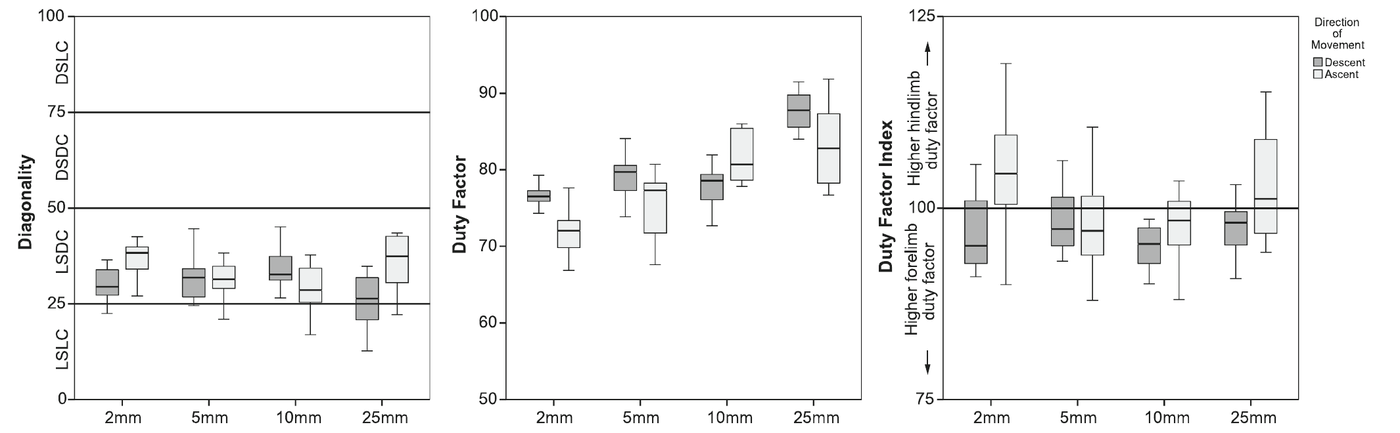
Ascending on the largest substrates (25 mm) was difficult for M. minutus, which resulted in a low sample size (n = 7). Therefore, any results regarding ascents on 25 mm substrates should be regarded with caution. Overall mean D was 33.26 (SD = 5.92, N = 78) for ascents. The majority of recorded strides were LSDC (N = 69), with only a small sample falling into the LSLC category (N = 9; Table 2; Binomial Exact p < 0.001). Diagonality (D) decreased gradually on larger substrates (N = 78, F(3,77) = 5.116, p = 0.003), with the exception of the largest (25 mm) substrate (Table 1; Figure 3). Duty factor (DF) was high, averaging 78.13 (SD = 4.01, N = 79) in ascents (Table 1). This translates into long contact times of the limbs on the substrates, as in quadrupedal walking. Moreover, DF increased significantly from smaller to larger substrates (Figure 3; N = 78, F(3,77) = 34.34, p < 0.001), controlling for the effect of D. Mean DFI was close to 100 (Table 1). DFI varied with substrate size and was significantly higher on 2 mm and 25 mm substrates (Figure 3; N = 78, F(3,77) = 5.28, p = 0.002). Interestingly, the mean DFI values on these size categories scored >100 (Table 1), denoting a shift towards the hind limbs. However, the 25 mm value should be treated with caution due to the low small sample.
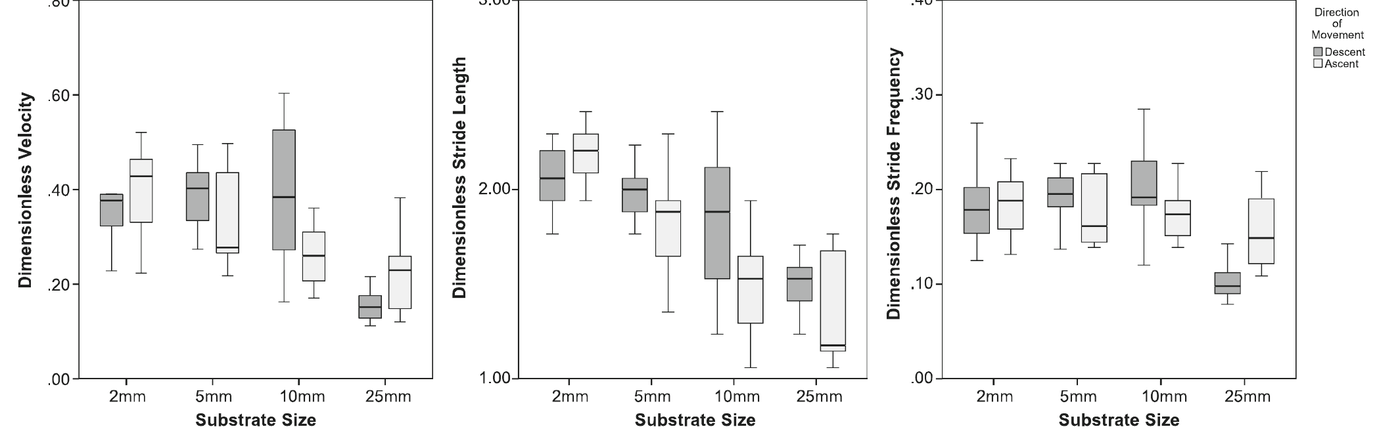
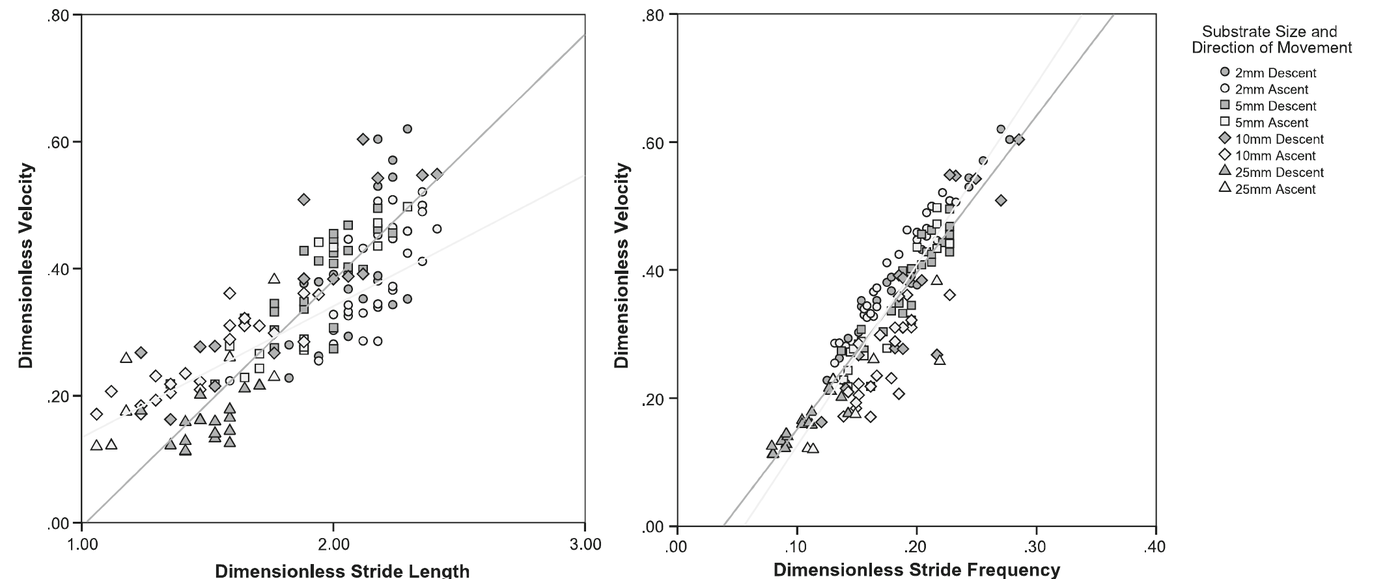
In ascents, dimensionless velocity and dimensionless stride length showed a strong trend towards decreasing as substrate size increased (Figure 4; Velocity: N = 78, F(3,77) = 16.53, p < 0.001; stride length: N = 78, F(3,77) = 50.55, p < 0.001). In contrast, there was no covariance between substrate size and dimensionless stride frequency (Figure 4; N = 78, F(3,77) = 1.51, p = 0.218). Moreover, stride length explained a large part of variation in velocity (Figure 5; N = 78, Rpart = 0.558, F(1,77) = 224.87, p < 0.001), closely followed by stride frequency (N = 78, Rpart = 0.490, F(2,77) = 2992.82, p < 0.001). Throughout our experiments, we also recorded tail use by M. minutus, but it was never used during ascents (0.0%, n = 78).
Table 2. Frequencies and percentages (in brackets) of lateral-sequence lateral couplets (LSLC) and lateral-sequence diagonal couplets (LSDC) gaits during ascents and descents of Micromys minutus.
| Substrate Size | Direction | LSLC | LSDC |
|---|---|---|---|
| 2 mm | Ascent | 0 (0.0%) | 19 (82.6%) |
| 2 mm | Descent | 4 (17.4%) | 32 (100%) |
| 5 mm | Ascent | 7 (38.9%) | 21 (91.3%) |
| 5 mm | Descent | 2 (8.7%) | 11 (61.1%) |
| 10 mm | Ascent | 5 (22.7%) | 15 (100%) |
| 10 mm | Descent | 0 (0.0%) | 17 (77.3%) |
| 25 mm | Ascent | 2 (28.6%) | 11 (61.1%) |
| 25 mm | Descent | 7 (38.9%) | 5 (71.4%) |
| All sizes | Ascent | 9 (11.5%) | 66 (83.5%) |
| All sizes | Descent | 13 (16.5%) | 69 (88.5%) |
Vertical Descents
Overall mean D was 30.40 (SD = 5.29, N = 79) for descents. The majority of recorded strides were LSDC (N = 66), with only a small sample falling into the LSLC category (N = 13; Table 2; Binomial Exact p < 0.001). Regarding the effect of substrate size, gaits became more diagonal (D increased) as substrates became larger (N = 79, F(3,78) = 3.45, p = 0.021), with the exception of the largest substrates (25 mm) (Figure 3; Table 1). Duty factor (DF) was very high, averaging 80.22 (SD = 2.52, N = 78) during descents (Table 1) and significantly increased from smaller to larger substrates (Figure 3; N = 79, F(3,78) = 60.49, p < 0.001), controlling for the effect of D. Mean DFI was slightly below 100. In contrast to the other gait metrics, substrate size had no overall effect on DFI (Figure 3; N = 79, F(3,78) = 1.27, p = 0.290) in descents.
As in ascents, dimensionless velocity also showed a strong trend towards decreasing with substrate size increase (Figure 4; N = 79, F(3,78) = 29.05, p < 0.001). The same trend was observed for dimensionless stride length and dimensionless stride frequency (Figure 4; stride length: N = 79, F(3,78) = 28.93, p < 0.001; stride frequency: N = 79, F(3,78) = 31.14, p < 0.001). In terms of velocity, the stepwise regression model for velocity (Figure 5) revealed that stride frequency was its primary regulator (N = 79, Rpart = 0.521, F(1,78) = 854.54, p < 0.001), followed by stride length (N = 79, Rpart = 0.268, F(2,78) = 3411.31, p < 0.001). In contrast to ascending locomotion, the tail was wrapped around the substrate in all descents (100.0%, n = 79).
Vertical Ascents vs. Vertical Descents
Diagonality was similar between ascents and descents (Figure 3; N = 157, F(1,156) = 1.812, p = 0.180), controlling for the effect of substrate diameter and DF. However, post-hoc tests revealed significantly lower mean D in ascents than descents, both on the 2 mm substrates (BMD = 1.39, p < 0.001) and the 25 mm substrates (BMD = 1.87, p = 0.021). Duty factor (DF) was significantly lower in ascents than descents (Figure 3; F(1,156) = 10.68, p = 0.001; controlling for the effect of substrate size and D). On the other hand, DFI was significantly higher in ascents than descents (Table 1; Figure 3; N = 177, F(1,156) = 13.41, p < 0.001).
Ascents were carried out at approximately similar velocities with descents (Figure 5; N = 157, F(1,156) = 2.25, p = 0.114; controlling for the effect of substrate size). However, post-hoc tests between categories showed that even though velocity was similar between both directions at the smallest substrates (BMD = 0.01, p = 0.690), ascents were slightly, but significantly, slower at 5 mm (BMD = 0.06, p = 0.038) and 10 mm (BMD = 0.12, p = 0.001) than descents. In contrast, ascents were significantly faster than descents at 25 mm (BMD = 0.066, p = 0.012), despite the sample limitations mentioned earlier.
Discussion
The results presented here show that M. minutus, one of the smallest rodents, are highly adept at vertical locomotion. They effectively climbed up and down, using LSDC symmetrical gaits with extended limb contact times on the different substrate sizes. Competent climbing skills are essential for these tiny rodents which are especially dependent on arboreal substrates during the reproductive season (Harris 1970, 1979a, b; Nordvig et al. 2001; Bence et al. 2003; Ozkan et al. 2003; Surmacki et al. 2005; Kuroe et al. 2007).
Compared to descents, ascending gaits of Eurasian harvest mice were characterized by a similar D, a lower DF, a higher DFI, and a complete lack of tail use. These findings partly support our initial expectations. In general, the relatively reduced DF, and hence the increase of swing phases, accompanied by the disengagement of the tail, promoted faster upward progression, by reducing contact duration with the substrate, probably counteracting the opposing pull of gravity (Cartmill 1974a; Hildebrand 1995; Preuschoft et al. 1995). Furthermore, as expressed by the increased DFI, the hind limbs were primarily responsible for generating force for the upward propulsion in M. minutus (Preuschoft et al. 1995; Preuschoft 2002). During vertical ascents, harvest mice face the challenge of negotiating both very fine and very large substrates. Fine substrates can be effectively and securely grasped by the prehensile feet of M. minutus (Urbani and Youlatos 2013), allowing for better control of progression. Furthermore, on fine substrates, hind limb upward propulsion was accompanied by increased D, within the LSDC category, a pattern encountered in other mammals as well (Cartmill et al. 2007; Nyakatura et al. 2008). Diagonal couplets gaits, when combined with increased hind limb stance phases, may enhance the ability to propel the body upwards for mammals that lack powerful primate-like grasping (Lammers and Biknevicius 2004), in a manner analogous to the DSDC gaits of primates (Stevens 2006; Nyakatura et al. 2008; Nyakatura and Heymann 2010). In this way, fine branch vertical ascents appeared to be effectively negotiated by behavioral adaptations promoting dynamic stability (Lammers and Zurcher 2011). As substrates became larger, D decreased, DF increased, and DFI remained statistically constant, despite lower mean values for 5 mm and 10 mm substrates. The progressive increase of stance duration compared to swing duration (increase in DF) on larger substrates, accompanied by a shift to more LS gaits (as suggested by lower D) implies cautious locomotor displacement and behavioral adaptations to more static than dynamic stability (Schmidt and Fischer 2011). Additionally, hind limbs cannot effectively grasp the largest (25 mm) substrates. On such substrates, DF and hind limb dominance (high DFI) are increased, in comparison to intermediately sized substrates. This shift suggests an emphasis on high force generation for upward propulsion by the hind limbs, despite the lack of grasping. Moreover, during ascents, velocity was regulated mainly by stride length, followed by stride frequency, corroborating our initial hypothesis that regulation by stride length is favorable in climbing. A similar pattern is observed in most climbing primates (Hirasaki et al. 1992; Isler and Thorpe 2003; Isler 2005; Hanna 2006; Delciellos and Vieira 2009; Hanna and Schmitt 2011). Longer strides probably save more energy than more frequent strides in ascending vertical locomotion (Hanna and Schmitt 2011), as stride length is inversely proportional to cost of transport (Kram and Taylor 1990).
On the other hand, when M. minutus was climbing down, they showed a similar D, but a higher DF and lower DFI compared to ascents. These findings are in accordance with our expectations. In effect, downward locomotion imposes a cranial/anterior shift of weight, which causes behavioral adaptations such as increased contact times and a higher fraction of the vertical impulse transferred to the forelimbs, enhancing their regulative and supportive role (Rollinson and Martin 1981; Lee et al. 2004; Nyakatura et al. 2008; Nyakatura and Heymann 2010; Shapiro and Young 2012). As our data on downward progression of M. minutus demonstrate, the potential risk of losing control because of the effect of gravity is counteracted by a higher reliance on the forelimbs, an increase in stance phase duration (i.e., substrate contact) of all limbs, and assistance in braking by tail anchoring in the posterior part of the body. Moreover, D was lowest (i.e., very lateral gaits) on the 2 mm and 25 mm substrates. As lateral-sequence gaits have been related to providing assistance in controlling and braking downward progression (Rollinson and Martin 1981; Nyakatura et al. 2008; Nyakatura and Heymann 2010), they may be indeed favorable for the most challenging substrates, such as the very fine (e.g., 2 mm) and very large (e.g., 25 mm) ones. Contrary to ascents, in descents velocity was regulated primarily by stride frequency. Despite being more energetically costly than regulation by stride length, stride frequency may confer enhanced safety and control of body progression. This is brought by a more frequent contact with the substrate, which allows for a higher resolution control of progression and the ability to halt or change direction swiftly (Kram and Taylor 1990; Hoyt et al. 2000; Isler 2005; Hanna 2006; Hanna and Schmitt 2011). Even though Eurasian harvest mice cannot invert their ankles, as squirrels can (pers. obs.), the combination of these gait parameters seems to guarantee secure and efficient downward progression, enabling the animals to exploit different arboreal layers and reach the ground.
The fact that Eurasian harvest mice used increased velocities and stride lengths, and reduced DF on the 2 mm substrates suggests that they are well adapted to climbing vertically both upwards and downwards on slender twigs. This is in accordance with previous findings indicating that they show an overall preference towards fine substrates (Urbani and Youlatos 2013) and is further in line with ecological data indicating a specialization in this particular niche during arboreal activities (Harris 1970; Nordvig et al. 2001; Bence et al. 2003; Surmacki et al. 2005; Kuroe et al. 2007). Their small size, along with their morphological and behavioral specializations, such as grasping extremities, a semi-prehensile tail, a diffuse bowing of the lumbodorsal region, diverse arboreal positional modes, and increased rates of pedal grasping (Ylönen 1990; Haffner 1996, 1998; Krattli 2001; Vazquez-Molinero et al. 2001; Urbani and Youlatos 2013) allow them to efficiently and swiftly move vertically from the ground to arboreal vegetation and back down. In this way, they can exploit challenging substrates including short trees, shrubs, vines, hedgerows, long grass, and even reed beds (Harris 1970, 1979a, b; Nordvig et al. 2001; Bence et al. 2003; Ozkan et al. 2003; Surmacki et al. 2005; Kuroe et al. 2007). Their proficiency in vertical climbing is integral to their ecology. Climbing is more pronounced during reproduction, when they build arboreal nests to avoid interspecific competition for nesting spaces (Ylönen 1990), as well as potential terrestrial predators (Jedrzejewska and Jedrzejewski 1990; Jedrzejewski et al. 1993). While accessing the arboreal niche, they can further acquire novel food sources, such as fruit, seeds, and invertebrates on the terminal twigs and stems increasing their fitness (Leach 1990; Nowak 1999). Moreover, secure and competent head-first downward climbing allows for constant scanning of the ground, enhancing detection of predators, competitors and potential food sources (Cartmill 1974b; Preuschoft et al. 1995; Preuschoft 2002). To do so, M. minutus can readily select the smallest substrates for moving downwards to the lower vegetation strata and the ground. In this way, they are able to reap the advantages of arboreality, while also efficiently utilizing the ground.
This ease of movement between terrestrial and arboreal habitats may have been an important ecological advantage in early eutherian evolution. In effect, two of the oldest eutherian mammals, Juramaia sinensis and Eomaia scansoria, were very small (15–17 g and 20–25 g, respectively) and have been functionally reconstructed as adept scansorialists (Ji et al. 2002; Luo et al. 2011). Reliable postcranial markers for arboreality, such as the phalangeal index (PI) and the proximal phalangeal index (PPI), are remarkably comparable between Eurasian harvest mice and the two fossil species [M. minutus: PI = 131, PPI = 68 (N = 3, pers. obs.); J. sinensis: PI = 121, PPI = 65 (Luo et al. 2011); E. scansoria: PI = 118, PPI = 68 (Ji et al. 2002)], and all fall within the range of arboreal or generalized extant eutherians (Kirk et al. 2008). Despite the fact that both fossils are relatively larger than M. minutus, their overall small size (<30 g) suggests that they would presumably be confronted with comparable challenges when facing uneven terrain and obstacles on both arboreal and terrestrial substrates (Jenkins 1974; Gasc 2001). Therefore, these features, i.e., overall small size and comparable branch seizing ability of the extremities, would likely induce them to employ comparable locomotor and postural solutions in the negotiation of available substrates (Gasc 2001; Fischer et al. 2002; Schmidt 2005; Bonnan et al. 2016). Additionally, the consistent use of LS gaits, and the ecological advantages they confer in the use of unstable arboreal substrates, might have also been employed by both Juramaia and Eomaia. Moreover, this is the most common gait pattern among extant eutherians, metatherians, and reptiles (Hildebrand 1976; Cartmill et al. 2007; McElroy et al. 2008). It is very likely that early eutherians also exploited arboreal substrates to negotiate ecological pressures, such as predation and inter- and intraspecific competition on a seasonally or yearly basis, in a way analogous to M. minutus (Jedrzejewska and Jedrzejewski 1990; Ylönen 1990; Jedrzejewski et al. 1993).
Although access to the arboreal milieu by climbing is accompanied by increased energetic costs, they are not as important at this small size (Hanna and Schmitt 2011). Apart from morphological adaptations, such as functional claws and pedal grasping (Cartmill 1974a; Preuschoft et al. 1995; Preuschoft 2002), upward climbing could be facilitated by behavioral mechanisms such as higher velocity, mainly regulated by stride length, and increased reliance on the hind limbs, as in M. minutus. Additionally, return to the ground by downward climbing would be further promoted by employing more lateral gaits for static stability, increased contact with the substrate, and a subtler regulation of velocity by stride frequency, assuring a swift and secure displacement (Cartmill 1974b; Preuschoft et al. 1995; Preuschoft 2002). The long tail of Juramaia (Luo et al. 2011) may have had a similar anchoring role as in M. minutus. Unfortunately, the lack of hind limb or tail remains from Eomaia need to be treated with caution in making behavioral inferences. In both ascents and descents, relatively slender substrates could have been preferentially used to maximize the competence of vertical locomotion and grasping. This combination of fine-branch arboreal and terrestrial habitats would have very likely increased the fitness of early eutherians and eutherians allowing them to subsequently evolve into the diverse Cenozoic radiations. Extant small arboreal mammals can thus constitute good models for elucidating and understanding the functional and behavioral mechanisms that may have promoted the evolution of early mammals and we would strongly encourage further research along this avenue.
Acknowledgements
All authors wish to express their gratitude to all the people who helped throughout this project: the staff of the Nowe Zoo of Poznań for granting permission and providing the specimens, as well as their invaluable help and patience throughout the experimental procedures, Peter Klimant for his extensive assistance in the experiments, and Doug Brown for essential modifications to the Tracker software that made data analysis possible. Two anonymous reviewers and the editor-in-chief, Dr. John Wible, provided feedback that greatly improved an earlier version of this manuscript. Financial support was provided through funds by the Erasmus studies scholarships to NEK, the School of Biology of the Aristotle University of Thessaloniki, and the Department of Systematic Zoology, Adam Mickiewicz University, Poznań.
References
- Alexander, R. M. (1977). Terrestrial locomotion. In R. M. Alexander & G. Goldspink (Eds.), Mechanics and energetics of animal locomotion (pp. 168–203). Chapman & Hall.
- Alexander, R. M. (1992). Exploring biomechanics: Animals in motion. Scientific American Library.
- Alexander, R. M., & Jayes, A. S. (1983). A dynamic similarity hypothesis for the gaits of quadrupedal mammals. Journal of Zoology, 201, 135–152.
- Arnold, S. J. (1983). Morphology, performance and fitness. American Zoologist, 23, 347–361.
- Association for the Study of Animal Behaviour/Animal Behavior Society. (2012). Guidelines for the treatment of animals in behavioural research and teaching. Animal Behaviour, 83, 301–309.
- Bence, S. L., Stander, K., & Griffiths, M. (2003). Habitat characteristics of harvest mouse nests on arable farmland. Agriculture, Ecosystems & Environment, 99, 179–186.
- Bi, S., Wang, Y., Guan, J., Sheng, X., & Meng, J. (2014). Three new Jurassic euharamiyidan species reinforce early divergence of mammals. Nature, 514, 579–584.
- Bonnan, M. F., Shulman, J., Varadharajan, R., Gilbert, C., Wilkes, M., Horner, A., & Brainerd, E. (2016). Forelimb kinematics of rats using XROMM, with implications for small eutherians and their fossil relatives. PLoS ONE, 11, e0149377.
- Brown, D. (2009). Tracker video analysis and modeling tool.
- Camargo, N. F., Sano, N. Y., Ribeiro, J. F., & Vieira, E. M. (2016). Contrasting the realized and fundamental niche of the arboreal walking performance of neotropical rodents. Journal of Mammalogy, 97, 155–166.
- Cartmill, M. (1974a). Pads and claws in arboreal locomotion. In F. A. Jenkins Jr. (Ed.), Primate locomotion (pp. 45–83). Academic Press.
- Cartmill, M. (1974b). Rethinking primate origins. Science, 184, 436–443.
- Cartmill, M. (1985). Climbing. In M. Hildebrand, D. M. Bramble, K. F. Liem, & D. B. Wake (Eds.), Functional vertebrate morphology (pp. 73–88). Belknap Press.
- Cartmill, M., Lemelin, P., & Schmitt, D. (2002). Support polygons and symmetrical gaits in mammals. Zoological Journal of the Linnean Society, 136, 401–420.
- Cartmill, M., Lemelin, P., & Schmitt, D. (2007). Primate gaits and primate origins. In M. Ravosa & M. Dagosto (Eds.), Primate origins: Adaptations and evolution (pp. 403–435). Springer.
- Delciellos, A. C., & Vieira, M. V. (2006). Arboreal walking performance in seven didelphid marsupials as an aspect of their fundamental niche. Austral Ecology, 31, 449–457.
- Delciellos, A. C., & Vieira, M. V. (2007). Stride lengths and frequencies of arboreal walking in seven species of didelphid marsupials. Acta Theriologica, 52, 101–111.
- Delciellos, A. C., & Vieira, M. V. (2009). Allometric, phylogenetic, and adaptive components of climbing performance in seven species of didelphid marsupials. Journal of Mammalogy, 90, 104–113.
- Demes, B., Larson, S. G., Stern, J. T., Jr., Jungers, W. L., Biknevicius, A. R., & Schmitt, D. (1994). The kinetics of primate quadrupedalism: "Hindlimb drive" reconsidered. Journal of Human Evolution, 26, 353–374.
- Fischer, M. S., Schilling, N., Schmidt, M., Haarhaus, D., & Witte, H. (2002). Basic limb kinematics of small therian mammals. Journal of Experimental Biology, 205, 1315–1338.
- Franz, T. M., Demes, B., & Carlson, K. J. (2005). Gait mechanics of lemurid primates on terrestrial and arboreal substrates. Journal of Human Evolution, 48, 199–217.
- Gaetano, L. C., & Rougier, G. W. (2011). New materials of Argentoconodon fariasorum (Mammaliaformes, Triconodontidae) from the Jurassic of Argentina and its bearing on triconodont phylogeny. Journal of Vertebrate Paleontology, 31, 829–843.
- Gasc, J.-P. (2001). Comparative aspects of gait, scaling and mechanics in mammals. Comparative Biochemistry and Physiology Part A, 131, 121–133.
- Haffner, M. (1996). A tendon-locking mechanism in two climbing rodents, Muscardinus avellanarius and Micromys minutus (Mammalia, Rodentia). Journal of Morphology, 227, 219–227.
- Haffner, M. (1998). A comparison of the gross morphology and micro-anatomy of the foot pads in two fossorial and two climbing rodents (Mammalia). Journal of Zoology, 244, 287–294.
- Hanna, J. B. (2006). Kinematics of vertical climbing in lorises and Cheirogaleus medius. Journal of Human Evolution, 50, 469–478.
- Hanna, J. B., & Schmitt, D. (2011). Locomotor energetics in primates: Gait mechanics and their relationship to the energetics of vertical and horizontal locomotion. American Journal of Physical Anthropology, 145, 43–54.
- Harrell, F. E. (2001). Regression modeling strategies: With applications to linear models, logistic regression, and survival analysis. Springer-Verlag.
- Harris, S. (1970). The secret life of the harvest mouse. Hamlyn.
- Harris, S. (1979a). History, distribution, status and habitat requirements of the harvest mouse (Micromys minutus) in Britain. Mammal Review, 9, 159–171.
- Harris, S. (1979b). Breeding season, litter size and nestling mortality of the harvest mouse, Micromys minutus (Rodentia: Muridae), in Britain. Journal of Zoology, 188, 437–442.
- Hesse, B., Nyakatura, J. A., Fischer, M. S., & Schmidt, M. (2014). Adjustments of limb mechanics in cotton-top tamarins to moderate and steep support orientations: Significance for the understanding of early primate evolution. Journal of Mammalian Evolution, 22, 435–450.
- Hildebrand, M. (1967). Symmetrical gaits of primates. American Journal of Physical Anthropology, 26, 119–130.
- Hildebrand, M. (1968). Symmetrical gaits of dogs in relation to body build. Journal of Morphology, 124, 353–359.
- Hildebrand, M. (1976). Analysis of tetrapod gaits: General considerations and symmetrical gaits. In R. M. Herman, S. Grillner, P. S. G. Stein, & D. G. Stuart (Eds.), Neural control of locomotion (pp. 203–236). Plenum Press.
- Hildebrand, M. (1995). Analysis of vertebrate structure (4th ed.). John Wiley & Sons.
- Hirasaki, E., Kumakura, H., & Matano, S. (1993). Kinesiological characteristics of vertical climbing in Ateles geoffroyi and Macaca fuscata. Folia Primatologica, 61, 148–156.
- Hirasaki, E., Kumakura, H., & Matano, S. (2000). Biomechanical analysis of vertical climbing in the spider monkey and the Japanese macaque. American Journal of Physical Anthropology, 113, 455–472.
- Hirasaki, E., Matano, S., Nakano, Y., & Ishida, H. (1992). Vertical climbing in Ateles geoffroyi and Macaca fuscata and its comparative neurological background. In S. Matano, R. D. Tuttle, H. Ishida, & M. Goodman (Eds.), Topics in primatology, Vol. 3: Evolutionary biology, reproductive endocrinology, and virology (pp. 156–165). University of Tokyo Press.
- Hof, A. L. (1996). Scaling gait data to body size. Gait & Posture, 4, 222–223.
- Hoyt, D. F., Wickler, S. J., & Cogger, E. A. (2000). Time of contact and step length: The effect of limb length, running speed, load carrying and incline. Journal of Experimental Biology, 203, 221–227.
- Hunt, K. D., Cant, J. G. H., Gebo, D. L., Rose, M. D., Walker, S. E., & Youlatos, D. (1996). Standardized descriptions of primate locomotor and postural modes. Primates, 37, 363–387.
- Ishiwaka, R., & Mori, T. (1999). Early development of climbing skills in harvest mice. Animal Behaviour, 58, 203–209.
- Isler, K. (2004). Footfall patterns, stride length and speed of vertical climbing in spider monkeys (Ateles fusciceps robustus) and woolly monkeys (Lagothrix lagotricha). Folia Primatologica, 75, 133–149.
- Isler, K. (2005). 3D-kinematics of vertical climbing in hominoids. American Journal of Physical Anthropology, 126, 66–81.
- Isler, K., & Thorpe, S. K. S. (2003). Gait parameters in vertical climbing of captive, rehabilitant and wild Sumatran orang-utans (Pongo pygmaeus abelii). Journal of Experimental Biology, 206, 4081–4096.
- Jedrzejewska, B., & Jedrzejewski, W. (1990). Antipredatory behaviour of bank voles and prey choice of weasels – enclosure experiments. Annales Zoologici Fennici, 27, 321–328.
- Jedrzejewski, W., Rychlik, L., & Jedrzejewska, B. (1993). Responses of bank voles to odours of seven species of predators: Experimental data and their relevance to natural predator-vole relationships. Oikos, 68, 251–257.
- Jenkins, F. A., Jr. (1974). Tree shrew locomotion and the origins of primate arborealism. In F. A. Jenkins Jr. (Ed.), Primate locomotion (pp. 85–116). Academic Press.
- Ji, Q., Luo, Z.-X., Yuan, C.-X., Wible, J. R., Zhang, J.-P., & Georgi, J. A. (2002). The earliest known eutherian mammal. Nature, 416, 816–822.
- Kalos, M. H., & Whitlock, P. A. (2009). Monte Carlo methods. Wiley-VCH.
- Karantanis, N.-E., Youlatos, D., & Rychlik, L. (2015). Diagonal gaits in the feathertail glider Acrobates pygmaeus (Acrobatidae, Diprotodontia): Insights for the evolution of primate quadrupedalism. Journal of Human Evolution, 86, 43–54. https://doi.org/10.1016/j.jhevol.2015.06.007
- Kirk, E. C., Lemelin, P., Hamrick, M. W., Boyer, D. M., & Bloch, J. I. (2008). Intrinsic hand proportions of euarchontans and other mammals: Implications for the locomotor behavior of plesiadapiforms. Journal of Human Evolution, 55, 278–299.
- Kram, R., & Taylor, C. R. (1990). Energetics of running: A new perspective. Nature, 346, 265–267.
- Krattli, H. (2001). Struktur und Funktion des Extremitäteninteguments bei einheimischen mäuseartigen (Muridae, Rodentia) [Doctoral dissertation, University of Zurich].
- Kuroe, M., Ohori, S., Takatsuki, S., & Miyashita, T. (2007). Nest-site selection by the harvest mouse Micromys minutus in seasonally changing environments. Acta Theriologica, 52, 355–360.
- Lammers, A. R. (2007). Locomotor kinetics on sloped arboreal and terrestrial substrates in a small quadrupedal mammal. Zoology, 110, 93–103.
- Lammers, A. R., & Biknevicius, A. R. (2004). The biodynamics of arboreal locomotion: The effects of substrate diameter on locomotor kinetics in the gray short-tailed opossum (Monodelphis domestica). Journal of Experimental Biology, 207, 4325–4336.
- Lammers, A. R., Earls, K. D., & Biknevicius, A. R. (2006). Locomotor kinetics and kinematics on inclines and declines in the gray short-tailed opossum Monodelphis domestica. Journal of Experimental Biology, 209, 4154–4166.
- Lammers, A. R., & Gauntner, T. (2008). Mechanics of torque generation during quadrupedal arboreal locomotion. Journal of Biomechanics, 41, 2388–2395.
- Lammers, A. R., & Zurcher, U. (2011). Stability during arboreal locomotion. In V. Klika (Ed.), Theoretical biomechanics. InTech.
- Leach, M. (1990). Mice of the British Isles. Shire Publications.
- Lee, D. V., Stakebake, E. F., Walter, R. M., & Carrier, D. R. (2004). Effects of mass distribution on the mechanics of level trotting in dogs. Journal of Experimental Biology, 207, 1715–1728.
- Lemelin, P., & Cartmill, M. (2010). The effect of substrate size on the locomotion and gait patterns of the kinkajou (Potos flavus). Journal of Experimental Zoology Part A, 313A, 157–168.
- Luo, Z.-X., Yuan, C.-X., Meng, Q.-J., & Ji, Q. (2011). A Jurassic eutherian mammal and divergence of marsupials and placentals. Nature, 476, 442–445.
- McElroy, E. J., Hickey, K. L., & Reilly, S. M. (2008). The correlated evolution of biomechanics, gait and foraging mode in lizards. Journal of Experimental Biology, 211, 1029–1040.
- Meng, J., Hu, Y., Wang, Y., Wang, X., & Li, C. (2006). A Mesozoic gliding mammal from northeastern China. Nature, 444, 889–893.
- Meng, Q.-J., Ji, Q., Zhang, Y.-G., Liu, D., Grossnickle, D. M., & Luo, Z.-X. (2015). An arboreal docodont from the Jurassic and mammaliaform ecological diversification. Science, 347, 764–768.
- Nordvig, K., Reddersen, J., & Jensen, T. S. (2001). Small mammal exploitation of upper vegetation strata in non-forest, mixed farmland habitats. Mammalian Biology, 66, 129–134.
- Nowak, R. M. (1999). Walker's mammals of the world (6th ed.). Johns Hopkins University Press.
- Nyakatura, J. A., Fischer, M. S., & Schmidt, M. (2008). Gait parameter adjustments of cotton-top tamarins (Saguinus oedipus, Callitrichidae) to locomotion on inclined arboreal substrates. American Journal of Physical Anthropology, 135, 13–26.
- Nyakatura, J. A., & Heymann, E. W. (2010). Effects of support size and orientation on symmetric gaits in free-ranging tamarins of Amazonian Peru: Implications for the functional significance of primate gait sequence patterns. Journal of Human Evolution, 58, 242–251.
- Ozkan, B., Yigit, N., & Colak, E. (2003). A study on Micromys minutus (Pallas, 1771) (Mammalia: Rodentia) in Turkish Thrace. Turkish Journal of Zoology, 27, 55–60.
- Pontzer, H. (2007). Effective limb length and the scaling of locomotor cost in terrestrial animals. Journal of Experimental Biology, 210, 1752–1761.
- Preuschoft, H. (2002). What does “arboreal locomotion” mean exactly and what are the relationships between “climbing,” environment and morphology? Zeitschrift für Morphologie und Anthropologie, 83, 171–188.
- Preuschoft, H., Witte, H., & Fischer, M. S. (1995). Locomotion in nocturnal prosimians. In L. Alterman, G. Doyle, & M. Izard (Eds.), Creatures of the dark (pp. 453–472). Plenum Press.
- Pridmore, P. A. (1994). Locomotion in Dromiciops australis (Marsupialia, Microbiotheriidae). Australian Journal of Zoology, 42, 679–699.
- Rollinson, J. M., & Martin, R. D. (1981). Comparative aspects of primate locomotion, with special reference to arboreal cercopithecines. Symposia of the Zoological Society of London, 48, 377–427.
- Schmidt, A., & Fischer, M. S. (2010). Arboreal locomotion in rats – The challenge of maintaining stability. Journal of Experimental Biology, 213, 3615–3624.
- Schmidt, A., & Fischer, M. S. (2011). The kinematic consequences of locomotion on sloped arboreal substrates in a generalized (Rattus norvegicus) and a specialized (Sciurus vulgaris) rodent. Journal of Experimental Biology, 214, 2544–2559.
- Schmidt, M. (2005). Hind limb proportions and kinematics: Are small primates different from other small mammals? Journal of Experimental Biology, 208, 3367–3383.
- Schmitt, D. (2003). Substrate size and primate forelimb mechanics: Implications for understanding the evolution of primate locomotion. International Journal of Primatology, 24, 1023–1036.
- Schmitt, D., & Lemelin, P. (2002). Origins of primate locomotion: Gait mechanics of the woolly opossum. American Journal of Physical Anthropology, 118, 231–238.
- Shapiro, L. J., & Young, J. W. (2012). Kinematics of quadrupedal locomotion in sugar gliders (Petaurus breviceps): Effects of age and substrate size. Journal of Experimental Biology, 215, 480–490.
- Shattuck, M. R., & Williams, S. A. (2010). Arboreality has allowed for the evolution of increased longevity in mammals. Proceedings of the National Academy of Sciences, 107, 4635–4639.
- Soligo, C., & Martin, R. D. (2006). Adaptive origins of primates revisited. Journal of Human Evolution, 50, 414–430.
- Soligo, C., & Smaers, J. B. (2016). Contextualising primate origins – An ecomorphological framework. Journal of Anatomy, 228, 608–629.
- Stevens, N. J. (2006). Stability, limb coordination and substrate type: The ecorelevance of gait sequence pattern in primates. Journal of Experimental Zoology Part A, 305A, 953–963.
- Stevens, N. J. (2008). The effect of branch diameter on primate gait sequence pattern. American Journal of Primatology, 70, 356–362.
- Surmacki, A., Goldyn, B., & Tryjanowski, P. (2005). Location and habitat characteristics of the breeding nests of the harvest mouse (Micromys minutus) in the reed-beds of an intensively used farmland. Mammalia, 69, 5–9.
- Urbani, B., & Youlatos, D. (2013). Positional behavior and substrate use of Micromys minutus (Rodentia: Muridae): Insights for understanding primate origins. Journal of Human Evolution, 64, 130–136.
- Vazquez-Molinero, R., Martin, T., Fischer, M. S., & Frey, R. (2001). Comparative anatomical investigations of the postcranial skeleton of Henkelotherium guimarotae Krebs, 1991 (Eupantotheria, Mammalia) and their implications for its locomotion. Zoosystematics and Evolution, 77, 207–216.
- Vilensky, J. A., Moore, A. M., & Libii, J. N. (1994). Squirrel monkey locomotion on an inclined treadmill: Implications for the evolution of gaits. Journal of Human Evolution, 26, 375–386.
- Wallace, I. J., & Demes, B. (2008). Symmetrical gaits of Cebus apella: Implications for the functional significance of diagonal sequence gait in primates. Journal of Human Evolution, 54, 783–794.
- White, T. D. (1990). Gait selection in the brush-tail possum (Trichosurus vulpecula), the northern quoll (Dasyurus hallucatus), and the Virginia opossum (Didelphis virginiana). Journal of Mammalogy, 71, 79–84.
- Witte, H., Preuschoft, H., & Fischer, M. S. (2002). The importance of the evolutionary heritage of locomotion on flat ground in small mammals for the development of arboreality. Zeitschrift für Morphologie und Anthropologie, 83, 221–233.
- Ylönen, H. (1990). Spatial avoidance between the bank vole Clethrionomys glareolus and the harvest mouse Micromys minutus: An experimental study. Annales Zoologici Fennici, 27, 313–320.
- Young, J. W. (2009). Substrate determines asymmetrical gait dynamics in marmosets (Callithrix jacchus) and squirrel monkeys (Saimiri boliviensis). American Journal of Physical Anthropology, 138, 403–420.
- Zheng, X., Bi, S., Wang, X., & Meng, J. (2013). A new arboreal haramiyid shows the diversity of crown mammals in the Jurassic period. Nature, 500, 199–202.
Comments