Arboreality in Acacia Rats (Thallomys paedulcus; Rodentia, Muridae): Gaits and Gait Metrics
Karantanis, N.-E., Rychlik, L., Herrel, A., & Youlatos, D. (2017). Arboreality in acacia rats (Thallomys paedulcus; Rodentia, Muridae): Gaits and gait metrics. Journal of Zoology, 303(2), 107–119. https://doi.org/10.1111/jzo.12473
Abstract
The acacia rat Thallomys paedulcus is a small arboreal rodent, extensively dependent on Acacia sp. trees. In order to understand the arboreal locomotor adaptations of the species, we examined their gaits in arboreal locomotion (i.e. diagonality, duty factor, duty factor index, velocity, and stride length and frequency). For these purposes, we filmed 12 captive specimens on simulated arboreal substrates of variable sizes (2 mm, 5 mm, 10 mm, 25 mm) and inclinations (0° and 45°). Acacia rats employed slow, symmetrical gaits with lower diagonality on the smaller substrates, which were progressively substituted by faster, asymmetrical half-bounding gaits on larger substrates. In general, inclination had no impact on gait metrics, except that ascents were slower than horizontal locomotion. Velocity increase was regulated primarily due to an increase in stride frequency, a pattern encountered in many small mammals, although stride length contributed significantly as well. These locomotor adaptations serve as a behavioural mechanism to cope with the challenges of the arboreal milieu. They appear to provide stability and enable safe negotiation of arboreal substrates, ultimately leading to the successful exploitation of Acacia trees in their natural habitat.
Introduction
Arboreal locomotion, in its many forms, has characterized mammals from their early radiations and has repeatedly and independently evolved over their history in a number of taxa (Bensley, 1901; Haines, 1958; Cartmill, 1974; Jenkins, 1974; Ji et al., 2002; Meng et al., 2015, 2006; Szalay, 2007; Gaetano & Rougier, 2011; Goswami et al., 2011; Luo et al., 2011; Zheng et al., 2013; Bi et al., 2014; Williamson et al., 2014). Rodents are no exception (Krattli, 2001; Zefferer, 2002; Samuels & Van Valkenburgh, 2008). Through arboreal activities, rodents gain access to specific food sources and stores, and can move, rest and eventually nest and raise offspring away from potential predators (Balat & Pelikan, 1959; De Graaff, 1978; Montgomery, 1980; Múrua & González, 1982; Kingdon, 1984; Ylönen, 1990; Jędrzejewska & Jędrzejewski, 1990; Jędrzejewski et al., 1993; Wagner et al., 2000; Juskaitis, 2002; Buesching et al., 2008; Czeszczewik et al., 2008; Dickman & Doncaster, 2009). In order to reap the advantages of arboreality, rodents (as other arboreal mammals) must safely and skilfully negotiate substrates of variable size, inclination, length and flexibility, in the complex, three-dimensional and discontinuous habitat of the different forest layers (Cartmill, 1974; Hildebrand, 1995). Towards this end, the morphology and locomotor and postural behaviour are accordingly specialized (Cartmill, 1974; Essner, 2003; Kirk et al., 2008; Samuels & Van Valkenburgh, 2008; Schmidt & Fischer, 2011; Camargo et al., 2012, 2016; Youlatos et al., 2015). Regarding locomotion, gaits can function as a mechanism that promotes stable and safe displacement along arboreal substrates (Cartmill et al., 2002, 2007; Lammers & Gauntner, 2008; Lemelin & Cartmill, 2010; Lammers & Zurcher, 2011a, 2011b).
Gaits are related to the sequence of forelimb and hindlimb swing and stance phases within a stride period, that is, two consecutive touchdowns of a reference limb, often the left hindlimb (Hildebrand, 1967, 1976, 1977; Alexander, 1977, 1992). Gaits can be analysed on the basis of limb synchronicity, as either symmetrical (Hildebrand, 1976), in which the footfalls of a girdle are evenly spaced in time, or asymmetrical (Hildebrand, 1977), in which the footfalls of at least one girdle are more or less concurrent. In both gait types, duty factor (DF) represents the percentage of a cycle during which a foot is on a substrate. Duty factor separates walking (DF > 50) from running (DF < 50) (Hildebrand, 1967). Duty factor index (DFI) is the 100-fold ratio of the duty factor of the hindlimbs divided by that of the forelimbs, and expresses the relative contact of the hindlimbs compared to that of the forelimbs (Cartmill et al., 2007). Finally, diagonality (D) or forelimb-hindlimb phase (Hildebrand, 1967, 1976, 1977; Cartmill et al., 2007) is applied exclusively to symmetrical gaits and represents the percentage of the stride cycle interval the footfall of a forelimb follows the footfall of the ipsilateral hindlimb. Diagonality separates diagonal-sequence (DS) gaits (D > 50), in which the next foot to come down after a hind footfall is the contralateral forelimb, from lateral-sequence (LS) gaits (D < 50), in which the next foot to come down after a hind footfall is the ipsilateral forelimb (Hildebrand, 1967). Moreover, in diagonal couplets gaits, either diagonal-sequence (DSDC; 50 < D < 75) or lateral-sequence (LSDC; 25 < D < 75), contralateral limbs move more concurrently. On the other hand, during lateral-couplets gaits, either diagonal-sequence (DSLC; 75 < D < 100) or lateral-sequence (LSLC; 0 < D < 25), ipsilateral limbs are more synchronized.
Symmetrical gaits are of special interest in arboreal locomotion, as their metrics have been linked to arboreal adaptations (Prost, 1965; Prost & Sussman, 1969; Cartmill et al., 2002, 2007). DSDC gaits are associated with dynamic stability, allowing the control and transfer of moments and torques imposed on the body axes (Lammers & Zurcher, 2011a). DSDC gaits have been linked to arboreality, as they are common in many arboreal taxa, such as primates (Hildebrand, 1967; Cartmill et al., 2007), a few metatherian didelphimorphs and phalangeroids (White, 1990; Pridmore, 1994; Cartmill et al., 2002; Schmitt & Lemelin, 2002; Karantanis et al., 2015), and the carnivoran Potos flavus (Lemelin & Cartmill, 2010). DSDC gaits produce medially oriented forces (Schmitt, 2003; Lammers & Biknevicius, 2004; Schmidt & Fischer, 2010). This allows animals to seize substrates and increase the applied force, and consequent friction, which reduces the possibility of slipping (Lammers & Zurcher, 2011a). Moreover, opposing mediolateral and angular impulses generated by contralateral limbs may reduce mediolateral deviations from the long axis of the branch (Shapiro & Raichlen, 2007). Moreover, in DSDC gaits, the forelimb moves onto new, untested substrates after the contralateral hindlimb has already been safely anchored on the previously used substrate. This may allow for safe withdrawal to safety if the new substrate is proven to be unstable, while keeping the centre of mass within the support polygon (Cartmill et al., 2007). However, in arboreal locomotion, LSDC gaits may be preferable in terms of static stability, as they allow an animal to keep its centre of mass within the support polygons, throughout the gait cycle, provided that three or four limbs are anchored on the substrate, hence at high DF (Lammers & Zurcher, 2011a). Although LS gaits are more common among terrestrial mammals, LSDC are also habitually used by a number of arboreal taxa, including callitrichid primates (Stevens, 2006, 2008; Nyakatura et al., 2007; Nyakatura et al., 2008; Nyakatura & Heymann, 2010), sugar gliders Petaurus breviceps (Shapiro & Young, 2010), as well as scansorial and arboreal rodents (Schmidt & Fischer, 2010, 2011; Karantanis et al., 2017).
On the other hand, asymmetrical gaits allow reaching higher speeds of locomotion (Hildebrand, 1977; Pridmore, 1994; Gasc, 2001; Young, 2009; Shapiro et al., 2016), and may provide advantages over symmetrical gaits, such as a reduction in metabolic costs (Hoyt & Taylor, 1981). Moreover, although in general asymmetrical gaits produce higher reaction forces than those of symmetrical gaits, the transition from trotting (symmetrical) to galloping (asymmetrical) has been shown to reduce peak forces on the muscles, tendons and bones (Farley & Taylor, 1991). In small mammals, asymmetrical gaits may also provide an energetic input to locomotion through the sagittal movements of their flexible spine and related muscles (Schilling & Hackert, 2006). In an arboreal setting, asymmetrical gaits also confer advantages in stability by reducing peak vertical forces, limiting centre of mass movements, and resulting in shorter and more frequent strides (Young, 2009; Schmidt & Fischer, 2010; Shapiro et al., 2016).
Other locomotor metrics, such as velocity, may also be useful as indicators of locomotor competence on arboreal substrates. Velocity is a function of stride frequency, that is, number of strides per unit of time, and stride length, that is, the distance covered within a single stride (Alexander, 1992; Hildebrand, 1995). Interestingly, among some neotropical rodents and marsupials, arboreal species usually exhibit overall higher velocities than terrestrial species on arboreal substrates (Delciellos & Vieira, 2006, 2007; Camargo et al., 2016). Higher velocities on narrow, arboreal substrates may contribute to maintenance of dynamic stability (Schmidt & Fischer, 2010). In arboreal mammals, an increase in velocity is achieved in different ways: stride frequency increase and stride length decrease (Delciellos & Vieira, 2006, 2007; Camargo et al., 2016); stride frequency decrease and stride length increase (Larson et al., 2000, 2001; Delciellos & Vieira, 2006, 2007); and stride frequency may primarily increase, followed, at a lesser rate, by stride length (Nyakatura et al., 2008; Karantanis et al., 2015). Increasing velocity through longer strides can be safer on arboreal substrates as it enables the forelimb to reach farther and reduces involuntary branch sway (Demes et al., 1994). It is often encountered in medium-sized and larger arboreal mammals (Larson et al., 2000, 2001; Delciellos & Vieira, 2006, 2007). In contrast, increasing velocity by increasing stride frequency, although energetically costly (Reilly et al., 2007), decreases body oscillations, allows continuous progression, and may thus be more advantageous for smaller mammals, which face insignificant branch sway (Strang & Steudel, 1990; Delciellos & Vieira, 2007).
As arboreal substrates are variable, differences in substrate size and inclination can influence arboreal locomotion and its parameters. Substrate size may impose significant constraints on locomotor patterns (Jenkins, 1974; Witte et al., 2002), and DS gaits may be especially useful on smaller, unstable substrates, assisting safe locomotion (Cartmill et al., 2007). However, results from previous studies are equivocal. A lower frequency of DS gaits has been observed in the majority of strepsirrhine primates examined (Stevens, 2008), the tamarin Saguinus fuscicollis (Nyakatura & Heymann, 2010), and the arboreal metatherian Petaurus breviceps (Shapiro & Young, 2010), while there is no correlation between substrate size and DS gaits in free-ranging tamarins Saguinus mystax (Nyakatura & Heymann, 2010). On the other hand, the arboreal metatherian Acrobates pygmaeus (Karantanis et al., 2015) and the kinkajou Potos flavus (Lemelin & Cartmill, 2010) display a higher occurrence of DS gaits on smaller substrates. Regarding velocity, results are also divergent. Some neotropical arboreal rodents walk faster on smaller substrates (Camargo et al., 2016), which probably serves to maintain stability in an animal lacking substantial grasping abilities (Schmidt & Fischer, 2010). On the other hand, some arboreal metatherians move more slowly (Delciellos & Vieira, 2006, 2007; Karantanis et al., 2015). Slow, cautious walking probably promotes a stable dynamic progression by reducing the torques produced at limb touchdown, increasing the simultaneous contact points on the substrate at any part of a gait cycle, and lengthening the relative duration of contact with the substrate (Hildebrand, 1976; Cartmill et al., 2002, 2007; Lammers & Zurcher, 2011a, 2011b).
Apart from substrate size, substrate inclination, and more specifically ascents and descents, also influence gait parameters. In ascents, the occurrence of DSDC gaits (increased D) (Prost & Sussman, 1969; Lammers, 2007; Nyakatura et al., 2008; Nyakatura & Heymann, 2010; Shapiro & Young, 2010; Shapiro et al., 2014; Karantanis et al., 2015), coupled with increased hindlimb stance phase durations (higher DFI), reduce yawing and lateral torques, enhancing the capacity to drive the body upwards (Vilensky et al., 1994; Lammers & Biknevicius, 2004; Stevens, 2006; Nyakatura et al., 2008; Nyakatura & Heymann, 2010). On the other hand, LSDC gaits may be advantageous in descents, allowing increased braking by the forelimbs, through a ‘stop-jolt’ mechanism (Rollinson & Martin, 1981; Nyakatura & Heymann, 2010). Additionally, as the centre of mass is shifted cranially/anteriorly, the longer contact times (lower DFI) and the higher fraction of vertical impulse on the forelimbs further augment their regulatory and supportive importance (Rollinson & Martin, 1981; Lee et al., 2004; Nyakatura et al., 2008; Young, 2012; Karantanis et al., 2015). In terms of velocity, descents are slower, compared to ascents and horizontal locomotion (Vilensky et al., 1994; Lammers et al., 2006; Lammers, 2007; Karantanis et al., 2015), likely because of the frictional adjustments of the extremities, and the loading and braking role of the forelimbs (Lammers et al., 2006; Lammers, 2007). Ascents may be faster than horizontal locomotion, as in the agile European red squirrels, as they help achieve dynamic stability (Schmidt & Fischer, 2011), but can also be slower, as in the more generalized rats (Schmidt & Fischer, 2010, 2011) and larger primates (Nakano, 2002). On the other hand, some smaller arboreal primates do not adjust velocity relative to their direction of movement (Nyakatura et al., 2008; Shapiro et al., 2016).
Considering the divergent responses of different arboreal mammals to the constraints imposed by the properties of the arboreal substrates on locomotor parameters, we examined arboreal gait patterns in an arboreal and nocturnal African rodent, the acacia rat Thallomys paedulcus (Sundevall, 1846). As is the case for most nocturnal African small mammals, there is limited published information for the species and almost nothing is known about its locomotion. Thallomys paedulcus is a murid rodent encountered in the African Acacia bushland, from Ethiopia, south to the east coast of South Africa (De Graaff, 1978; Kingdon, 1984; Mills & Hes, 1997; Monadjem, 1999; Skinner & Chimimba, 2005; Taylor & Boitani, 2008). Acacia trees play an important role on the ecology and biology of the species. Acacia rats exploit heavily the trunks and branches of Acacia trees, where they build their nests at heights around 4 m. The thick thorns of the trees provide them protection from predators, such as owls and arboreal snakes (Delany, 1972; De Graaff, 1978; Kingdon, 1984; Dean et al., 1999). Their morphology is adapted to an arboreal lifestyle with a long tail covered with long tactile hairs, relatively short limbs, curved claws on the digits and broad hind feet, with short toes and raised pads and a well-developed, long, partially opposable fifth digit (De Graaff, 1978; Reed, 2003). As this morphology makes acacia rats able and committed arborealists (Earl & Nel, 1976), it is also important to identify the behavioural locomotor adaptations they have evolved in order to successfully exploit the arboreal habitat. In this context, we here investigate the relation between gait parameters, that is diagonality, duty factor, duty factor index, velocity, stride length and stride frequency, and substrate size and direction of movement of T. paedulcus. In our experiments, acacia rats negotiated inclining, declining and horizontal arboreal substrates from small to relatively larger diameters, simulating the branch diversity encountered in acacia forests, the natural habitat of the species. On small substrates, we expect acacia rats to display higher diagonality (D), in a manner to promote secure locomotion, unmodified duty factor index (DFI), higher velocity and lower duty factor (DF). During ascents, acacia rats should demonstrate increased diagonality (D) and duty factor index (DFI), with an opposite trend in descents, as well as lower velocity, compared to horizontal locomotion. This is the first study that explores gait metrics in these arboreal rodents, and similar data are valuable for elucidating the different locomotor adaptations that rodents have evolved in relation to arboreality.
Materials and Methods
Specimens
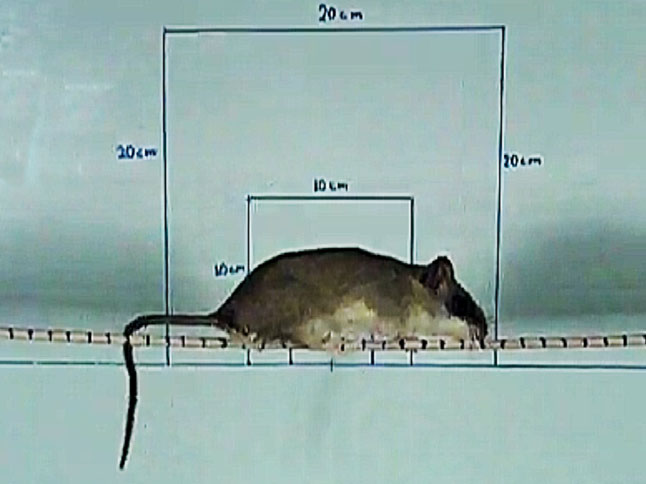
For the purposes of this study, we tested 12 adult male acacia rats Thallomys paedulcus (Muridae, Rodentia; Figure 1). All specimens were captive-born and are housed in the permanent collection of Nowe Zoo, Poznań, Poland. The animals inhabited a large enclosure (H: 120 cm × W: 240 cm × D: 120 cm) under a reversed day-night regime. The enclosure contained natural materials for nesting and a wide variety of arboreal substrates of different sizes and inclinations that simulate their natural habitat. The animals moved freely within this enriched environment and showed no indications of stress or stereotypies. During the experiments, all specimens were healthy and active, were handled with care, and did not display any stereotypical or stressful behaviour. The zoo keeps no data on any relatedness between the different animals, therefore it was unknown whether the subjects were related or not. Mean head-body length of the specimens used was 13.4 cm (SD = 1.6 cm, range: 12.6–14.0 cm), mean mass was 70.2 g (SD = 11 g, range: 62–74 g) and mean effective hindlimb length, that is, the distance between the hip joint and the substrate, parallel to the axis of gravity, was 3.5 cm (SD = 0.69 cm, range: 2.9–3.7 cm). All measurements were taken directly on the study subjects.
Experimental Setup
We used a single, specially configured, glass terrarium (L: 90 cm × H: 40 cm × W: 40 cm), topped by a wooden cover, for filming. Within the terrarium, we set up 80-cm long poles, made of cylindrical semi-hardwood, which were supported by wooden frames on each end. All poles were marked with vertical blue lines every 1 cm for reliable absolute length estimation (Figure 1). During the recording, the visible length of the rod on the videos was between 30 and 40 cm. Diameter and direction of movement accounted for the classification of the different substrate categories. Following previous experimental study on a series of small-bodied mammals, we considered four classes of diameters (2 mm, 5 mm, 10 mm, 25 mm) (Karantanis et al., 2015, 2016, 2017). These classes simulate a range of branches, from the finest terminal twigs to boughs, which impose differential locomotor constraints in the natural habitat of the studied species. In a similar manner, we also used three different directions of movement (descent at 45°, horizontal, ascent at 45°), which in combination with the four size classes, totalled to 12 distinct substrate categories.
The experiments occurred in three video recording sessions, during June 2013. All experiments occurred under special lighting conditions, during daytime hours, which corresponded to the nocturnal active period of the subjects. During each session, two subjects were individually transferred from their enclosures to the filming terrarium. Initially, every individual was allowed to move freely within the filming terrarium in order to accommodate itself to the new environment. Minimal or no stimulation was required for the subjects to walk on the poles. During each filming session, subjects were tested several times on all 12 substrate categories. After each filming session, the animal was transported back to a temporary enclosure, to ensure that no individual was tested twice during a particular session. For video recording, we used a Sanyo digital camcorder (VPC-HD 2000; Sanyo, Osaka, Japan), set at 240 fps, and positioned at a distance of 1 m from the filming terrarium in order to reduce image distortion. For our analyses on diagonality, we considered only symmetrical gaits [i.e. initiating with the touchdown of the left hindlimb and ending at the subsequent touchdown of the same limb, including both lift-offs and touchdowns of all limbs (Hildebrand, 1967, 1968, 1976)]. For all other parameters, we considered both complete symmetrical and asymmetrical gaits. We discarded any cycles involving beginnings or endings of locomotor bouts or loss of balance. We only analysed continuous locomotion, regardless of velocity, as indicative of natural unbiased behaviour. Handling and filming of the animals were performed with the permission of the Local Ethical Commission for Animal Experiments in Poznań, followed the guidelines for the treatment of animals in behavioural research and teaching (ASAB/ABS, 2012), and complied with relative regulations and legislations of the Adam Mickiewicz University and the Aristotle University of Thessaloniki.
Gait Analyses
Video analysis and data collection, distance and time calculations were made by importing videos and calibrating time and distance measurements using Tracker 4.92 (Brown, 2009). Time was calibrated taking into account the 240 fps of the videos, and distance was calibrated using the reference marks on the substrates. Using Tracker, we recorded the number of the frame at which each footfall and lift-off took place. Microsoft Excel 2010 (Redmond, WA, USA), and SPSS 23 (SPSS Inc., Chicago, IL, USA) were used for all statistical analyses.
For our analyses, we considered the following gait parameters: (i) Diagonality (D) (Hildebrand, 1967; Cartmill et al., 2007) is the percentage of the stride cycle interval the footfall of a forelimb follows behind the ipsilateral hindlimb. Although it was measured as a scale variable, it was also divided into five ordinal classes: (a) Lateral Sequence Lateral Couplets (0 ≤ LSLC < 25), (b) Lateral Sequence Diagonal Couplets (25 ≤ LSDC < 50), (c) Trot (=50), (d) Diagonal Sequence Diagonal Couplets (50 < DSDC ≤ 75), (e) Diagonal Sequence Lateral Couplets (75 < DSLC ≤ 100); (ii) Duty Factor (DF) is the mean of duty factors of all limbs, defined as the percentage of a cycle during which a limb is in contact with the substrate. Walking gaits correspond to DF > 50, whereas running gaits score < 50; (iii) Duty Factor Index (DFI) is the ratio of hindlimb duty factor (DFh) to forelimb duty factor (DFf), calculated as 100 × DFh/DFf (Cartmill et al., 2007). DFI > 100 indicate longer hindlimb than forelimb stance durations, whereas DFI < 100 specify shorter hindlimb than forelimb stance durations; (iv) Stride Duration (t) is total duration of a single stride in seconds; (v) Stride Length (l) is the distance covered during a single stride cycle, in meters; (vi) Velocity (v) is the speed at which the subjects moved, calculated by dividing stride length with stride duration, in meters/s (m s⁻¹); (vii) Stride Frequency (f) is the number of strides per second.
As these four last parameters are size-dependent, we standardized them using the effective hindlimb length (Pontzer, 2005, 2007a, 2007b). The effective hindlimb length is used to calculate the dimensionless measures of stride duration, stride length, velocity and stride frequency which provide comparative measures of locomotor competence across different species (Alexander, 1977; Alexander & Jayes, 1983; Hof, 1996). The dimensionless measures were calculated as follows: Dimensionless Stride Duration (tD) = t / √(l0/g); Dimensionless Stride Length (lD) = l / l0; Dimensionless Velocity (vD) = v / √(g·l0); Dimensionless Stride Frequency (fD) = f / √(g/l0); where l0 is the effective hindlimb length of each animal and g is the acceleration of gravity (g = 9.81 m s⁻²). All measures of time and length were converted to the SI system. All overall values reported represent the sum of mean values per substrate category, divided by the number of substrate categories in which gaits were recorded.
For statistical analyses, we opted for Analysis of Covariance (ANCOVA) to explore relationships between variables while controlling for other possible covariates. When necessary, comparisons between categories or across species were performed by Bonferroni Post hoc tests, calculating Bonferroni Mean Difference (BMD) values, based on estimates by the univariate ANCOVA models. Finally, we constructed stepwise regression models to examine the impact of both dimensionless stride frequency and stride length on velocity. The impact of each parameter was estimated using the R calculated by the model (Harrell, 2001). Spearman’s rank correlation was used to test for relations between stride length and stride frequency.
Results
We recorded a total of 81 gait cycles over a total of six substrate categories: 56 symmetrical walks (70.6%) and 25 asymmetrical half-bounding gaits (29.4%), in which the hindlimbs touched down simultaneously while one forelimb was trailing the other. The animals failed to negotiate the 2-mm substrates, so no data on this category are presented. Additionally, we failed to obtain data on descents, as the animals constantly preferred to climb down the vertical support at the tallest end of the setup. In order to avoid stressing the animals, we opted not to force them further. Tables 1 and 2 present the summary of observations per substrate and direction of movement.
Gait Metrics and Their Interactions
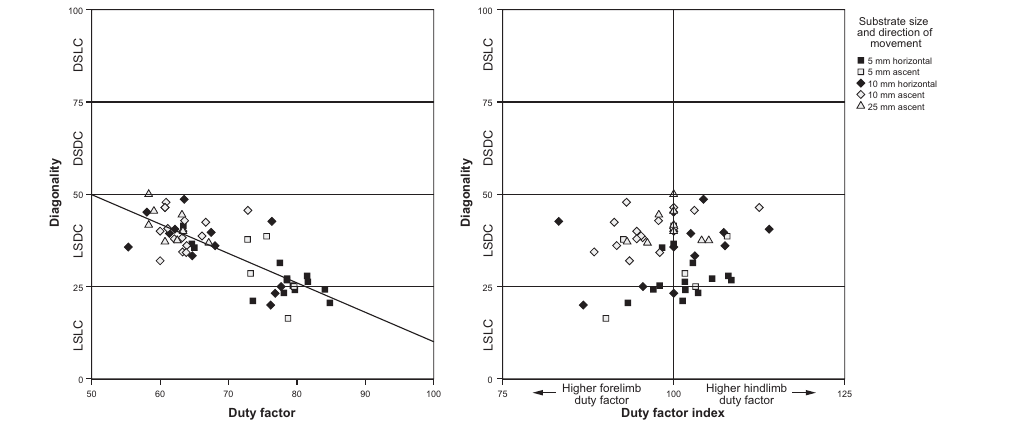
Diagonality and its correlations to other gait parameters were calculated only for symmetrical gaits (Hildebrand, 1967, 1968, 1976; Cartmill et al., 2002). A breakdown of all recorded parameters is shown in Table 1 for symmetrical gaits and Table 2 for asymmetrical gaits. Overall diagonality for symmetrical gaits was 34.89 (n = 5, SD = 6.75) indicating lateral-sequence diagonal couplets (LSDC) gaits. Mean duty factor was 68.93 (n = 5, SD = 4.83) indicating slow walking. The duty factor index (DFI) was 99.45 (n = 5, SD = 5.92), implying an equilibrium in the stance phases of the fore- and hindlimbs. We found an overall significant covariance between diagonality and duty factor (Figure 2; N = 57, F(1,56) = 9.225, P = 0.004; controlling for substrate size and direction of movement), but not DFI (Figure 2; N = 57, F(1,56) = 1.287, P = 0.289; controlling for substrate size and direction of movement). Overall duty factor for asymmetrical gaits was 56.51 (n = 3, SD = 4.15) and DFI was 100.68 (n = 3, SD = 15.79).
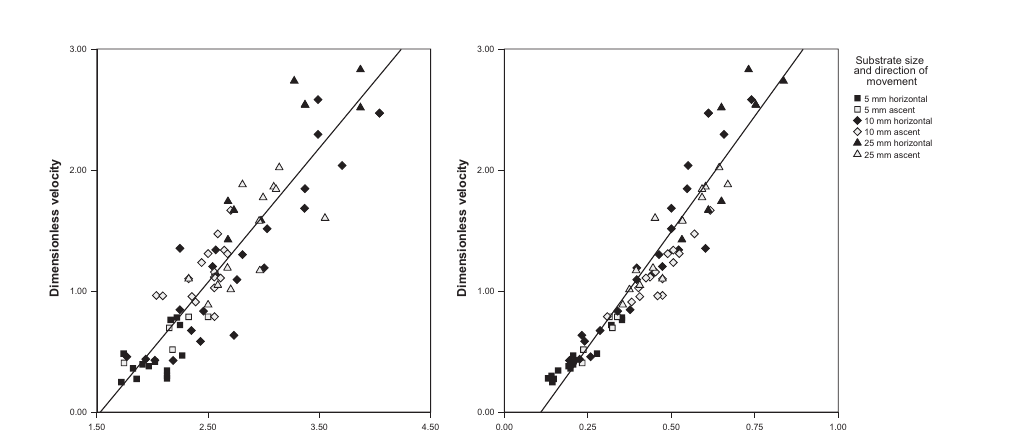
Our regression model showed that, during horizontal locomotion, stride frequency had a bigger impact (N = 47, F(1,45) = 755.627, Rpart = 0.386, P < 0.001) on velocity than stride length (Figure 3; N = 47, F(1,44) = 112.869, Rpart = 0.201, P < 0.001). The same pattern held in ascents (Stride frequency: N = 81, F(1,32) = 247.588, Rpart = 0.587, P < 0.001; Stride length: N = 81, F(1,31) = 261.720, Rpart = 0.320). Stride frequency and stride length also correlated in both horizontal (N = 81, R = 0.848, P < 0.001) and ascending (N = 81, R = 0.534, P = 0.001) locomotion.
Table 1. Summary of means and standard deviations (in brackets) of the gait statistics for symmetrical, walking gaits in Thallomys paedulcus. N of observations indicates the number of analysed cycles for each substrate size and direction of movement category; N of individuals indicates the number of individuals for which valid gait cycles were recorded in each category.
| Category | N obs | N ind | Diagonality | Duty factor | Hindlimb duty factor | Forelimb duty factor | Duty factor index | Velocity (m s⁻¹) | Stride length (m) | Stride frequency (s⁻¹) | Stride duration (s) | Dim. velocity | Dim. stride length | Dim. stride frequency | Dim. stride duration |
|---|---|---|---|---|---|---|---|---|---|---|---|---|---|---|---|
| Horizontal 2 mm | 0 | 0 | No data | ||||||||||||
| Horizontal 5 mm | 14 | 8 | 27.99 (6.14) | 76.45 (7.13) | 76.96 (7.36) | 75.94 (7.28) | 101.4 (4.18) | 0.264 (0.107) | 0.073 (0.007) | 3.583 (1.305) | 0.312 (0.101) | 0.444 (0.182) | 2.024 (0.187) | 0.217 (0.078) | 5.131 (1.628) |
| Horizontal 10 mm | 12 | 6 | 35.78 (8.95) | 67.3 (7.80) | 67.12 (6.48) | 67.49 (10.01) | 100.35 (8.61) | 0.480 (0.216) | 0.088 (0.014) | 5.301 (1.884) | 0.210 (0.069) | 0.801 (0.360) | 2.406 (0.367) | 0.324 (0.115) | 3.452 (1.131) |
| Horizontal 25 mm | 0 | 0 | Exclusively asymmetrical gaits | ||||||||||||
| Overall Horizontal | 31.89 (7.55) | 71.88 (7.47) | 72.04 (6.92) | 71.72 (8.65) | 100.88 (6.40) | 0.372 (0.162) | 0.081 (0.011) | 4.442 (1.595) | 0.261 (0.085) | 0.623 (0.271) | 2.215 (0.277) | 0.271 (0.097) | 4.292 (1.380) | ||
| Ascent 2 mm | 0 | 0 | No data | ||||||||||||
| Ascent 5 mm | 6 | 5 | 29.28 (9.28) | 75.97 (3.10) | 75.53 (4.21) | 76.4 (4.27) | 99.08 (7.45) | 0.371 (0.099) | 0.075 (0.009) | 4.887 (0.851) | 0.210 (0.039) | 0.639 (0.170) | 2.180 (0.280) | 0.289 (0.050) | 3.546 (0.653) |
| Ascent 10 mm | 16 | 6 | 40.25 (4.78) | 63.26 (3.25) | 62.2 (3.77) | 64.33 (3.65) | 96.82 (5.68) | 0.672 (0.132) | 0.086 (0.007) | 7.803 (1.283) | 0.132 (0.023) | 1.151 (0.228) | 2.474 (0.194) | 0.464 (0.075) | 2.210 (0.384) |
| Ascent 25 mm | 9 | 4 | 41.17 (4.62) | 61.68 (2.87) | 61.53 (2.93) | 61.83 (3.24) | 99.6 (3.67) | 0.778 (0.244) | 0.096 (0.010) | 8.025 (1.817) | 0.13 (0.028) | 1.339 (0.419) | 2.778 (0.287) | 0.475 (0.108) | 2.197 (0.466) |
| Overall Ascent | 36.90 (6.23) | 66.97 (3.07) | 66.42 (3.64) | 67.52 (3.72) | 98.50 (5.60) | 0.607 (0.158) | 0.086 (0.009) | 6.905 (1.317) | 0.157 (0.030) | 1.043 (0.272) | 2.477 (0.254) | 0.409 (0.078) | 2.651 (0.501) | ||
| Overall | 34.89 (6.75) | 68.93 (4.83) | 68.67 (4.95) | 69.20 (5.69) | 99.45 (5.92) | 0.513 (0.160) | 0.084 (0.009) | 5.920 (1.428) | 0.199 (0.052) | 0.875 (0.272) | 2.372 (0.263) | 0.354 (0.085) | 3.307 (0.852) |
Table 2. Summary of means and standard deviations (in brackets) of the gait statistics for asymmetrical, half-bounding gaits in Thallomys paedulcus. N indicates the number of analysed cycles for each category; N of individuals indicates the number of individuals for which valid gait cycles were recorded.
| Category | N obs | N ind | Duty factor | Hindlimb duty factor | Forelimb duty factor | Duty factor index | Velocity (m s⁻¹) | Stride length (m) | Stride frequency (s⁻¹) | Stride duration (s) | Dim. velocity | Dim. stride length | Dim. stride frequency | Dim. stride duration |
|---|---|---|---|---|---|---|---|---|---|---|---|---|---|---|
| Horizontal 2 mm | 0 | 0 | No data | |||||||||||
| Horizontal 5 mm | 0 | 0 | Exclusively symmetrical gaits | |||||||||||
| Horizontal 10 mm | 12 | 7 | 58.84 (7.12) | 60.01 (7.89) | 57.68 (8.60) | 105.60 (16.77) | 0.999 (0.335) | 0.104 (0.016) | 9.384 (2.067) | 0.113 (0.030) | 1.770 (0.617) | 3.191 (0.635) | 0.542 (0.115) | 1.934 (0.467) |
| Horizontal 25 mm | 9 | 5 | 55.56 (3.40) | 52.08 (5.14) | 59.05 (5.75) | 89.14 (14.63) | 1.26 (0.323) | 0.110 (0.016) | 11.354 (1.758) | 0.090 (0.014) | 2.175 (0.557) | 3.202 (0.471) | 0.672 (0.105) | 1.521 (0.244) |
| Overall Horizontal | 57.20 (5.26) | 56.04 (6.52) | 58.36 (7.17) | 97.37 (15.70) | 1.131 (0.329) | 0.107 (0.016) | 10.369 (1.913) | 0.101 (0.022) | 1.973 (0.587) | 3.197 (0.553) | 0.607 (0.110) | 1.727 (0.355) | ||
| Ascent 2 mm / 5 mm / 10 mm | 0 | 0 | No data / exclusively symmetrical gaits | |||||||||||
| Ascent 25 mm | 4 | 4 | 55.12 (1.92) | 56.75 (2.32) | 53.50 (5.49) | 107.30 (15.98) | 1.011 (0.110) | 0.108 (0.010) | 9.474 (1.447) | 0.108 (0.017) | 1.731 (0.162) | 3.102 (0.320) | 0.564 (0.093) | 1.811 (0.311) |
| Overall Ascent | 55.12 (1.92) | 56.75 (2.32) | 53.50 (5.49) | 107.30 (15.98) | 1.011 (0.110) | 0.108 (0.010) | 9.474 (1.447) | 0.108 (0.017) | 1.731 (0.162) | 3.102 (0.320) | 0.564 (0.093) | 1.811 (0.311) | ||
| Overall | 56.51 (4.15) | 56.28 (5.12) | 56.74 (6.61) | 100.68 (15.79) | 1.091 (0.256) | 0.107 (0.014) | 10.071 (1.757) | 0.103 (0.020) | 1.892 (0.445) | 3.165 (0.475) | 0.593 (0.104) | 1.755 (0.340) |
Effects of Substrate Diameter
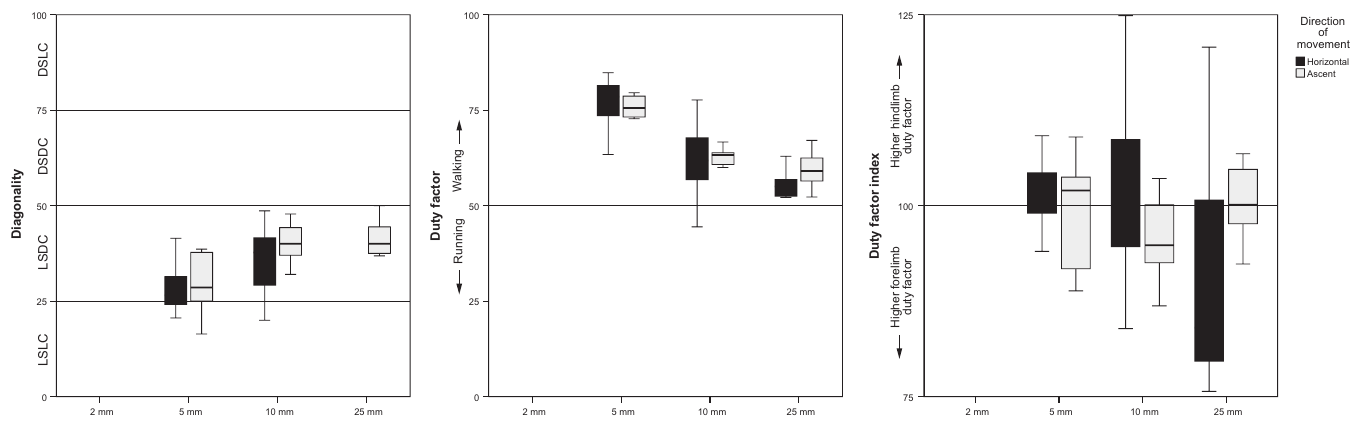
Diagonality in symmetrical gaits showed no covariance with substrate size, controlling for the effect of DF (horizontal: N = 26, F(2,25) = 0.389, P = 0.535; ascent: N = 34, F(3,30), P = 0.108). DF decreased significantly on larger substrates (Figure 4) during ascents (N = 34, F(3,33) = 10.405, P < 0.001) and horizontal locomotion (N = 47, F(2,46) = 5.386, P = 0.026). DFI did not covary with substrate size (Figure 4) in either horizontal locomotion (N = 47, F(2,46) = 3.342, P = 0.086) or ascents (N = 34, F(3,33) = 1.689, P = 0.201).
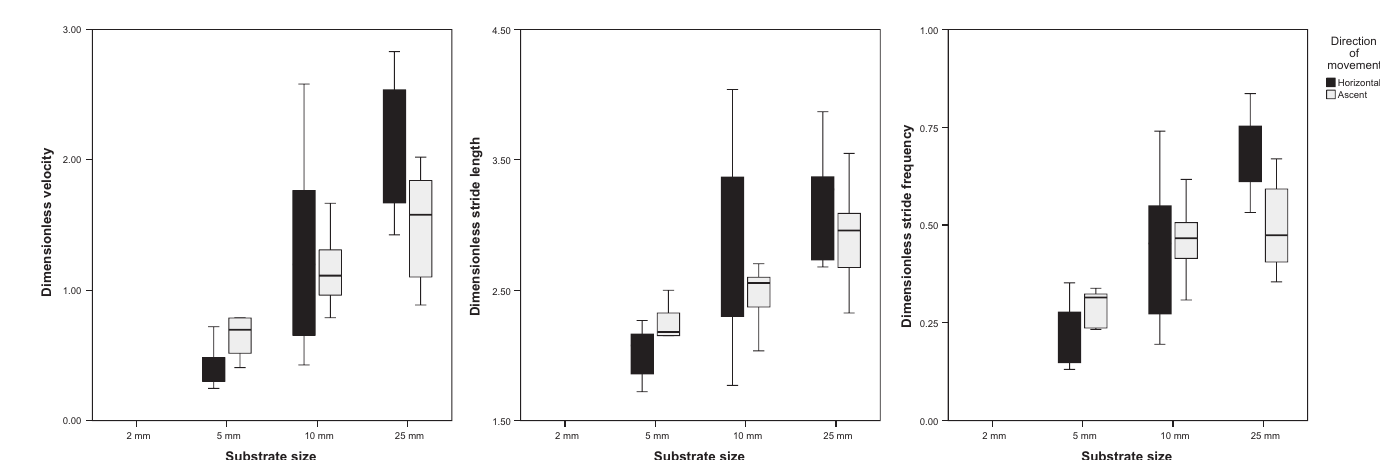
Dimensionless velocity increased on larger substrates (Figure 5), in both horizontal (N = 47, F(2,46) = 26.017, P < 0.001) or ascending (N = 34, F(3,33) = 13.704, P < 0.001) locomotion. The same pattern (Figure 5) was observed for stride length (horizontal: N = 47, F(2,46) = 16.270, P < 0.001; ascent: N = 34, F(3,33) = 15.446, P < 0.001) and stride frequency (horizontal: N = 47, F(2,46) = 34.133, P < 0.001; ascent: N = 34, F(3,33) = 11.113, P < 0.001).
Effect of Direction of Movement
Direction of movement had no effect on D (F = 0.837, P = 0.365; controlling for DF and substrate size), DF (F = 0.002; P = 0.963; controlling for D and substrate size) or DFI (F = 0.000, P = 0.994; controlling for substrate size). Velocity was higher in horizontal compared to ascending locomotion (BMD = 0.238; N = 81, F(2,80) = 4.293, P = 0.042). We obtained a similar result for stride length (BMD = 0.233; N = 81, F(2,80) = 5.261, P = 0.025), but there was no effect of direction of movement on stride frequency (BMD = 0.019; N = 81, F(2,80) = 0.440, P = 0.509).
Symmetrical and Asymmetrical Gaits
Half-bounding asymmetrical gaits were characterized by lower DF (BMD = 7.545, N = 81, F(2,80) = 16.457, P < 0.001), similar DFI (BMD = 3.556, N = 81, F(2,80) = 1.078, P = 0.301), and higher velocity (BMD = 0.829, N = 81, F(2,80) = 41.986, P < 0.001), stride frequency (BMD = 0.190, N = 81, F(2,80) = 32.932, P < 0.001) and stride length (BMD = 0.649, N = 81, F(2,80) = 29.598, P < 0.001) than symmetrical walks, controlling for substrate size and direction of movement. Half-bounding became more frequent on larger substrates (Tables 1 and 2), and appeared to be the preferred method for faster progression.
Discussion
Overall, arboreal locomotion of Thallomys paedulcus was confined to the 5-mm, 10-mm, 25-mm substrates. Unlike other similarly sized rodents, acacia rats were not able to utilize the 2-mm substrates (Karantanis et al., 2017). Their symmetrical gaits were characterized by lateral-sequence diagonal couplets (LSDC) gaits, of relatively high duty factor (DF), and balanced fore- and hindlimbs DFs, as indicated by the duty factor index (DFI). Diagonality (D) and DFI did not covary with substrate size, though DF, velocity, stride length and stride frequency decreased in smaller substrates. Additionally, the occurrence of asymmetrical gaits increased on larger substrates. D, DF and DFI remained unaffected by direction of movement; however, velocity and stride length, but not stride frequency, significantly decreased in ascents compared to horizontal locomotion. Therefore, our results were not entirely in line with our a priori hypotheses. This first report on the locomotion of acacia rats confirms ecological observations of its skilled and effective use of arboreal substrates. Unfortunately, we failed to record descents on sloped substrates. Nevertheless, this failure hints at the possible importance of vertical climbing in T. paedulcus, which requires further investigations.
Contrary to our expectations, D decreased on smaller substrates. It has been suggested that D increases (i.e. more diagonal gait) on narrow substrates, enhancing safety by allowing the test of new substrates by the forelimbs, while keeping the contralateral hindlimb anchored on a stable substrate (Cartmill et al., 2007). However, observations on a number of arboreal mammals provide equivocal evidence for (Nyakatura et al., 2008; Nyakatura & Heymann, 2010; Shapiro et al., 2014) and against this conjecture (Cartmill et al., 2007; Lemelin & Cartmill, 2010; Karantanis et al., 2015). Acacia rats were able to negotiate narrow substrates by employing less diagonal gaits in comparison to more diagonal gaits on larger substrates. In this way, it appears that LSDC gaits enhance stability for arboreal mammals without strongly prehensile forelimbs (Lammers & Biknevicius, 2004), in a way analogous to the DSDC gaits of the prehensile-footed primates (Stevens, 2006; Nyakatura et al., 2008; Nyakatura & Heymann, 2010). Moreover, the overall reduction in relative swing phases (increased DF), along with a decrease in velocity, implies cautious walking. This contrasts our predictions for faster gaits on narrow substrates, based on observations on some arboreal neotropical rodents (Camargo et al., 2016). Faster gaits may be preferable to achieve dynamic stability (Schmidt & Fischer, 2011), but there may be other advantages of lower velocity in fine-branch locomotion. Small substrates induce a more mid-sagittal limb placement producing narrower support polygons (Hildebrand, 1976; Cartmill et al., 2002, 2007; Lammers & Zurcher, 2011a). Narrow support polygons amplify the risk of the centre of mass being placed outside, which is further accentuated by the laterally directed, destabilizing torques produced every time a limb touches down (Lammers & Zurcher, 2011b). A lower speed of progression and short aerial phases increase the number of contact points at any part of a gait cycle, and provide more time to counteract the destabilizing torques (Lammers & Gauntner, 2008; Lammers & Zurcher, 2011a, 2011b). In this way, these gait adjustments, relative to substrate size, most probably assist acacia rats in negotiating a wide array of substrates.
Regarding direction of movement, we did not observe any significant correlations with most of the examined gait parameters, excluding velocity and stride length, which were lower in ascents. This contrasts previous findings, where DFI often increases and D decreases in ascending locomotion, to assist in generating additional propulsion (Nyakatura et al., 2008; Nyakatura & Heymann, 2010; Karantanis et al., 2015). Considering that the hindlimbs carry a higher load and exhibit higher stance ratios than forelimbs in ascents (Preuschoft, 2002), the balanced use of fore- and hindlimbs in T. paedulcus could be related to its limited powerful grasping abilities. In this way both fore- and hindlimbs possibly accomplish equally significant roles during ascents (Schmidt, 2011; Schmidt & Fischer, 2011). However, further investigations on grasping ability and kinematics may be more informative on the absence of such differences. On the other hand, ascending velocity and stride length were lower than those of horizontal locomotion. These adjustments are similar to those made by brown rats (Schmidt & Fischer, 2010, 2011) and some primates (Nakano, 2002). In contrast, European red squirrels, Sciurus vulgaris, display higher velocity in ascents. Functionally, reduced velocity during ascent promotes safe progression through static stability, contrary to the dynamic stability obtained through higher velocity (Schmidt & Fischer, 2011). In this way, these adjustments probably contribute to safe, stable and continuous upward progression.
Thallomys paedulcus were able to competently negotiate relatively narrow substrates (5 mm). On larger substrates, velocity, stride length and stride frequency gradually increased, as expected. This pattern was further accompanied by a higher occurrence of asymmetrical gaits, which completely replaced symmetrical gaits on the largest substrates (25 mm). In T. paedulcus, asymmetrical half-bounding gaits were characterized by lower DF, similar DFI, and higher velocity, stride frequency and stride length, than symmetrical walks. The extended suspension phases of the limbs (lower DF), brought about by asymmetrical gaits, optimize the ability to avoid obstacles, such as bumps and stubs on a branch, and may enhance energetic economy (Bertram & Gutmann, 2009). Moreover, some transitions from symmetrical to asymmetrical gaits may contribute to reduced strain on the musculoskeletal system (Farley & Taylor, 1991) or to increased energetic economy at higher speeds (Hoyt & Taylor, 1981; Schilling & Hackert, 2006), in comparison to symmetrical running. For small arboreal mammals, such as T. paedulcus, asymmetrical gaits may also assist in dynamic stability, by reducing overall peak vertical forces, restraining the movement of the centre of mass within the support polygons, and using shorter and more frequent strides which allows for a greater control of locomotion (Young, 2009; Schmidt & Fischer, 2010; Shapiro et al., 2016). In acacia rats this is further underscored by the regulation of velocity mainly by stride frequency, with a secondary, though significant, role played by stride length. This pattern is often observed in other small mammals (Delciellos & Vieira, 2006, 2007; Karantanis et al., 2015; Camargo et al., 2016). On the one hand, velocity increase by stride frequency reduces body oscillations in arboreal locomotion, increasing arboreal stability (Strang & Steudel, 1990; Delciellos & Vieira, 2006). On the other hand, it is energetically costly (Reilly et al., 2007) and causes more branch sway, compared to velocity regulation by stride length (Demes et al., 1994), which is more common for larger mammals (Larson et al., 2000, 2001). However, body oscillations may be more disrupting than branch sway for small-bodied arboreal mammals, rendering velocity increase by stride frequency more advantageous (Strang & Steudel, 1990; Delciellos & Vieira, 2007).
This study showed that T. paedulcus used and adjusted gaits in a way to maximize the effectiveness of locomotion on arboreal substrates. The arboreal capacities of acacia rats are further supported by their morphology, and more precisely, the long tail, covered with long tactile hair, the relatively short limbs, the curved claws on the digits and the broad hind feet, with short toes and raised pads and a well-developed, long, partially opposable fifth digit (De Graaff, 1978; Reed, 2003). Similar characters have been functionally related to arboreal adaptations in rodents (Krattli, 2001; Zefferer, 2002; Samuels & Van Valkenburgh, 2008; Camargo et al., 2012; Carrizo et al., 2014). The functional interplay between these morphological adaptations and the related gait modifications, allows T. paedulcus to successfully negotiate the diversity of sizes and inclinations of the available substrates of Acacia trees. Acacia rats respond to narrow substrates by reducing their velocity and the aerial phase of their strides, and using more lateral gaits. This strategy, assisted by their partly grasping hind feet (De Graaff, 1978), possibly enables access to fruit, seeds and arthropods, which are often found on terminal branches. When on larger substrates, they maximize their locomotor competence by increasing velocity and aerial phases through asymmetrical half-bounding gaits. As a result, they are able to move swiftly, minimizing exposure and maximizing vigilance for predators (McAdam & Kramer, 1998). Acacia rats are also able to successfully ascend moderately inclined substrates by reducing their velocity and achieving static stability. In this way, they can travel securely upwards from their ground burrows along up to the terminal branches, taking advantage of the inclined branch architecture of Acacia trees (Delany, 1972; Earl & Nel, 1976; De Graaff, 1978; Kingdon, 1984; Mills & Hes, 1997; Dean et al., 1999; Monadjem, 1999; Reed, 2003; Skinner & Chimimba, 2005).
These locomotor adaptations are possibly crucial for the survival of animals, such as T. paedulcus, which concentrate in scattered tree formations within the dry and nutrient-deprived environment of the African savannah. These agglomerations provide high accumulation of nutrients from plant materials and animal waste (Belsky, 1994) and richer water concentration compared to their surroundings (Vetaas, 1992). These features attract a high diversity of savannah animals, which are subject to increased competition (Dean et al., 1999). The morpho-behavioural adaptations enable acacia rats to exploit the available microhabitats provided by Acacia trees for nesting, protection from predators among the tree thorns, burrowing among roots and feeding on tree products and arthropods found on or near the trees (Delany, 1972; Earl & Nel, 1976; De Graaff, 1978; Kingdon, 1984; Mills & Hes, 1997; Dean et al., 1999; Monadjem, 1999; Reed, 2003; Skinner & Chimimba, 2005). The successful utilization of their environment underscores the important role of Acacia rats, as prey, parasite hosts (Kingdon, 1984; Linzey & Kesner, 1997) and seed dispersers (Howe & Smallwood, 1982). Consequently, T. paedulcus may be a key species for the conservation of Acacia formations, which are of great importance for the African savannah (Lindenmayer & Fischer, 2006). Therefore, it is vital to identify and comprehend the ways acacia rats successfully respond to the challenges imposed by their demanding habitat. The present research provides information on the adaptive significance of behavioural mechanisms of acacia rats and we hope that it will serve as a launch pad for further research on an understudied species with a special ecological role.
Acknowledgements
We are particularly indebted to the staff members of the Nowe Zoo, Poznań, Poland for granting permits and access to work with the acacia rats, as well as for their active assistance in the execution of the experiments. Their help was invaluable and made this study possible. Financial support was provided by a postgraduate Erasmus Fellowship to NEK, the School of Biology of the Aristotle University of Thessaloniki and the Department of Systematic Zoology of the Faculty of Biology of the Adam Mickiewicz University in Poznań.
References
- Alexander, R. M. (1977). Terrestrial locomotion. In R. M. Alexander & G. Goldspink (Eds.), Mechanics and energetics of animal locomotion (pp. 168–203). Chapman & Hall.
- Alexander, R. M. (1992). Exploring biomechanics: Animals in motion. Scientific American Library.
- Alexander, R. M., & Jayes, A. S. (1983). A dynamic similarity hypothesis for the gaits of quadrupedal mammals. Journal of Zoology, 201, 135–152.
- Association for the Study of Animal Behaviour/Animal Behavior Society. (2012). Guidelines for the treatment of animals in behavioural research and teaching. Animal Behaviour, 83, 301–309.
- Balat, F., & Pelikan, J. (1959). On Apodemus flavicollis (Melch.) occupying nest boxes for birds. Zoologicky List, 3, 257–287.
- Belsky, A. J. (1994). Influences of trees on savanna productivity: Tests of shade, nutrients, and tree-grass competition. Ecology, 75, 922–932.
- Bensley, A. B. (1901). On the question of an arboreal ancestry of the Marsupialia, and the interrelationships of the mammalian subclasses. American Naturalist, 35, 117–138.
- Bertram, J. E. A., & Gutmann, A. (2009). Motions of the running horse and cheetah revisited: Fundamental mechanics of the transverse and rotary gallop. Journal of the Royal Society Interface, 6, 549–559.
- Bi, S., Wang, Y., Guan, J., Sheng, X., & Meng, J. (2014). Three new Jurassic euharamiyidan species reinforce early divergence of mammals. Nature, 514, 579–584.
- Brown, D. (2009). Tracker video analysis and modeling tool.
- Buesching, C. D., Newman, C., Twell, R., & Macdonald, D. W. (2008). Reasons for arboreality in wood mice Apodemus sylvaticus and bank voles Myodes glareolus. Mammalian Biology, 73, 318–324.
- Camargo, N. F., Ribeiro, J. F., Gurgel-Goncalves, R., Palma, A. R. T., Mendonca, A. F., & Vieira, E. M. (2012). Is footprint shape a good predictor of arboreality in sigmodontine rodents from a neotropical savanna? Acta Theriologica, 57, 261–267.
- Camargo, N. F., Sano, N. Y., Ribeiro, J. F., & Vieira, E. M. (2016). Contrasting the realized and fundamental niche of the arboreal walking performance of neotropical rodents. Journal of Mammalogy, 97, 155–166.
- Carrizo, L. V., Tulli, M. J., Dos Santos, D. A., & Abdala, V. (2014). Interplay between postcranial morphology and locomotor types in Neotropical sigmodontine rodents. Journal of Anatomy, 224, 469–481.
- Cartmill, M. (1974). Pads and claws in arboreal locomotion. In F. A. Jenkins Jr. (Ed.), Primate locomotion (pp. 45–83). Academic Press.
- Cartmill, M., Lemelin, P., & Schmitt, D. (2002). Support polygons and symmetrical gaits in mammals. Zoological Journal of the Linnean Society, 136, 401–420.
- Cartmill, M., Lemelin, P., & Schmitt, D. (2007). Primate gaits and primate origins. In M. Ravosa & M. Dagosto (Eds.), Primate origins: Adaptations and evolution (pp. 403–435). Springer.
- Czeszczewik, D. C., Walankiewicz, W. W., & Stanska, M. S. (2008). Small mammals in nests of cavity-nesting birds: Why should ornithologists study rodents? Canadian Journal of Zoology, 86, 286–293.
- De Graaff, G. (1978). Notes on the Southern African black-tailed tree rat Thallomys paedulcus (Sundevall, 1846) and its occurrence in the Kalahari Gemsbok National Park. Koedoe, 21, 181–190.
- Dean, W. R. J., Milton, S. J., & Jeltsch, F. (1999). Large trees, fertile islands, and birds in arid savanna. Journal of Arid Environments, 41, 61–78.
- Delany, M. J. (1972). The ecology of small rodents in tropical Africa. Mammal Review, 2, 1–42.
- Delciellos, A. C., & Vieira, M. V. (2006). Arboreal walking performance in seven didelphid marsupials as an aspect of their fundamental niche. Austral Ecology, 31, 449–457.
- Delciellos, A. C., & Vieira, M. V. (2007). Stride lengths and frequencies of arboreal walking in seven species of didelphid marsupials. Acta Theriologica, 52, 101–111.
- Demes, B., Larson, S. G., Stern, J. T., Jr., Jungers, W. L., Biknevicius, A. R., & Schmitt, D. (1994). The kinetics of primate quadrupedalism: "Hindlimb drive" reconsidered. Journal of Human Evolution, 26, 353–374.
- Dickman, C. R., & Doncaster, C. P. (2009). Responses of small mammals to red fox (Vulpes vulpes) odour. Journal of Zoology, 204, 521–531.
- Earl, Z., & Nel, J. A. J. (1976). Climbing behavior in three African rodent species. Zoologica Africana, 11, 183–192.
- Essner, R. L. (2003). Locomotion, morphology, and habitat use in arboreal squirrels (Rodentia: Sciuridae) [Doctoral dissertation].
- Farley, C. T., & Taylor, C. R. (1991). A mechanical trigger for the trot-gallop transition in horses. Science, 253, 306–308.
- Gaetano, L. C., & Rougier, G. W. (2011). New materials of Argentoconodon fariasorum (Mammaliaformes, Triconodontidae) from the Jurassic of Argentina and its bearing on triconodont phylogeny. Journal of Vertebrate Paleontology, 31, 829–843.
- Gasc, J.-P. (2001). Comparative aspects of gait, scaling and mechanics in mammals. Comparative Biochemistry and Physiology Part A, 131, 121–133.
- Goswami, A., Prasad, G. V. R., Upchurch, P., Boyer, D. M., Seiffert, E. R., Verma, O., Gheerbrant, E., & Flynn, J. J. (2011). A radiation of arboreal basal eutherian mammals beginning in the Late Cretaceous of India. Proceedings of the National Academy of Sciences, 108, 16333–16338.
- Haines, R. W. (1958). Arboreal or terrestrial ancestry of placental mammals. Quarterly Review of Biology, 33, 1–23.
- Harrell, F. E. (2001). Regression modeling strategies: With applications to linear models, logistic regression, and survival analysis. Springer-Verlag.
- Hildebrand, M. (1967). Symmetrical gaits of primates. American Journal of Physical Anthropology, 26, 119–130.
- Hildebrand, M. (1968). Symmetrical gaits of dogs in relation to body build. Journal of Morphology, 124, 353–359.
- Hildebrand, M. (1976). Analysis of tetrapod gaits: General considerations and symmetrical gaits. In R. M. Herman, S. Grillner, P. S. G. Stein, & D. G. Stuart (Eds.), Neural control of locomotion (pp. 203–236). Plenum Press.
- Hildebrand, M. (1977). Analysis of asymmetrical gaits. Journal of Mammalogy, 58, 131–156.
- Hildebrand, M. (1995). Analysis of vertebrate structure (4th ed.). John Wiley & Sons.
- Hof, A. L. (1996). Scaling gait data to body size. Gait & Posture, 4, 222–223.
- Howe, H. F., & Smallwood, J. (1982). Ecology of seed dispersal. Annual Review of Ecology and Systematics, 13, 201–228.
- Hoyt, D. F., & Taylor, C. R. (1981). Gait and the energetics of locomotion in horses. Nature, 292, 239–240.
- Jędrzejewska, B., & Jędrzejewski, W. (1990). Antipredatory behaviour of bank voles and prey choice of weasels – enclosure experiments. Annales Zoologici Fennici, 27, 321–328.
- Jędrzejewski, W., Rychlik, L., & Jędrzejewska, B. (1993). Responses of bank voles to odours of seven species of predators: Experimental data and their relevance to natural predator-vole relationships. Oikos, 68, 251–257.
- Jenkins, F. A. (1974). Tree shrew locomotion and the origins of primate arborealism. In F. A. Jenkins Jr. (Ed.), Primate locomotion (pp. 85–116). Academic Press.
- Ji, Q., Luo, Z.-X., Yuan, C.-X., Wible, J. R., Zhang, J.-P., & Georgi, J. A. (2002). The earliest known eutherian mammal. Nature, 416, 816–822.
- Juskaitis, R. (2002). Spatial distribution of the yellow-necked mouse (Apodemus flavicollis) in large forest areas and its relation with seed crop of forest trees. Mammalian Biology, 67, 206–211.
- Karantanis, N.-E., Youlatos, D., & Rychlik, L. (2015). Diagonal gaits in the feathertail glider Acrobates pygmaeus (Acrobatidae, Diprotodontia): Insights for the evolution of primate quadrupedalism. Journal of Human Evolution, 86, 43–54. https://doi.org/10.1016/j.jhevol.2015.06.007
- Karantanis, N.-E., Rychlik, L., Herrel, A., & Youlatos, D. (2016). Vertical locomotion in Micromys minutus (Rodentia: Muridae): Insights into the evolution of eutherian climbing. Journal of Mammalian Evolution. https://doi.org/10.1007/s10914-016-9374-5
- Karantanis, N.-E., Rychlik, L., Herrel, A., & Youlatos, D. (2017). Arboreal gaits in three sympatric rodents Apodemus agrarius, Apodemus flavicollis (Rodentia, Muridae) and Myodes glareolus (Rodentia, Cricetidae). Mammalian Biology, 83, 51–63. https://doi.org/10.1016/j.mambio.2016.12.004
- Kingdon, J. (1984). East African mammals: An atlas of evolution in Africa. University of Chicago Press.
- Kirk, E. C., Lemelin, P., Hamrick, M. W., Boyer, D. M., & Bloch, J. I. (2008). Intrinsic hand proportions of euarchontans and other mammals: Implications for the locomotor behavior of plesiadapiforms. Journal of Human Evolution, 55, 278–299.
- Krattli, H. (2001). Struktur und Funktion des Extremitäteninteguments bei einheimischen mäuseartigen (Muridae, Rodentia) [Doctoral dissertation, University of Zurich].
- Lammers, A. R. (2007). Locomotor kinetics on sloped arboreal and terrestrial substrates in a small quadrupedal mammal. Zoology, 110, 93–103.
- Lammers, A. R., & Biknevicius, A. R. (2004). The biodynamics of arboreal locomotion: The effects of substrate diameter on locomotor kinetics in the gray short-tailed opossum (Monodelphis domestica). Journal of Experimental Biology, 207, 4325–4336.
- Lammers, A. R., & Gauntner, T. (2008). Mechanics of torque generation during quadrupedal arboreal locomotion. Journal of Biomechanics, 41, 2388–2395.
- Lammers, A. R., & Zurcher, U. (2011a). Stability during arboreal locomotion. In V. Klika (Ed.), Theoretical biomechanics. IntechOpen.
- Lammers, A. R., & Zurcher, U. (2011b). Torque around the center of mass: Dynamic stability during quadrupedal arboreal locomotion in the Siberian chipmunk (Tamias sibiricus). Zoology, 114, 95–103.
- Lammers, A. R., Earls, K. D., & Biknevicius, A. R. (2006). Locomotor kinetics and kinematics on inclines and declines in the gray short-tailed opossum Monodelphis domestica. Journal of Experimental Biology, 209, 4154–4166.
- Larson, S. G., Schmitt, D., Lemelin, P., & Hamrick, M. (2000). Uniqueness of primate forelimb posture during quadrupedal locomotion. American Journal of Physical Anthropology, 112, 87–101.
- Larson, S. G., Schmitt, D., Lemelin, P., & Hamrick, M. (2001). Limb excursion during quadrupedal walking: How do primates compare to other mammals? Journal of Zoology, 255, 353–365.
- Lee, D. V., Stakebake, E. F., Walter, R. M., & Carrier, D. R. (2004). Effects of mass distribution on the mechanics of level trotting in dogs. Journal of Experimental Biology, 207, 1715–1728.
- Lemelin, P., & Cartmill, M. (2010). The effect of substrate size on the locomotion and gait patterns of the kinkajou (Potos flavus). Journal of Experimental Zoology Part A, 313A, 157–168.
- Lindenmayer, D., & Fischer, J. (2006). Habitat fragmentation and landscape change: An ecological and conservation synthesis. Island Press.
- Linzey, A. V., & Kesner, M. H. (1997). Small mammals of a woodland-savannah ecosystem in Zimbabwe. I. Density and habitat occupancy patterns. Journal of Zoology, 243, 137–152.
- Luo, Z.-X., Yuan, C.-X., Meng, Q.-J., & Ji, Q. (2011). A Jurassic eutherian mammal and divergence of marsupials and placentals. Nature, 476, 442–445.
- McAdam, A. G., & Kramer, D. L. (1998). Vigilance as a benefit of intermittent locomotion in small mammals. Animal Behaviour, 55, 109–117.
- Meng, J., Hu, Y., Wang, Y., Wang, X., & Li, C. (2006). A Mesozoic gliding mammal from northeastern China. Nature, 444, 889–893.
- Meng, Q.-J., Ji, Q., Zhang, Y.-G., Liu, D., Grossnickle, D. M., & Luo, Z. (2015). An arboreal docodont from the Jurassic and mammaliaform ecological diversification. Science, 347, 764–768.
- Mills, M., & Hes, L. (1997). The complete book of southern African mammals. Struik Book Distributors.
- Monadjem, A. R. A. (1999). Geographic distribution patterns of small mammals in Swaziland in relation to abiotic factors and human land-use activity. Biodiversity and Conservation, 8, 223–237.
- Montgomery, W. I. (1980). The use of arboreal runways by the woodland rodents, Apodemus sylvaticus (L.), A. flavicollis (Melchior) and Clethrionomys glareolus (Schreber). Mammal Review, 10, 189–195.
- Múrua, R., & González, L. A. (1982). Microhabitat selection in two Chilean cricetid rodents. Oecologia, 52, 12–15.
- Nakano, Y. (2002). The effects of substratum inclination on locomotor patterns in primates. Zeitschrift für Morphologie und Anthropologie, 83, 189–199.
- Nyakatura, J. A., & Heymann, E. W. (2010). Effects of support size and orientation on symmetric gaits in free-ranging tamarins of Amazonian Peru: Implications for the functional significance of primate gait sequence patterns. Journal of Human Evolution, 58, 242–251.
- Nyakatura, J. A., Klinge, A., Fischer, M. S., & Schmidt, M. (2007). Locomotion on sloped arboreal substrates: A comparison of gait parameters in cotton-top tamarins and an arboreal australodelphid marsupial. Journal of Morphology, 268, 1112.
- Nyakatura, J. A., Fischer, M. S., & Schmidt, M. (2008). Gait parameter adjustments of cotton-top tamarins (Saguinus oedipus, Callitrichidae) to locomotion on inclined arboreal substrates. American Journal of Physical Anthropology, 135, 13–26.
- Pontzer, H. (2005). A new model predicting locomotor cost from limb length via force production. Journal of Experimental Biology, 208, 1513–1524.
- Pontzer, H. (2007a). Effective limb length and the scaling of locomotor cost in terrestrial animals. Journal of Experimental Biology, 210, 1752–1761.
- Pontzer, H. (2007b). Predicting the energy cost of terrestrial locomotion: A test of the LiMb model in humans and quadrupeds. Journal of Experimental Biology, 210, 484–494.
- Preuschoft, H. (2002). What does "arboreal locomotion" mean exactly and what are the relationships between "climbing", environment and morphology? Zeitschrift für Morphologie und Anthropologie, 83, 171–188.
- Pridmore, P. A. (1994). Locomotion in Dromiciops australis (Marsupialia, Microbiotheriidae). Australian Journal of Zoology, 42, 679–699.
- Prost, J. H. (1965). The methodology of gait analysis and gaits of monkeys. American Journal of Physical Anthropology, 23, 215–240.
- Prost, J. H., & Sussman, R. W. (1969). Monkey locomotion on inclined surfaces. American Journal of Physical Anthropology, 31, 53–58.
- Reed, D. N. (2003). Micromammals paleoecology: Past and present relationships between African small mammals and their habitats. SUNY.
- Reilly, S. M., McElroy, E. J., & Biknevicius, A. R. (2007). Posture, gait and the ecological relevance of locomotor costs and energy-saving mechanisms in tetrapods. Zoology, 110, 271–289.
- Rollinson, J. M., & Martin, R. D. (1981). Comparative aspects of primate locomotion, with special reference to arboreal cercopithecines. Symposia of the Zoological Society of London, 48, 377–427.
- Samuels, J. X., & Van Valkenburgh, B. (2008). Skeletal indicators of locomotor adaptations in living and extinct rodents. Journal of Morphology, 269, 1387–1411.
- Schilling, N., & Hackert, R. (2006). Sagittal spine movements of small therian mammals during asymmetrical gaits. Journal of Experimental Biology, 209, 3925–3939.
- Schmidt, A. (2011). Functional differentiation of trailing and leading forelimbs during locomotion on the ground and on a horizontal branch in the European red squirrel (Sciurus vulgaris, Rodentia). Zoology, 114, 155–164.
- Schmidt, A., & Fischer, M. S. (2010). Arboreal locomotion in rats – the challenge of maintaining stability. Journal of Experimental Biology, 213, 3615–3624.
- Schmidt, A., & Fischer, M. S. (2011). The kinematic consequences of locomotion on sloped arboreal substrates in a generalized (Rattus norvegicus) and a specialized (Sciurus vulgaris) rodent. Journal of Experimental Biology, 214, 2544–2559.
- Schmitt, D. (2003). Evolutionary implications of the unusual walking mechanics of the common marmoset (C. jacchus). American Journal of Physical Anthropology, 122, 28–37.
- Schmitt, D., & Lemelin, P. (2002). Origins of primate locomotion: Gait mechanics of the woolly opossum. American Journal of Physical Anthropology, 118, 231–238.
- Shapiro, L. J., & Raichlen, D. A. (2007). A response to Cartmill et al.: Primate gaits and arboreal stability. American Journal of Physical Anthropology, 133, 825–827.
- Shapiro, L. J., & Young, J. W. (2010). Is primate-like quadrupedalism necessary for fine-branch locomotion? A test using sugar gliders (Petaurus breviceps). Journal of Human Evolution, 58, 309–319.
- Shapiro, L. J., Young, J. W., & VandeBerg, J. L. (2014). Body size and the small branch niche: Using marsupial ontogeny to model primate locomotor evolution. Journal of Human Evolution, 68, 14–31.
- Shapiro, L. J., Kemp, A. D., & Young, J. W. (2016). Effects of substrate size and orientation on quadrupedal gait kinematics in mouse lemurs (Microcebus murinus). Journal of Experimental Zoology Part A, 325, 329–343.
- Skinner, J., & Chimimba, C. (2005). The mammals of the southern African subregion. Cambridge University Press.
- Stevens, N. J. (2006). Stability, limb coordination and substrate type: The ecorelevance of gait sequence pattern in primates. Journal of Experimental Zoology Part A, 305A, 953–963.
- Stevens, N. J. (2008). The effect of branch diameter on primate gait sequence pattern. American Journal of Primatology, 70, 356–362.
- Strang, K. T., & Steudel, K. (1990). Explaining the scaling of transport costs: The role of stride frequency and stride length. Journal of Zoology, 221, 343–358.
- Szalay, F. S. (2007). Ancestral locomotor modes, placental mammals, and the origin of Euprimates: Lessons from history. In M. J. Ravosa & M. Dagosto (Eds.), Primate origins: Adaptations and evolution (pp. 457–487). Springer.
- Taylor, P., & Boitani, L. (2008). Thallomys paedulcus. IUCN Red List of Threatened Species 2008. https://doi.org/10.2305/IUCN.UK.2008.RLTS.T21692A9309064.en
- Vetaas, O. R. (1992). Micro-site effects of trees and shrubs in dry savannas. Journal of Vegetation Science, 3, 337–344.
- Vilensky, J. A., Moore, A. M., & Libii, J. N. (1994). Squirrel monkey locomotion on an inclined treadmill: Implications for the evolution of gaits. Journal of Human Evolution, 26, 375–386.
- Wagner, D. M., Feldhamer, G. A., & Newman, J. A. (2000). Microhabitat selection by golden mice (Ochrotomys nuttalli) at arboreal nest sites. American Midland Naturalist, 144, 220–225.
- White, T. D. (1990). Gait selection in the brush-tail possum (Trichosurus vulpecula), the northern quoll (Dasyurus hallucatus), and the virginia opossum (Didelphis virginiana). Journal of Mammalogy, 71, 79–84.
- Williamson, T. E., Brusatte, S. L., & Wilson, G. P. (2014). The origin and early evolution of metatherian mammals: The Cretaceous record. ZooKeys, 465, 1–76.
- Witte, H., Preuschoft, H., & Fischer, M. S. (2002). The importance of the evolutionary heritage of locomotion on flat ground in small mammals for the development of arboreality. Zeitschrift für Morphologie und Anthropologie, 83, 221–233.
- Ylönen, H. (1990). Spatial avoidance between the bank vole Clethrionomys glareolus and the harvest mouse Micromys minutus: An experimental study. Annales Zoologici Fennici, 27, 313–320.
- Youlatos, D., Karantanis, N. E., Byron, C. D., & Panyutina, A. (2015). Pedal grasping in an arboreal rodent relates to above-branch behavior on slender substrates. Journal of Zoology, 296, 239–248.
- Young, J. W. (2009). Substrate determines asymmetrical gait dynamics in marmosets (Callithrix jacchus) and squirrel monkeys (Saimiri boliviensis). American Journal of Physical Anthropology, 138, 403–420.
- Young, J. W. (2012). Gait selection and the ontogeny of quadrupedal walking in squirrel monkeys (Saimiri boliviensis). American Journal of Physical Anthropology, 147, 580–592.
- Zefferer, M. (2002). Adaptation des terminalen Zehengliedes an die Fortbewegung bei Kleinsäugern (Mammalia) [Bachelor's thesis, University of Zurich].
- Zheng, X., Bi, S., Wang, X., & Meng, J. (2013). A new arboreal haramiyid shows the diversity of crown mammals in the Jurassic period. Nature, 500, 199–202.
Comments