Arboreal Locomotion in Eurasian Harvest Mice Micromys minutus (Rodentia: Muridae): The Gaits of Small Mammals
Karantanis, N.-E., Rychlik, L., Herrel, A., & Youlatos, D. (2017). Arboreal locomotion in Eurasian harvest mice Micromys minutus (Rodentia: Muridae): The gaits of small mammals. Journal of Experimental Zoology Part A: Ecological and Integrative Physiology, 327(4), 175–188. https://doi.org/10.1002/jez.2068
Abstract
Body size imposes significant constraints on arboreal locomotion. Despite the wealth of research in larger arboreal mammals, there is a lack of data on arboreal gaits of small mammals. In this context, the present study explores arboreal locomotion in one of the smallest rodents, the Eurasian harvest mice Micromys minutus (10 g). We examined gait metrics (i.e., diagonality, duty factor [DF], DF index, velocity, stride length, and stride frequency) of six adult male mice on simulated arboreal substrates of different sizes (2, 5, 10, and 25 mm) and inclinations (0° and 45°). Micromys minutus employed slow, lateral sequence symmetrical gaits on the smaller substrates, which shifted to progressively faster symmetrical gaits of higher diagonality on larger substrates. Both ascents and descents were associated with a higher diagonality, and ascents with a higher DF index compared to horizontal locomotion, underscoring the role of the grasping hind feet. Velocity increase was brought about primarily by an increase in stride frequency, a pattern often encountered in other small mammals, with a secondary and significant contribution of stride length. These findings indicate that, except for velocity and the way it is regulated, there are no significant differences in gait metrics between larger and smaller arboreal mammals. Moreover, the locomotor adaptations of Eurasian harvest mice represent behavioral mechanisms that promote stable, safe, and continuous navigation along slender substrates and ultimately contribute to the successful exploitation of the arboreal milieu.
Introduction
Small mammals walk and run in markedly different ways compared to larger mammals, as body size and mass impose significant constraints on locomotion (Alexander and Jayes, 1983). In this way, they share some common locomotor features that differentiate them from their larger relatives. They usually run with a crouched limb posture, while larger animals run with more extended limbs (Biewener, 1989a, 1989b, 1990) and often move in quick bursts of intermittent locomotion (McAdam and Kramer, 1998). Their limb kinematics, such as the increased contribution and combined operation of proximal limb segments, spine, and pelvic movements, as well as locomotor performance are convergent to one another, although different from those of their larger relatives (Biewener, 1989b; Fischer et al., 2002; Iriarte-Díaz, 2002). In an arboreal context, small mammals perceive substrates as wider, longer, and flatter, where they move with continuous slow and fast quadrupedal gaits and cross gaps mainly by leaping rather than bridging (Cartmill, 1985). Moreover, the three-dimensional, discontinuous arboreal milieu, with substrates of variable size, orientation, length, and robustness compels arboreal mammals to diverse morphobehavioral solutions to avoid losing balance and falling (Cartmill, 1974). Larger arboreal mammals are more prone to branch fracture and face difficulties balancing on top of supports (Cartmill, 1985). Nevertheless, for very small mammals, arboreal and terrestrial locomotion may be a false dichotomy, as they face similar challenges when coping with obstacles on both terrestrial and arboreal substrates (Jenkins, 1974). Although studies of locomotion of small mammals have increased in recent years (e.g., Fischer et al., 2002; Lammers, 2007; Schmidt, 2008; Hanna and Schmitt, 2011; Schmidt and Fischer, 2011; Karantanis et al., 2015; Shapiro et al., 2016), data at the very low end of mammalian body mass spectrum are still lacking.
Despite their locomotor similarities and convergences, small mammals are characterized by differing gait patterns and metrics, and respond to changes in substrate properties in different ways. Thus, scansorial/arboreal rodents and some scansorial/arboreal metatherians employ lateral sequence (LS) gaits, where the footfall of a forelimb takes place at a time interval less than half of the gait cycle, following the footfall of the ipsilateral hind limb (Cartmill et al., 2002; Schmidt and Fischer, 2010; Shapiro and Young, 2010). LS gaits have been frequently related to arboreal static stability, as they favor the placement of the center of mass within the support polygon of the limbs during slower locomotion (Lammers and Zurcher, 2011a). On the other hand, many arboreal metatherians and primates display primarily diagonal sequence (DS) gaits, in which the footfall of a forelimb takes place at a time interval more than half of the gait cycle, following the footfall of the ipsilateral hind limb (Pridmore, 1994; Lemelin et al., 2003; Karantanis et al., 2015; Shapiro et al., 2016). DS gaits have been related to dynamic stability, allowing for a more refined control and transfer of moments and torques imposed on the body axes (Lammers and Zurcher, 2011a), and appears to facilitate the exploration of unstable substrates with the forelimbs while the protracted grasping hind limb allows for safe anchoring of the body (Cartmill et al., 2007).
Apart from gaits, velocity and its regulation through stride length and stride frequency also differs among different small mammals. High arboreal velocities contribute to dynamic stability (Schmidt and Fischer, 2010) and are linked to efficient arboreal capacities (Delciellos and Vieira, 2006; Flaherty et al., 2010; Camargo et al., 2016). Velocity can increase either by increasing primarily stride frequency and, at a lesser rate, stride length (Nyakatura et al., 2008; Karantanis et al., 2015, 2017a), by increasing stride frequency and decreasing stride length (Delciellos and Vieira, 2006; Camargo et al., 2016), or by reducing stride frequency and increasing stride length (Larson et al., 2000, 2001; Delciellos and Vieira, 2006). The increase in velocity through an increase in stride length is possibly safer in an arboreal setting, allowing for a longer reach of the forelimbs and reducing involuntary branch sway (Demes et al., 1994), and is often encountered in medium-sized and larger arboreal mammals (Larson et al., 2000, 2001; Delciellos and Vieira, 2006). On the other hand, increasing velocity by stride frequency, although more energetically costly (Reilly et al., 2007), probably reduces body oscillations and facilitates continuous progression, making it a better option for smaller mammals, subject to negligible branch sway (Delciellos and Vieira, 2006).
The responses of small mammals to substrate properties also seem to vary significantly. Some small mammals negotiate narrower substrates by increasing diagonality (i.e., the relative time interval between ipsilateral forelimb and hind limb footfalls) (Pridmore, 1994; Shapiro and Young, 2010; Karantanis et al., 2015; Shapiro et al., 2016), whereas others may shift to more LS gaits (Karantanis et al., 2017a). Moreover, some mammals with prehensile extremities appear to increase the fractions of stance phases in stride cycles (i.e., duty factor [DF]) and decrease velocity on narrower substrates (Delciellos and Vieira, 2006; Shapiro and Young, 2010; Karantanis et al., 2015), promoting a stable and secure locomotion by decreasing torques produced at limb touchdowns (Lammers and Zurcher, 2011b). Some neotropical rodents seem to have opted for higher speeds on smaller substrates (Camargo et al., 2016), possibly compensating for the lack of grasping abilities to maintain dynamic stability (Schmidt and Fischer, 2010). Finally, velocity in others remains unaffected by substrate size (Shapiro et al., 2016).
Substrate inclination also seems to influence the arboreal locomotion of small mammals. During ascents, both diagonality and DF index (i.e., ratio of the DF of the hind limbs to that of forelimbs) increase, denoting more DS gaits and a higher reliance on the hind limbs compared to the forelimbs (Shapiro and Young, 2010; Schmidt and Fischer, 2011; Karantanis et al., 2015; Shapiro et al., 2016). This reduces yawing and lateral torques and enhances the ability to propel the body upwards (Nyakatura et al., 2008; Nyakatura and Heymann, 2010). On the other hand, available data on velocity show contrasting behaviors, with European red squirrels increasing speed during ascents, to obtain dynamic stability, and rats decreasing speed, to maintain static stability (Schmidt and Fischer, 2011). During descents, diagonality and DF index are lower compared to ascents, suggesting more lateral gaits and forelimb control, allowing the forelimbs to provide braking through a “stop-jolt” mechanism and to enhance their regulatory and supportive role (Rollinson and Martin, 1981; Nyakatura et al., 2008; Nyakatura and Heymann, 2010; Karantanis et al., 2015).
Despite the differences in locomotor responses of small mammals to the properties of arboreal substrates, all these behavioral mechanisms appear to enhance stability and safety that apparently contribute to the effective and successful exploitation of the arboreal milieu. But how are these achieved at a very small size? In this context, we studied the arboreal locomotion of one of the smallest scansorial rodents, the Eurasian harvest mice Micromys minutus (Pallas, 1771). Eurasian harvest mice weigh about 10 g (Trout, 1978a, 1978b) and use both terrestrial and arboreal substrates, but increase arboreal activities during the breeding season (Ylönen, 1990). Micromys minutus habitually use low vegetation, including long grass or even reed beds, short trees, shrubs, vines, and hedgerows (Harris, 1970; Nordvig et al., 2001; Bence et al., 2003; Özkan et al., 2003; Surmacki et al., 2005; Kuroe et al., 2007). Arboreality enables safe nest construction, avoidance of interspecific competition (Ylönen, 1990) and potential predators (Jędrzejewska and Jędrzejewski, 1990; Jędrzejewski et al., 1993), and promotes foraging for seeds, fruits, and invertebrates on terminal twigs and stems (Leach, 1990). Additionally, M. minutus exhibit a diverse arboreal locomotor and postural behavior (Urbani and Youlatos, 2013), facilitated by the semiprehensile tail, which aids in descents, enables suspensory postures, and assists in bridging gaps, and the grasping feet, which allow firm hold of the substrates for suspensory behavior, habitual vertical climbing, and enable walking and clambering over twigs (Leach, 1990; Haffner, 1996, 1998; Ishiwaka and Mori, 1999; Krattli, 2001; Zefferer, 2002).
Considering the arboreal capacities of Eurasian harvest mice, the current study aims to elucidate behavioral adaptations related to arboreal quadrupedal locomotion at a very small size scale in mammals. We expect Eurasian harvest mice to display behavioral adaptations related to increased stability and successful utilization of the smallest substrates, analogous to other specialized arboreal mammals. On the narrowest substrates, we anticipate M. minutus to use more DS gaits, shorter aerial phases, and low velocity. More LS gaits, comparatively increased forelimb DF, and lower velocity were also expected during descending locomotion. On the other hand, during ascents, we expect more DS, comparatively higher hind limb DF and higher velocity. Finally, similarly to other small mammals, we also expected velocity to be regulated primarily by stride frequency, rather than stride length.
Methods
Specimens
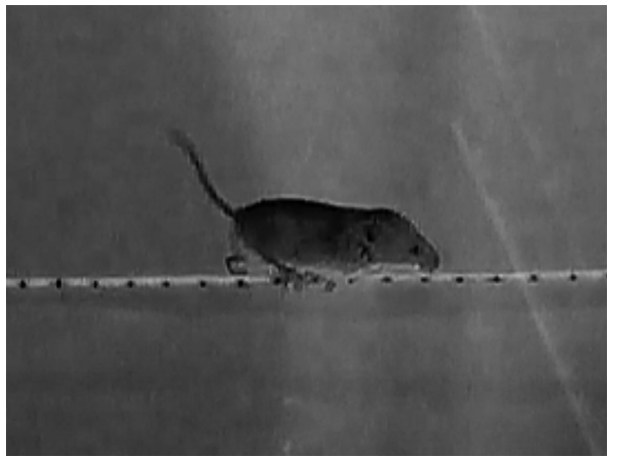
For the purposes of the current study, we tested six male adult M. minutus (Muridae, Rodentia) (Fig. 1). All specimens were captive born and permanently housed in the collections of the Nowe Zoo, Poznań, Poland, in large naturalistic enclosures. Their housing contained a large variety of available substrates of diverse sizes and orientations, enabling the harvest mice to move freely in an enriched environment. In their regular enclosures, the Eurasian harvest mice made extensive use of any available arboreal substrate inside the enclosures and were naturally inclined to use the provided substrates during the experimental procedures. Before the experiments, the Eurasian harvest mice were transported to a laboratory in the Faculty of Biology (Adam Mickiewicz University, Poznań, Poland), where they were housed all together in a glass terrarium filled with natural materials for nesting and climbing, in an attempt to reduce stress. Since the animals are nocturnal, lighting was configured to operate in a reversed day–night regime. All specimens were fully habituated to human presence and did not display any stereotypical or stressful behavior. Mean total head–body length of the subjects was 5.9 cm (SD = 0.12, range = 5.7–6.1 cm, n = 6), mean body mass was 6.8 g (SD = 1.02, range = 5.8–7.9 g, n = 6), and mean effective hind limb length, that is, the length of the leg as a strut (Pontzer, 2005, 2007a, 2007b), was 1.73 cm (SD = 0.02, range = 1.68–1.74 cm, n = 6). All measurements were taken directly on the anaesthetized subject animals via digital precision calipers (Mitutoyo, Japan). Regarding the effective hind limb length, direct measurements were taken after placing the limb in a posture imitating that of the standing animal. All manipulations were performed by the specialized staff of the Nowe Zoo and adhered to the guidelines for the treatment of animals in behavioral research and teaching (ASAB/ABS, 2012) and to the relevant regulations and legislations of the Nowe Zoo and the Adam Mickiewicz University in Poznań. Subsequently, these measurements were further compared to those obtained from photo stills of the different animals walking on different substrate diameters via ImageJ (imagej.nih.gov/ij). In this way, we wanted to eliminate any potential errors deriving from the small size and crouched posture of the animal for measuring effective hind limb length and calculating standardized gait parameters (Pontzer, 2007a, 2007b).
Experimental Setup
A single, specially configured glass terrarium (L: 90 cm × H: 40 cm × W: 40 cm) was used for filming. It was surrounded by transparent glass windows and it was topped by a wooden frame, with a lid door and wire mesh for ventilation. Within the terrarium, we established a wooden frame to support the poles. The poles were 80 cm long, cylindrical, semihardwood rods. They were marked with vertical blue lines every 1 cm for a reliable estimation of absolute lengths. During filming, the visible rod length was approximately 30 cm. Diameter and direction of movement accounted for the classification of different substrate categories. Thus, four diameters (2, 5, 10, and 25 mm) and three movement directions (descent at 45°, horizontal, and ascent at 45°) defined a total of 12 distinct substrate categories.
Data collection was completed in six recording sessions, during June 2013. During each recording session, the animals were transferred from their enclosure to the filming terrarium. Prior to filming, each individual was allowed free movement within the filming terrarium. Minimal or no stimulation was required for the subjects to walk on the poles. After each filming session, the animal was transported to another accommodation terrarium to ensure that no individual was tested twice during a session.
For video recording, we used a Sanyo digital camcorder (VPC-HD 2000; Sanyo, Osaka, Japan), filming at 240 fps, which was positioned at 1 m from the filming terrarium to reduce image distortion. For our analyses, we considered only complete gaits, as indicative of natural, unbiased behavior, initiating with the touchdown of the left hind limb and ending at the subsequent touchdown of the same limb (Hildebrand, 1967, 1976, 1985). Cycles involving beginnings or endings of locomotor bouts (action of significant acceleration or deceleration) or loss of balance (irregular footfalls) were discarded due to not being able to measure metrics reliably. The present research followed the guidelines for the treatment of animals in behavioral research and teaching (ASAB/ABS, 2012) and complied with relevant regulations and legislations of the Nowe Zoo and the Adam Mickiewicz University in Poznań and the relevant legislation of the Aristotle University of Thessaloniki. Handling, housing of animals, and behavioral tests were done with the permission of the Local Ethical Commission for the Animal Experiments in Poznań.
Gait Analyses
Video analysis and data collection, distance, and time calculations were made by importing videos and calibrating time and distance measurements using Tracker 4.87 (Brown, 2017). Microsoft Excel 2010 (Redmond, WA) and SPSS 20 (SPSS Inc., Chicago, IL) were used for all statistical analyses.
Asymmetrical cycles were diagnosed by whether the time from the first fore or hind footfall to the next fore or hind footfall was greater than 60% or less than 40% of the total stride period (±10% deviation from symmetry) (Lemelin and Cartmill, 2010). For our analyses, we considered the following gait parameters:
- Diagonality (D) (Cartmill et al., 2002), the percentage of the stride cycle by which the footfall of a forelimb follows behind the ipsilateral hind limb and applies only at symmetrical gaits. Although it was measured as a scale variable, it was also divided into five ordinal classes (sensu Cartmill et al., 2002): (a) Lateral Sequence Lateral Couplets (0 ≤ LSLC < 25), (b) Lateral Sequence Diagonal Couplets (25 ≤ LSDC < 50), (c) Trot (= 50), (d) Diagonal Sequence Diagonal Couplets (50 < DSDC ≤ 75), (e) Diagonal Sequence Lateral Couplets (75 < DSLC ≤ 100);
- Duty factor (DF), the mean of DFs of all limbs, defined as the percentage of a cycle during which a limb is in contact with the substrate;
- Duty factor index (DFI), the ratio of forelimb DF (DFf) and hind limb DF (DFh), calculated as 100 × DFh/DFf (Cartmill et al., 2002). Values > 100 indicate longer hind limb than forelimb relative stance durations, whereas values < 100 specify shorter hind limb than forelimb relative stance durations;
- Stride duration (t), total duration of a single stride in seconds, measured from the frame where a stride cycle began until the frame of the same stride cycle ended;
- Stride length (l), the corresponding distance covered during a single stride cycle, in meters;
- Velocity (v), the speed at which the subjects moved, calculated by dividing stride length with stride duration, and measured in m/s;
- Stride frequency (f), the number of strides per second;
As these parameters are size dependent, we used the effective hind limb length to calculate the dimensionless measures of stride duration, stride length, velocity, and stride frequency (Hof, 1996). These calibrated absolute measurements are useful for estimating competence during locomotion (Alexander, 1977; Alexander and Jayes, 1983; Hof, 1996): dimensionless stride duration (tD) = t / √(l0/g); dimensionless stride length (lD) = l / l0; dimensionless velocity (vD) = v / √(g × l0); dimensionless stride frequency (fD) = f / √(g/l0); where l0 is the effective hind limb length of each animal and g is the acceleration of gravity (g = 9.81 m/s²).
Where overall values are reported, they represent the sum of means of each recorded category, divided by the number of categories with observations. We tested for statistically significant discrepancies in the utilization of DS and LS gaits using binomial testing, but also incorporated the trot category into the analysis by using a χ² test. All of these analyses were carried out using two-tailed Monte Carlo procedures for enhanced p estimation accuracy (Kalos and Whitlock, 2009).
Analysis of covariance (ANCOVA) was selected to explore variable relationships while controlling for other possible covariants when both scale and ordinal variables were involved. When comparisons between categories were necessary, a Bonferroni mean difference (BMD) was calculated using ANCOVA estimates. Stepwise regression models were constructed to examine the impact of both stride frequency and stride length on velocity using their dimensionless counterparts. The impact of each parameter was calculated with the R² of partial correlations, that is, the correlation between a dependent variable and its covariate, after the impact of other covariates is removed (Harrell, 2001).
Results
We recorded a total of 164 valid, walking stride cycles during the experiments. Overall, the walks of harvest mice were LS gaits (Table 1) with moderate velocities. No asymmetrical gaits were observed in any substrate category or direction of movement. We found no statistical differences between individuals in any of the metrics (P > 0.05), hence all data were lumped together for subsequent analyses.
Gait Metrics and Their Interactions
The mean diagonality (D) of M. minutus strides was 38.90 (Table 1, Fig. 2). LS gaits dominated (LSDC and LSLC, combined n = 139), with few DSDC gaits (n = 17), and even fewer trots (n = 8) (lateral vs. diagonal: binomial test, P < 0.001; lateral vs. trot vs. diagonal, χ² = 204.634, P < 0.001; Table 2).
DF ranged from 54.63 to 85.75, with individual values and category means consistently higher than 50.00 (Table 1, Fig. 2), indicating that Eurasian harvest mice only walked. Furthermore, we found a significant negative effect of DF on D (N = 156, F(120,163) = 2.518, P = 0.001, controlling for substrate size, direction of movement, and velocity). Consequently, all subsequent tests, regarding either D or DF, were also controlled for the other parameter.
The DFI averaged 96.30 (Table 1, Fig. 2), indicating a generally lower DF of the hind limbs compared to that of forelimbs. Diagonality and the DFI had a strong positive relation, controlling for the effect of substrate size, and direction of movement (N = 164, F(117,163) = 2.728, P < 0.001).
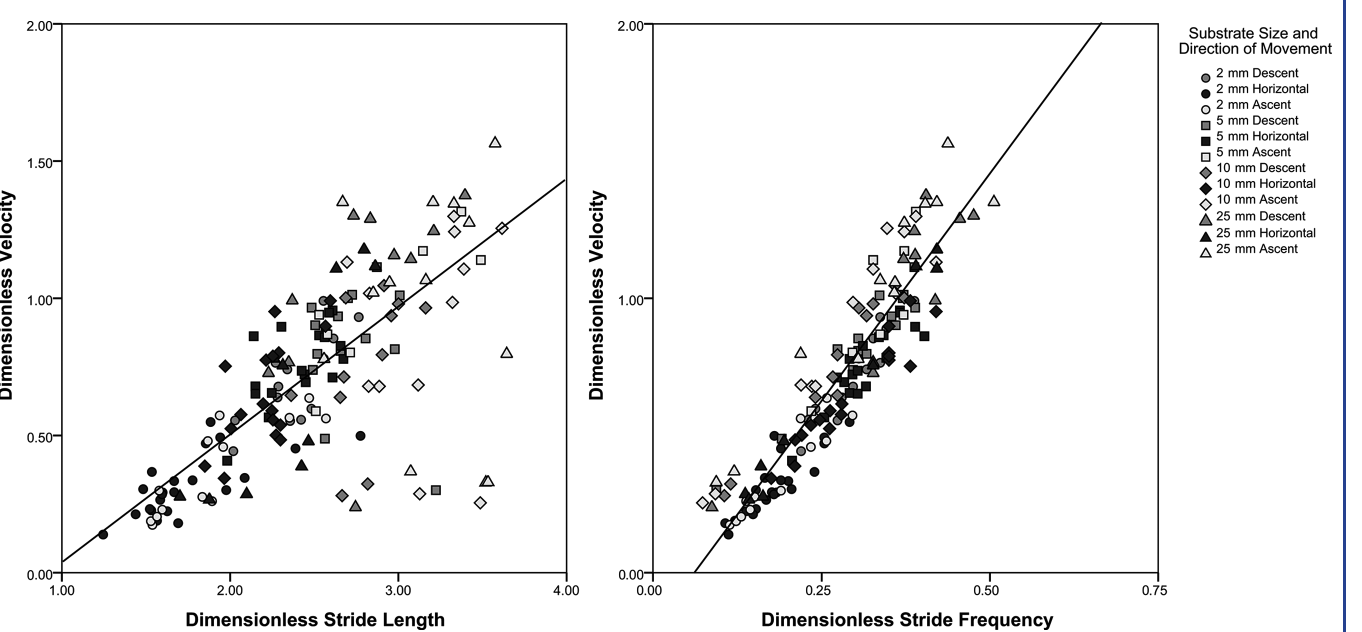
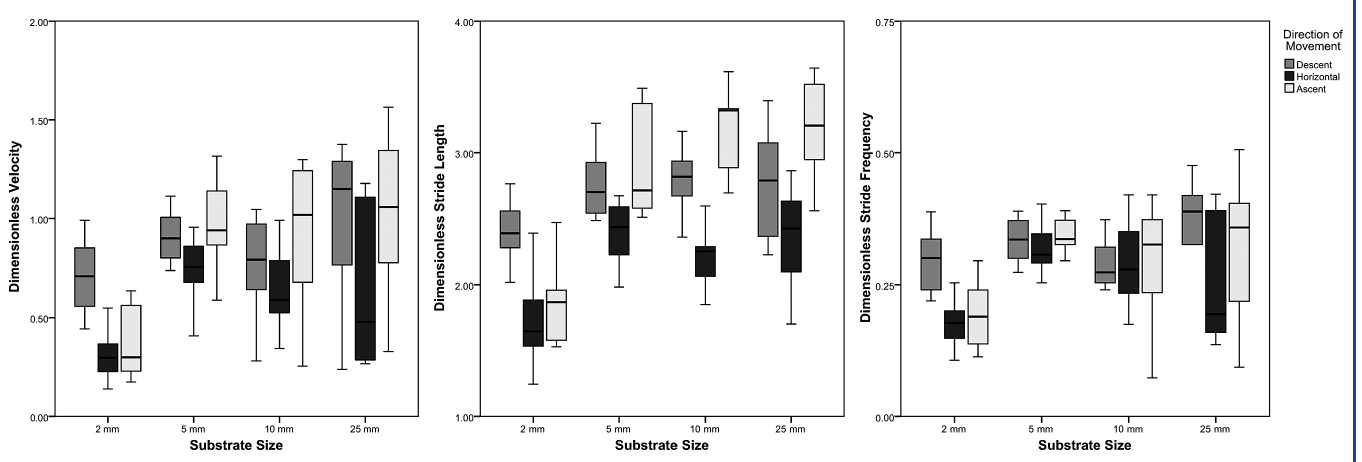
The construction of a stepwise regression model on the effects of stride frequency and stride length on velocity (Fig. 3) showed that stride frequency was the main factor for velocity regulation (N = 164, Rpart = 0.772, F(1,162) = 1833.757, P < 0.001). Stride length also played a significant role, but explained a much smaller part of variation in velocity (N = 164, Rpart = 0.260, F(1,161) = 484.695, P < 0.001).
Table 1. Summary of means and standard deviations (in brackets) of the gait statistics for Micromys minutus. N indicates the number of analyzed cycles for each substrate size and direction of movement category.
| Size (mm) | Direction | N | Diagonality | Duty factor | Hindlimb DF | Forelimb DF | DFI | Velocity (m s-1) | Stride length (m) | Stride freq. (s-1) | Stride dur. (s) | Dim. velocity | Dim. stride length | Dim. stride freq. | Dim. stride dur. |
|---|---|---|---|---|---|---|---|---|---|---|---|---|---|---|---|
| 2 | Descent | 14 | 40.69 (5.73) | 65.06 (3.31) | 63.77 (4.24) | 66.35 (3.88) | 96.31 (7.01) | 0.294 (0.067) | 0.042 (0.004) | 7.014 (1.212) | 0.147 (0.026) | 0.712 (0.164) | 2.396 (0.214) | 0.295 (0.051) | 3.487 (0.622) |
| Horizontal | 22 | 23.88 (5.29) | 79.61 (4.25) | 76.88 (5.29) | 82.34 (4.40) | 93.46 (5.91) | 0.13 (0.046) | 0.03 (0.006) | 4.309 (1.153) | 0.248 (0.065) | 0.318 (0.114) | 1.747 (0.338) | 0.18 (0.047) | 5.942 (1.560) | |
| Ascent | 13 | 31.63 (6.68) | 73.58 (8.79) | 72.67 (8.14) | 74.48 (9.99) | 98.01 (6.47) | 0.155 (0.070) | 0.033 (0.006) | 4.573 (1.478) | 0.242 (0.079) | 0.377 (0.171) | 1.899 (0.361) | 0.192 (0.062) | 5.765 (1.877) | |
| 5 | Descent | 15 | 44.2 (10.75) | 59.64 (3.31) | 58.89 (3.52) | 60.38 (4.87) | 97.96 (7.75) | 0.431 (0.344) | 0.048 (0.004) | 8.853 (5.911) | 0.147 (0.092) | 1.047 (0.833) | 2.758 (0.249) | 0.372 (0.252) | 3.51 (2.186) |
| Horizontal | 18 | 37.14 (4.79) | 62.86 (2.79) | 59.93 (3.23) | 65.79 (2.94) | 91.13 (3.85) | 0.309 (0.056) | 0.041 (0.003) | 7.571 (1.172) | 0.135 (0.023) | 0.755 (0.139) | 2.39 (0.211) | 0.315 (0.049) | 3.251 (0.558) | |
| Ascent | 9 | 45.03 (2.89) | 58.66 (1.66) | 58.98 (2.72) | 58.34 (2.29) | 101.25 (6.41) | 0.405 (0.094) | 0.051 (0.008) | 7.904 (1.111) | 0.129 (0.021) | 0.982 (0.227) | 2.934 (0.434) | 0.332 (0.047) | 3.072 (0.511) | |
| 10 | Descent | 11 | 42.83 (5.40) | 59.15 (2.66) | 58.87 (2.45) | 59.44 (3.20) | 99.15 (3.44) | 0.313 (0.110) | 0.049 (0.004) | 6.382 (2.095) | 0.185 (0.100) | 0.757 (0.267) | 2.8 (0.219) | 0.269 (0.088) | 4.4 (2.373) |
| Horizontal | 17 | 34.72 (5.35) | 65.95 (4.21) | 63.29 (5.46) | 68.62 (5.42) | 92.66 (10.00) | 0.268 (0.080) | 0.038 (0.003) | 6.954 (1.742) | 0.153 (0.040) | 0.652 (0.193) | 2.212 (0.197) | 0.292 (0.073) | 3.642 (0.947) | |
| Ascent | 16 | 46.79 (3.73) | 59.33 (2.19) | 59.41 (2.83) | 59.26 (1.89) | 100.24 (3.23) | 0.377 (0.150) | 0.055 (0.005) | 6.858 (2.624) | 0.193 (0.145) | 0.913 (0.362) | 3.176 (0.288) | 0.288 (0.111) | 4.611 (3.525) | |
| 25 | Descent | 10 | 42.55 (6.98) | 59.07 (1.47) | 57.92 (0.93) | 60.22 (2.48) | 96.3 (3.58) | 0.421 (0.145) | 0.048 (0.007) | 8.684 (2.609) | 0.145 (0.120) | 1.023 (0.353) | 2.791 (0.388) | 0.364 (0.109) | 3.465 (2.850) |
| Horizontal | 9 | 41.48 (5.98) | 64.48 (4.40) | 62.42 (5.57) | 66.54 (6.08) | 94.43 (11.44) | 0.268 (0.162) | 0.041 (0.007) | 6.21 (2.975) | 0.198 (0.088) | 0.65 (0.393) | 2.352 (0.398) | 0.261 (0.126) | 4.702 (2.099) | |
| Ascent | 13 | 51.43 (3.99) | 60.03 (1.84) | 60.31 (2.93) | 59.76 (1.29) | 100.92 (4.43) | 0.4 (0.174) | 0.055 (0.006) | 7.373 (3.245) | 0.187 (0.136) | 0.972 (0.423) | 3.192 (0.355) | 0.31 (0.136) | 4.459 (3.225) | |
| Total | 164 | 40.20 (5.63) | 63.95 (3.41) | 62.78 (3.94) | 65.13 (4.06) | 96.82 (6.13) | 0.314 (0.125) | 0.044 (0.005) | 6.890 (2.277) | 0.176 (0.078) | 0.763 (0.303) | 2.554 (0.304) | 0.289 (0.096) | 4.192 (1.861) |
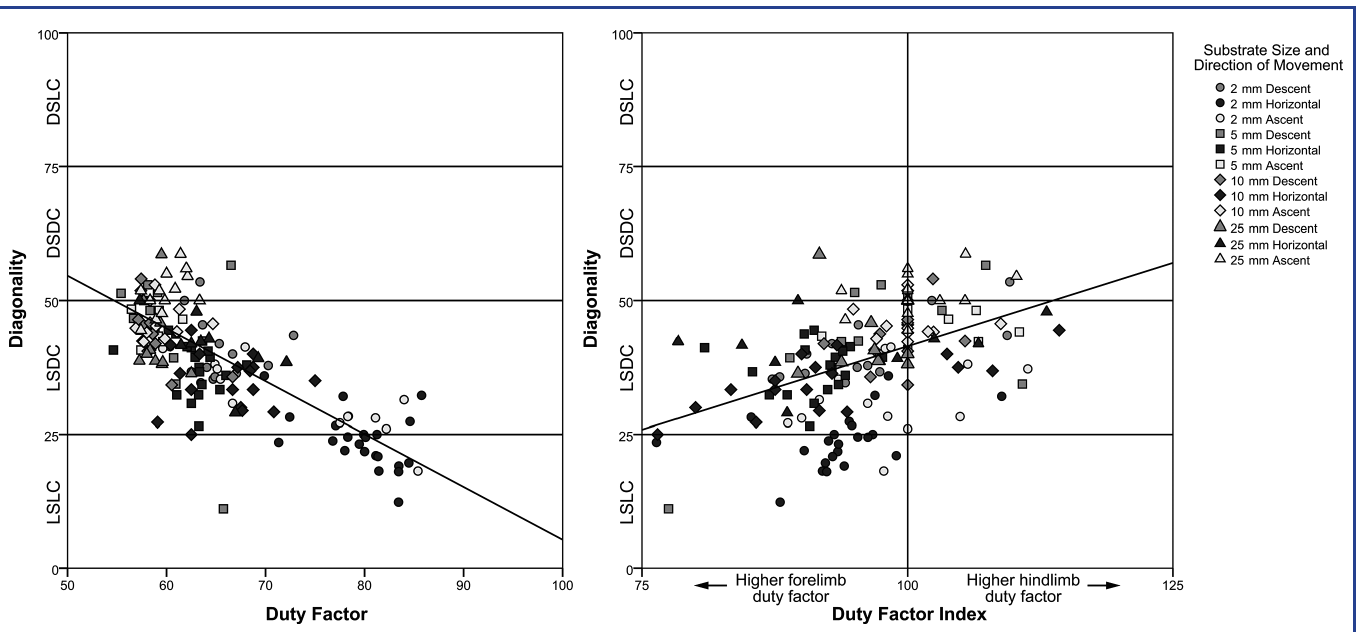
Table 2. Summarized statistics of gait diagonality classifications for Micromys minutus, reporting frequencies and per-row percentages.
| Size (mm) | Direction | LSLC (%) | LSDC (%) | Trot (%) | DSDC (%) | DSLC (%) |
|---|---|---|---|---|---|---|
| 2 | Descent | 0 (0.0) | 12 (85.7) | 1 (7.1) | 1 (7.1) | 0 (0.0) |
| Horizontal | 16 (72.7) | 6 (27.3) | 0 (0.0) | 0 (0.0) | 0 (0.0) | |
| Ascent | 1 (7.7) | 12 (92.3) | 0 (0.0) | 0 (0.0) | 0 (0.0) | |
| 5 | Descent | 1 (6.7) | 9 (60.0) | 1 (6.7) | 4 (26.7) | 0 (0.0) |
| Horizontal | 0 (0.0) | 18 (100) | 0 (0.0) | 0 (0.0) | 0 (0.0) | |
| Ascent | 0 (0.0) | 9 (100) | 0 (0.0) | 0 (0.0) | 0 (0.0) | |
| 10 | Descent | 0 (0.0) | 10 (90.9) | 0 (0.0) | 1 (9.1) | 0 (0.0) |
| Horizontal | 1 (5.9) | 16 (94.1) | 0 (0.0) | 0 (0.0) | 0 (0.0) | |
| Ascent | 0 (0.0) | 9 (69.2) | 1 (7.7) | 3 (23.1) | 0 (0.0) | |
| 25 | Descent | 0 (0.0) | 8 (80) | 1 (10) | 1 (10) | 0 (0.0) |
| Horizontal | 0 (0.0) | 8 (88.9) | 1 (11.1) | 0 (0.0) | 0 (0.0) | |
| Ascent | 0 (0.0) | 3 (23.1) | 3 (23.1) | 7 (14.0) | 0 (0.0) | |
| All sizes | Descent | 1 (2.0) | 39 (78.0) | 3 (6.0) | 7 (14.0) | 0 (0.0) |
| Horizontal | 17 (25.8) | 48 (72.7) | 1 (1.5) | 0 (0.0) | 0 (0.0) | |
| Ascent | 1 (2.1) | 33 (68.8) | 4 (8.3) | 10 (20.8) | 0 (0.0) | |
| Total | 19 (11.6) | 120 (73.2) | 8 (4.9) | 17 (10.4) | 0 (0.0) |
Effects of Substrate Diameter
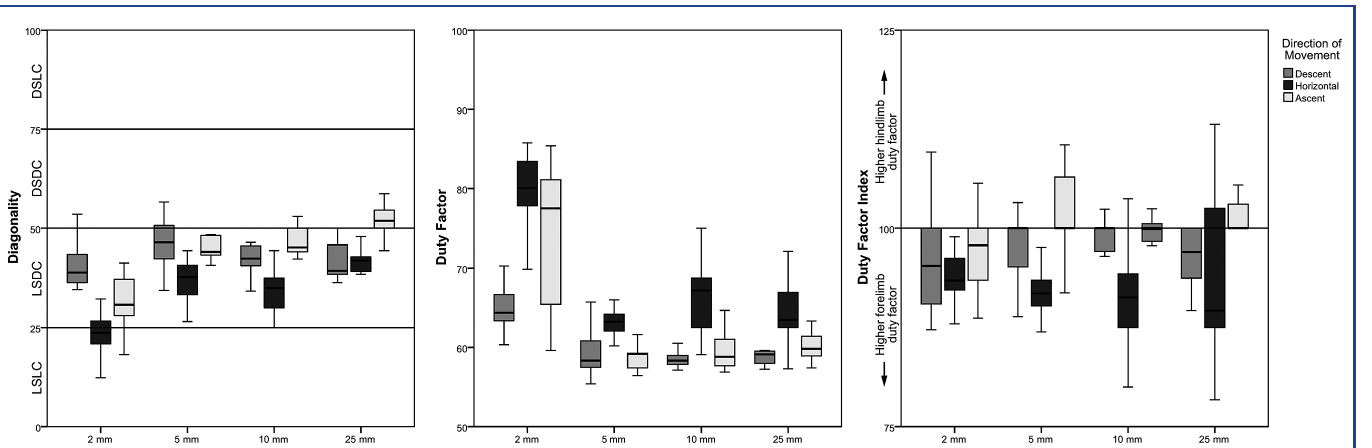
Overall, there was a significant increase in D with substrate size increase (Fig. 4; N = 164, F(3,163) = 3.719, P = 0.013; controlling for DF and direction of movement). On the contrary, DF tended to decrease on larger substrates (Fig. 4; N = 164, F(3,163) = 36.658, P < 0.001; controlling for the direction of movement). Essentially, even though the subjects used the smallest substrates (2 mm) without loss of balance, they were more cautious, with an increased relative stance phase of all limbs. DFI was not affected by substrate size (Fig. 4; N = 164, F(3,163) = 2.839, P = 0.094, controlling for direction of movement and D).
Substrate size had a significant effect on velocity (Fig. 5; N = 164, F(3,163) = 15.391, P < 0.001; controlling for direction of movement). Furthermore, stride frequency (controlling for the effect of stride length, N = 164, F(3,163) = 3.083, P = 0.029) and stride length (controlling for the effect of stride frequency, N = 164, F(3,163) = 23.624, P < 0.001) also increased from smaller to larger substrates (Fig. 5). However, the velocity and stride frequency increases from 5 to 10 mm substrates were small to negligible (Fig. 5).
Effect of Direction of Movement
The direction of movement had a significant impact on D (Fig. 4; N = 164, F(2,163) = 13.705, P < 0.001; controlling for substrate size and DF). Diagonality on horizontal supports was significantly lower than on both descents (BMD = 3.853, P = 0.008) and ascents (BMD = 6.154, P < 0.001). However, ascents and descents did not differ significantly (BMD = 2.301, P = 0.173).
The direction of movement also had a significant influence on DF (Fig. 4; N = 164, F(2,163) = 6.093, P = 0.003; controlling for substrate size and velocity), with overall shorter relative limb contact periods in descents compared to horizontal locomotion (overall: BMD = 5.999, P < 0.001; 5 mm: BMD = 2.841, P = 0.022; 10 mm: BMD = 6.359, P < 0.001; 25 mm: BMD = 5.043, P = 0.003). However, differences were not significant on 2 mm substrates (BMD = 1.838, P = 0.904). Ascents were also characterized by lower DF compared to horizontal locomotion, in all substrate diameter categories (overall: BMD = 2.329, P = 0.012; 2 mm: BMD = 4.153, P = 0.003; 5 mm: BMD = 3.909, P = 0.005; 10 mm: BMD = 5.578, P < 0.001; 25 mm: BMD = 4.131, P = 0.008). Ascents and descents displayed no significant differences (BMD = 2.329, P = 0.087) in any substrate diameter category (2 mm: BMD = 2.315, P = 0.549; 5 mm: BMD = 1.068, P = 1.000; 10 mm: BMD = 0.780, P = 1.000; 25 mm: BMD = 0.912, P = 1.000).
Direction of movement had an impact on DFI as well (Fig. 4; N = 164, F(2,163) = 4.794, P = 0.010, controlling for substrate diameter and D), with ascents scoring overall higher DFIs than horizontal locomotion (BMD = 4.074, P = 0.008). However, there were no significant differences between ascents and descents (BMD = 2.444, P = 0.150), or descents and horizontal locomotion (BMD = 1.663, P = 0.649).
Velocity (Fig. 5; N = 164, F(2,163) = 8.791, P < 0.001) was lower in horizontal locomotion than in descents (BMD = 0.027, P < 0.001) and ascents (BMD = 0.017, P = 0.045). No statistically significant difference was recorded between ascents and descents (BMD = 0.011, P = 0.406). Stride length (Fig. 5; N = 164, F(2,163) = 27.110, P < 0.001) during horizontal locomotion was lower than descents (BMD = 0.568, P < 0.001) and ascents (BMD = 0.582, P < 0.001), but was very similar between ascents and descents (BMD = 0.164, P = 1.000). Stride frequency (Fig. 5; N = 164, F(2,163) = 5.566, P = 0.005) was significantly higher in descents compared to horizontal locomotion (BMD = 0.063, P = 0.014), but only marginally, and not significantly, compared to ascents (BMD = 0.053, P = 0.079), and similar between ascents and horizontal locomotion (BMD = 0.010, P = 1.000).
Discussion
The present findings show that M. minutus are capable of using a wide range of substrate sizes and inclinations, employing predominantly LS walking gaits (high DF, low velocity, and diagonality < 50). On narrower substrates, gaits became less diagonal and more cautious (higher DF, lower velocity). Diagonality (D) was significantly higher, and DF was significantly lower in nonhorizontal (ascent, descent) compared to horizontal locomotion. The DFI was significantly higher in ascents compared to horizontal locomotion. Stride frequency was the main regulator of velocity, with stride length playing a secondary, but significant, role. Although these behavioral responses conform to the arboreal capacities of Eurasian harvest mice (Urbani and Youlatos, 2013), our initial predictions were only partly supported.
Effect of Substrate Diameter
The Eurasian harvest mice gradually reduce D and increase DF on narrow substrates (i.e., 2 and 5 mm in our study), with the most extreme values on the narrowest substrates (2 mm). Essentially, this combination leads to primarily slow LSDC walks, with extensive relative stance phases of the limbs. Additionally, the inverse correlation of D with DF at LS gaits helps keep the center of mass within the support polygons (Cartmill et al., 2002), resulting in a continuous, nondisrupted locomotion along arboreal substrates. Even though DS gaits coupled with hind foot grasping have been functionally linked to the safe negotiation of unstable substrates, as they allow for testing novel substrates (Cartmill et al., 2007), M. minutus used exclusively LS gaits on all types of substrates. In fact, LS gaits are also common in other scansorial mammals, such as rats, Rattus norvegicus (Schmidt and Fischer, 2011), woodmice, Apodemus agrarius, Apodemus flavicollis, voles, Myodes glareolus (Karantanis et al., 2017a), and the metatherians Monodelphis domestica (Lemelin et al., 2003; Lammers and Biknevicius, 2004) and Dasyurus hallucatus (White, 1990). Moreover, LS gaits are also common among some arboreal specialists, such as the rodents Sciurus vulgaris (Schmidt and Fischer, 2011) and Thallomys paedulcus (Karantanis et al., in prep.), the metatherians Petaurus breviceps (Shapiro and Young, 2010) and Didelphis virginiana (White, 1990), and callitrichid primates (Stevens, 2006, 2008; Nyakatura et al., 2008; Nyakatura and Heymann, 2010). On the other hand, many arboreal metatherians with prehensile extremities, from the small Acrobates pygmaeus (Karantanis et al., 2015) and Caluromys philander (Schmitt and Lemelin, 2002; Lemelin et al., 2003) to the larger Trichosurus vulpecula (White, 1990), most primates, from the small Microcebus murinus (Shapiro et al., 2016) to the larger strepsirrhines and catarrhines (Hildebrand, 1967; Stevens, 2006, 2008; Cartmill et al., 2007), and the carnivoran Potos flavus (Lemelin and Cartmill, 2010) habitually employ DS gaits. The distribution of DS and LS gaits among arboreal mammals is particularly difficult to interpret. Phylogeny (Primates, Didelphidae, Phalangeroidea, Procyonidae), microhabitat use (tree crown extremities), and substrate handling (prehensile hind- and/or forefeet) may possibly play important roles.
Velocity and its regulating factors, stride frequency and stride length, were low on smaller substrates but gradually increased on larger substrates. However, in a study on sigmodontine rodents (Camargo et al., 2016), velocities of arboreal species decreased as substrate size increased, while the opposite was true for terrestrial species. On narrower substrates, arboreal species moved faster, increased stride frequency and decreased stride length, but terrestrial species decreased both stride frequency and stride length or maintained stride frequency and decreased stride length (Camargo et al., 2016). Higher walking velocity on narrow substrates may, in some cases, denote a better adaptation to arboreal locomotion (Delciellos and Vieira, 2006; Camargo et al., 2016), and promote the maintenance of dynamic stability (Schmidt and Fischer, 2011). On the other hand, when a quadruped moves on an arboreal substrate, the support polygons are very narrow (Lammers and Zurcher, 2011a), increasing the risk of the center of mass being placed outside them. Furthermore, each time a limb touches down, the torque produced further enhances the possibility to lose balance and locomotor flow (Lammers and Zurcher, 2011b). These torques may be relatively reduced in a tiny arboreal mammal, but are, nevertheless, present. A slow, controlled walk, especially on the narrowest of substrates, would reduce the produced torques, increase the simultaneous contact points on the substrate at any given time, and provide longer time periods to accommodate a dynamic continuous locomotor pattern, which is essential for successful arboreal navigation (Lammers and Zurcher, 2011a).
Effect of Substrate Inclination
Regardless of the direction of movement, M. minutus maintained LS gaits. Moreover, even though D did not differ between oblique ascents and descents, as was also the case for vertical ascents and descents in M. minutus (Karantanis et al., 2017b), it was significantly higher in nonhorizontal locomotion than in horizontal locomotion, resulting in more LSDC gaits. The DFI was also higher in ascents than during horizontal locomotion, but no significant difference was detected between ascents and descents, although the vertical ascents of the Eurasian harvest mice were characterized by higher DFI than vertical descents (Karantanis et al., 2017b). In a natural setting, downwards angled substrates are usually rather unstable and would require secure anchoring of the limbs (Nyakatura et al., 2008; Nyakatura and Heymann, 2010; Karantanis et al., 2015). On declines, arboreal mammals face a cranial/anterior shift of the center of mass, which is associated with increasing contact time length and a higher fraction of vertical impulse on the forelimbs, enhancing their regulative and supportive role (Rollinson and Martin, 1981; Nyakatura et al., 2008). LS gaits are thought to allow the forelimbs to provide retardation through a “stop-jolt” before the hind limbs contact the substrate (Rollinson and Martin, 1981). The increase in D in M. minutus can be viewed as a shift toward diagonal couplet gaits, which, whether LSDC, trot, or DSDC, appear to confer advantages in arboreal stability (Cartmill et al., 2002, 2007). The more contralaterally paired limbs of diagonal couplets gaits exert opposing substrate reaction forces when in contact with the substrate, and reduce craniocaudal torsional moments, thus assisting in stabilizing the torso (Lammers and Gauntner, 2008; Nyakatura et al., 2008). Furthermore, an increase in D and DFI was also observed during ascending locomotion. In ascents, more diagonal gaits assist in generating additional propulsion by limiting the retarding role of the forelimbs in the first part of the stance phase when the autopodium is anterior to the extremities’ pivot (Nyakatura et al., 2008). Although M. minutus did not shift to DS gaits, LSDC gaits may have a similar effect on locomotor competence, especially in the presence of grasping hind feet (Preuschoft, 2002). LSDC gaits are equally stable to DSDC (Cartmill et al., 2002, 2007), and when coupled with higher hind limb than forelimb DFs (higher DFI), they may enable a more controlled, faster upward progression, with a similar effect to DSDC gaits.
Arboreal Locomotor Adjustments at a Small Body Size
Successful negation of the arboreal milieu, and especially of the finest, unstable substrates, is usually achieved by behavioral mechanisms that contribute to stable, safe, and continuous uninterrupted body progression along branches. These constraints appear to be similar even at a small body scale, as demonstrated by our observations on the Eurasian harvest mice.
In this context, regarding velocity regulation in M. minutus, stride frequency was the main regulating mechanism, with stride length playing a secondary, although significant, role. This way of increasing velocity is different from that of arboreal sigmodontine rodents, which increase velocity by increasing stride length and reducing stride frequency (Camargo et al., 2016). However, two small-bodied metatherians, Gracilinanus microtarsus (Delciellos and Vieira, 2006), A. pygmaeus (Karantanis et al., 2015), and some scansorial rodents (Karantanis et al., 2017a) adjust velocity in a similar manner to Eurasian harvest mice. Primates, larger arboreal marsupials (Larson et al., 2000, 2001; Delciellos and Vieira, 2006), and a few terrestrial neotropical rodents (Camargo et al., 2016) regulate velocity by increasing stride length instead of frequency. The increase in stride length enables a farther reach of the forelimbs, which, coupled with secure grasping, when available, ultimately reduces involuntary branch sway (Demes et al., 1994). On the other hand, an increase in stride frequency, although relatively costly in energy (Strang and Steudel, 1990; Reilly et al., 2007), may be better suited for small-bodied arboreal mammals for which branch swaying may be negligible, but not body oscillations. Body oscillations produce moments that disturb regular progression and may cause loss of stability, which may be particularly important when negotiating small, slender substrates. Regulation by stride frequency reduces these involuntary oscillations and could thus promote a more continuous and safer progression along arboreal substrates (Delciellos and Vieira, 2006).
The habitual use of LS gaits by a small narrow-branch dweller, along with a further reduction of D in narrower substrates, can only be adequately explained by comparing this strategy to other small mammals that use DS gaits. Especially at the lower end of the mammalian size scale, it is interesting to compare the behavioral strategies adopted by the similarly sized M. minutus and the metatherian feathertail glider A. pygmaeus. In contrast to Eurasian harvest mice, feathertail gliders utilize fast DS gaits and increase D on narrow substrates (Karantanis et al., 2015). Both species are adept arboreal specialists and tend to habitually use fine branches (Urbani and Youlatos, 2013; Youlatos et al., in prep.). Both species possess morphological adaptations such as broad apical pads, dermatoglyphs, a relatively divergent hallux, and deep curved claws for effective hind foot grasping (Haffner, 1996, 1998; Rosenberg and Rose, 1999; Krattli, 2001; Zefferer, 2002). However, the hind and forefeet of A. pygmaeus possess gland-rich plantar and palmar pads that further increase friction and resist substrate reaction forces enhancing their grasping ability (Rosenberg and Rose, 1999). Finally, in contrast to Eurasian harvest mice, feathertail gliders are much faster (Karantanis et al., 2015). The advantage of DS gaits to provide safe arboreal progression, by testing new unstable new substrates, seems improbable during high-speed locomotion (Nyakatura et al., 2008). Nevertheless, DS gaits may confer better dynamic stability (i.e., during fast locomotion), possibly allowing a better control and transfer of moments and torques across the body axes (Lammers and Zurcher, 2011a). Increased D on narrow branches, as exemplified by A. pygmaeus, but not M. minutus, produces medially oriented forces (Schmitt, 2003; Lammers and Biknevicius, 2004; Schmidt and Fischer, 2010). This allows animals to seize substrates and increase friction, which reduces the possibility of slipping (Lammers and Zurcher, 2011a). Moreover, opposing mediolateral and angular impulses generated by contralateral limbs may reduce mediolateral deviations from the long axis of the branch (Shapiro and Raichlen, 2007). These mechanisms assure continuous uninterrupted progression and minimize any risks of toppling over, both of which contribute to successful branch negotiation. Although the interpretation of the advantages of DS gaits has functionally focused on grasping hind feet (Cartmill et al., 2007), we believe that increased forelimb grasping capacity may be integral for effective DS gaits, as the combined grasping function of forelimb and hind limb would contribute to increasing stability. In contrast, mammals that do not possess strong hind and/or forefoot grasping abilities may not be able to apply equally strong contralateral forces during arboreal locomotion. In this case, the habitual use of LS gaits enables keeping the center of mass within the support polygon throughout the gait cycle, provided that three or four limbs are in contact with the substrate (i.e., high DF) (Lammers and Zurcher, 2011a). The combination of lower D with a higher DF on narrow substrates in some scansorial rodents with similar grasping capabilities (Karantanis et al., 2017a), as well as in M. minutus, implies behavioral adaptations for increased static stability (slow locomotion) on arboreal substrates. It is very likely that these differences account for the variation in the functional use of DS and LS gaits in arboreal locomotion, therefore calling for further investigations in arboreal and semiarboreal taxa.
The use of relatively cautious locomotion by Eurasian harvest mice is further denoted by the lack of use of any asymmetrical gaits, regardless of substrate diameter and inclination. In effect, many small arboreal and scansorial mammals tend to switch to asymmetrical gaits at higher velocities (Young, 2009; Schmidt and Fischer, 2011; Shapiro et al., 2016; Karantanis et al., 2017a). Extended aerial phases in gaits may be associated with bounding and leaping and likely facilitate obstacle avoidance and enhanced maneuvring (Hildebrand, 1980). This is particularly highlighted by one of the smallest primates, M. murinus, which display asymmetrical gaits with extended aerial phases, especially on larger substrates, which maximize acceleration, maneuvrability, and energetic economy (Shapiro et al., 2016). Although it may appear uneconomical for M. minutus to not use asymmetrical gaits, it may be relevant to its locomotor ecology. Eurasian harvest mice are characterized by the predominant use of very narrow, flexible substrates and the lack of airborne or bounding locomotion (Urbani and Youlatos, 2013). The sparsity of leaping, as well as the need for increased cautiousness on narrow substrates, by lowering velocity and increasing DF, possibly constitute long aerial phases, and therefore asymmetrical gaits, unnecessary in their locomotor behavior.
The findings of the present study demonstrate that, in contrast to kinematics (Fischer, 1994; Fischer et al., 2002; Schmidt, 2005; Schilling and Hackert, 2006), gaits and associated metrics may not be size dependent. Only velocity regulation, with a higher input of stride frequency to stride length was functionally related to small size, possibly linked to safer and uninterrupted arboreal locomotion (Delciellos and Vieira, 2006). This lack of differences may imply a certain behavioral plasticity across body mass range and the complex interaction of mechanisms that regulate locomotion. They might further underscore the common constraints that all mammals face when negotiating arboreal substrates. Despite of this, our results further indicate that M. minutus invest on safe, secure continuous locomotion contributing to an effective negotiation of arboreal substrates of a variety of inclinations and sizes. Although they almost exclusively used LS gaits, they adjusted gait parameters per substrate constraints to enhance stability. Despite their miniscule size, they did not differ from other arboreal mammals without grasping forefeet, in the ways they adjusted gaits for terminal branch locomotion (i.e., a decrease in D and DF and an increase in velocity), thus promoting uninterrupted, stable progression (Pridmore, 1994; Cartmill et al., 2002; Shapiro and Raichlen, 2005; Shapiro and Young, 2010; Lammers and Zurcher, 2011a). At such a small body size, we may wonder why arboreal stability is important. After all, such tiny animals are far less likely to be injured or killed after falling off. However, reassuming their previous position on an elevated arboreal layer would be both energetically and time consuming, and very likely decrease fitness. But more importantly, falling from a tree, even though it may not be physically damaging, would severely expose the animal to potential terrestrial predators. Considering this significant risk, it is of no surprise that M. minutus, despite its miniscule size, displays behavioral gait adaptations that optimize arboreal stability, in similar ways to larger arboreal and scansorial mammals, and ensure a safe, uninterrupted, continuous progression along arboreal substrates.
Finally, it is important to highlight the significant role of the grasping hind feet in ascending and descending locomotion where they enable upwards body propulsion and facilitated finer braking and control over declines. In fact, the enhanced stability provided by the hind feet allows successful negotiation and effective climbing on the narrowest, most unstable arboreal substrates (Urbani and Youlatos, 2013; Karantanis et al., 2017b). These substrates correspond to long grass and reeds, and fine twigs on short trees, shrubs, vines, and hedgerows that abound in their natural habitat. These locomotor adjustments enable M. minutus to successfully exploit the arboreal habitat, facilitating nest construction during reproduction, reducing interspecific competition, avoiding predation, and providing timely access to valuable arboreal food sources (Buesching et al., 2008; Harris, 1970, 1979; Nordvig et al., 2001; Bence et al., 2003; Özkan et al., 2003; Surmacki et al., 2005; Kuroe et al., 2007). As locomotion plays an important part in the ecology and evolution of arboreal mammals, we hope that the present study provides a basis for similar studies investigating the locomotor abilities of arboreal rodents, as well as other small arboreal mammals. This will ultimately help elucidate the evolution and adaptive significance of gaits and their parameters within the mammalian radiations.
Acknowledgments
All authors wish to express their gratitude to all the people who helped throughout this project: Katarzyna Byczyk and other staff members of the Nowe Zoo of Poznań for providing the animals and assistance, Peter Klimant for his essential assistance in the carrying out of the experiments, and Doug Brown for essential modifications to the open source Tracker software, which made data analysis possible. Financial support was provided through funds by the Erasmus Studies Scholarships to NEK, the Department of Systematic Zoology, AMU, and the Department of Zoology, AUTh.
References
- Alexander, R. M. (1977). Terrestrial locomotion. In R. M. Alexander & G. Goldspink (Eds.), Mechanics and energetics of animal locomotion (pp. 168–203). Chapman & Hall.
- Alexander, R. M., & Jayes, A. S. (1983). A dynamic similarity hypothesis for the gaits of quadrupedal mammals. Journal of Zoology, 201, 135–152.
- ASAB/ABS. (2012). Guidelines for the treatment of animals in behavioural research and teaching. Animal Behaviour, 83, 301–309.
- Bence, S. L., Stander, K., & Griffiths, M. (2003). Habitat characteristics of harvest mouse nests on arable farmland. Agriculture, Ecosystems & Environment, 99, 179–186.
- Biewener, A. A. (1989a). Mammalian terrestrial locomotion and size. BioScience, 39, 776–783.
- Biewener, A. A. (1989b). Scaling body support in mammals: Limb posture and muscle mechanics. Science, 245, 45–48.
- Biewener, A. A. (1990). Biomechanics of mammalian terrestrial locomotion. Science, 250, 1097–1103.
- Brown, D. (2017). Tracker Video Analysis and Modeling Tool [Computer software].
- Buesching, C. D., Newman, C., Twell, R., & Macdonald, D. W. (2008). Reasons for arboreality in wood mice Apodemus sylvaticus and bank voles Myodes glareolus. Mammalian Biology, 73, 318–324.
- Camargo, N. F., Sano, N. Y., Ribeiro, J. F., & Vieira, E. M. (2016). Contrasting the realized and fundamental niche of the arboreal walking performance of neotropical rodents. Journal of Mammalogy, 97, 155–166.
- Cartmill, M. (1974). Pads and claws in arboreal locomotion. In F. A. Jenkins Jr. (Ed.), Primate locomotion (pp. 45–83). Academic Press.
- Cartmill, M. (1985). Climbing. In M. Hildebrand, D. M. Bramble, K. F. Liem, & D. B. Wake (Eds.), Functional vertebrate morphology (pp. 73–88). Harvard University Press.
- Cartmill, M., Lemelin, P., & Schmitt, D. (2002). Support polygons and symmetrical gaits in mammals. Zoological Journal of the Linnean Society, 136, 401–420.
- Cartmill, M., Lemelin, P., & Schmitt, D. (2007). Primate gaits and primate origins. In M. Ravosa & M. Dagosto (Eds.), Primate origins: Adaptations and evolution (pp. 403–435). Springer.
- Delciellos, A. C., & Vieira, M. V. (2006). Arboreal walking performance in seven didelphid marsupials as an aspect of their fundamental niche. Austral Ecology, 31, 449–457.
- Demes, B., Larson, S. G., Stern, J. T., Jr., Jungers, W. L., Biknevicius, A. R., & Schmitt, D. (1994). The kinetics of primate quadrupedalism: “Hindlimb drive” reconsidered. Journal of Human Evolution, 26, 353–374.
- Fischer, M. S. (1994). Crouched posture and high fulcrum, a principle in the locomotion of small mammals: The example of the rock hyrax (Procavia capensis) (Mammalia: Hyracoidea). Journal of Human Evolution, 26, 501–524.
- Fischer, M. S., Schilling, N., Schmidt, M., Haarhaus, D., & Witte, H. (2002). Basic limb kinematics of small therian mammals. Journal of Experimental Biology, 205, 1315–1338.
- Flaherty, E. A., Ben-David, M., & Smith, W. P. (2010). Quadrupedal locomotor performance in two species of arboreal squirrels: Predicting energy savings of gliding. Journal of Comparative Physiology B, 180, 1067–1078.
- Haffner, M. (1996). A tendon-locking mechanism in two climbing rodents, Muscardinus avellanarius and Micromys minutus. Journal of Morphology, 227, 219–227.
- Haffner, M. (1998). A comparison of the gross morphology and micro-anatomy of the foot pads in two fossorial and two climbing rodents (Mammalia). Journal of Zoology, 244, 287–294.
- Hanna, J. B., & Schmitt, D. (2011). Interpreting the role of climbing in primate locomotor evolution: Are the biomechanics of climbing influenced by habitual substrate use and anatomy? International Journal of Primatology, 32, 430–444.
- Harrell, F. E. (2001). Regression modeling strategies: With applications to linear models, logistic regression, and survival analysis. Springer-Verlag.
- Harris, S. (1970). The secret life of the harvest mouse. Hamlyn.
- Harris, S. (1979). History, distribution, status and habitat requirements of the harvest mouse (Micromys minutus) in Britain. Mammal Review, 9, 159–171.
- Hildebrand, M. (1967). Symmetrical gaits of primates. American Journal of Physical Anthropology, 26, 119–130.
- Hildebrand, M. (1976). Analysis of tetrapod gaits: General considerations and symmetrical gaits. In R. M. Herman, S. Grillner, P. S. G. Stein, & D. G. Stuart (Eds.), Neural control of locomotion (pp. 203–236). Plenum Press.
- Hildebrand, M. (1980). The adaptive significance of tetrapod gait selection. American Zoologist, 20, 255–267.
- Hildebrand, M. (1985). Walking and running. In M. Hildebrand, D. M. Bramble, K. F. Liem, & D. B. Wake (Eds.), Functional vertebrate morphology (pp. 38–57). Harvard University Press.
- Hof, A. L. (1996). Scaling gait data to body size. Gait & Posture, 4, 222–223.
- Iriarte-Díaz, J. (2002). Differential scaling of locomotor performance in small and large terrestrial mammals. Journal of Experimental Biology, 205, 2897–2908.
- Ishiwaka, R., & Mori, T. (1999). Early development of climbing skills in harvest mice. Animal Behaviour, 58, 203–209.
- Jędrzejewska, B., & Jędrzejewski, W. (1990). Antipredatory behaviour of bank voles and prey choice of weasels – Enclosure experiments. Annales Zoologici Fennici, 27, 321–328.
- Jędrzejewski, W., Rychlik, L., & Jędrzejewska, B. (1993). Responses of bank voles to odours of seven species of predators: Experimental data and their relevance to natural predator-vole relationships. Oikos, 68, 251–257.
- Jenkins, F. A. (1974). Tree shrew locomotion and the origins of primate arborealism. In F. A. Jenkins Jr. (Ed.), Primate locomotion (pp. 85–116). Academic Press.
- Kalos, M. H., & Whitlock, P. A. (2009). Monte Carlo methods. Wiley-VCH.
- Karantanis, N.-E., Youlatos, D., & Rychlik, L. (2015). Diagonal gaits in the feathertail glider Acrobates pygmaeus (Acrobatidae, Diprotodontia): Insights for the evolution of primate quadrupedalism. Journal of Human Evolution, 86, 43–54. https://doi.org/10.1016/j.jhevol.2015.06.007
- Karantanis, N.-E., Rychlik, L., Herrel, A., & Youlatos, D. (2017a). Arboreal gaits in three sympatric rodents Apodemus agrarius, Apodemus flavicollis (Rodentia, Muridae) and Myodes glareolus (Rodentia, Cricetidae). Mammalian Biology, 83, 51–63.
- Karantanis, N.-E., Rychlik, L., Herrel, A., & Youlatos, D. (2017b). Vertical locomotion in Micromys minutus (Rodentia: Muridae): Insights into the evolution of eutherian climbing. Journal of Mammalian Evolution. https://doi.org/10.1007/s10914-016-9374-5
- Krattli, H. (2001). Struktur und Funktion des Extremitäteninteguments bei einheimischen mäuseartigen (Muridae, Rodentia) [Doctoral dissertation, University of Zurich].
- Kuroe, M., Ohori, S., Takatsuki, S., & Miyashita, T. (2007). Nest-site selection by the harvest mouse Micromys minutus in seasonally changing environments. Acta Theriologica, 52, 355–360.
- Lammers, A. R. (2007). Locomotor kinetics on sloped arboreal and terrestrial substrates in a small quadrupedal mammal. Zoology, 110, 93–103.
- Lammers, A. R., & Biknevicius, A. R. (2004). The biodynamics of arboreal locomotion: The effects of substrate diameter on locomotor kinetics in the gray short-tailed opossum (Monodelphis domestica). Journal of Experimental Biology, 207, 4325–4336.
- Lammers, A. R., & Gauntner, T. (2008). Mechanics of torque generation during quadrupedal arboreal locomotion. Journal of Biomechanics, 41, 2388–2395.
- Lammers, A. R., & Zurcher, U. (2011a). Stability during arboreal locomotion. In V. Klika (Ed.), Theoretical biomechanics (pp. 319–334). InTech.
- Lammers, A. R., & Zurcher, U. (2011b). Torque around the center of mass: Dynamic stability during quadrupedal arboreal locomotion in the Siberian chipmunk (Tamias sibiricus). Zoology, 114, 95–103.
- Larson, S. G., Schmitt, D., Lemelin, P., & Hamrick, M. (2000). Uniqueness of primate forelimb posture during quadrupedal locomotion. American Journal of Physical Anthropology, 112, 87–101.
- Larson, S. G., Schmitt, D., Lemelin, P., & Hamrick, M. (2001). Limb excursion during quadrupedal walking: How do primates compare to other mammals? Journal of Zoology, 255, 353–365.
- Leach, M. (1990). Mice of the British Isles. Shire Publications.
- Lemelin, P., & Cartmill, M. (2010). The effect of substrate size on the locomotion and gait patterns of the kinkajou (Potos flavus). Journal of Experimental Zoology Part A, 313A, 157–168.
- Lemelin, P., Schmitt, D., & Cartmill, M. (2003). Footfall patterns and interlimb co-ordination in opossums (Family Didelphidae): Evidence for the evolution of diagonal-sequence walking gaits in primates. Journal of Zoology, 260, 423–429.
- McAdam, A. G., & Kramer, D. L. (1998). Vigilance as a benefit of intermittent locomotion in small mammals. Animal Behaviour, 55, 109–117.
- Nordvig, K., Reddersen, J., & Jensen, T. S. (2001). Small mammal exploitation of upper vegetation strata in non-forest, mixed farmland habitats. Mammalian Biology, 66, 129–134.
- Nyakatura, J. A., & Heymann, E. W. (2010). Effects of support size and orientation on symmetric gaits in free-ranging tamarins of Amazonian Peru: Implications for the functional significance of primate gait sequence patterns. Journal of Human Evolution, 58, 242–251.
- Nyakatura, J. A., Fischer, M. S., & Schmidt, M. (2008). Gait parameter adjustments of cotton-top tamarins (Saguinus oedipus, Callitrichidae) to locomotion on inclined arboreal substrates. American Journal of Physical Anthropology, 135, 13–26.
- Özkan, B., Yigit, N., & Colak, E. (2003). A study on Micromys minutus (Pallas, 1771) (Mammalia: Rodentia) in Turkish Thrace. Turkish Journal of Zoology, 27, 55–60.
- Pontzer, H. (2005). A new model predicting locomotor cost from limb length via force production. Journal of Experimental Biology, 208, 1513–1524.
- Pontzer, H. (2007a). Predicting the energy cost of terrestrial locomotion: A test of the LiMb model in humans and quadrupeds. Journal of Experimental Biology, 210, 484–494.
- Pontzer, H. (2007b). Effective limb length and the scaling of locomotor cost in terrestrial animals. Journal of Experimental Biology, 210, 1752–1761.
- Preuschoft, H. (2002). What does “arboreal locomotion” mean exactly and what are the relationships between “climbing,” environment and morphology? Zeitschrift für Morphologie und Anthropologie, 83, 171–188.
- Pridmore, P. A. (1994). Locomotion in Dromiciops australis (Marsupialia, Microbiotheriidae). Australian Journal of Zoology, 42, 679–699.
- Reilly, S. M., McElroy, E. J., & Biknevicius, A. R. (2007). Posture, gait and the ecological relevance of locomotor costs and energy-saving mechanisms in tetrapods. Zoology, 110, 271–289.
- Rollinson, J. M., & Martin, R. D. (1981). Comparative aspects of primate locomotion, with special reference to arboreal cercopithecines. Symposia of the Zoological Society of London, 48, 377–427.
- Rosenberg, H. I., & Rose, R. (1999). Volar adhesive pads of the feathertail glider, Acrobates pygmaeus (Marsupialia; Acrobatidae). Canadian Journal of Zoology, 77, 233–248.
- Schilling, N., & Hackert, R. (2006). Sagittal spine movements of small therian mammals during asymmetrical gaits. Journal of Experimental Biology, 209, 3925–3939.
- Schmidt, A., & Fischer, M. S. (2010). Arboreal locomotion in rats – The challenge of maintaining stability. Journal of Experimental Biology, 213, 3615–3624.
- Schmidt, A., & Fischer, M. S. (2011). The kinematic consequences of locomotion on sloped arboreal substrates in a generalized (Rattus norvegicus) and a specialized (Sciurus vulgaris) rodent. Journal of Experimental Biology, 214, 2544–2559.
- Schmidt, M. (2005). Hind limb proportions and kinematics: Are small primates different from other small mammals? Journal of Experimental Biology, 208, 3367–3383.
- Schmidt, M. (2008). Forelimb proportions and kinematics: How are small primates different from other small mammals? Journal of Experimental Biology, 211, 3775–3789.
- Schmitt, D. (2003). Evolutionary implications of the unusual walking mechanics of the common marmoset (C. jacchus). American Journal of Physical Anthropology, 122, 28–37.
- Schmitt, D., & Lemelin, P. (2002). Origins of primate locomotion: Gait mechanics of the woolly opossum. American Journal of Physical Anthropology, 118, 231–238.
- Shapiro, L. J., & Raichlen, D. A. (2005). Lateral sequence walking in infant Papio cynocephalus: Implications for the evolution of diagonal sequence walking in primates. American Journal of Physical Anthropology, 126, 205–213.
- Shapiro, L. J., & Raichlen, D. A. (2007). A response to Cartmill et al.: Primate gaits and arboreal stability. American Journal of Physical Anthropology, 133, 825–827.
- Shapiro, L. J., & Young, J. W. (2010). Is primate-like quadrupedalism necessary for fine-branch locomotion? A test using sugar gliders (Petaurus breviceps). Journal of Human Evolution, 58, 309–319.
- Shapiro, L. J., Kemp, A. D., & Young, J. W. (2016). Effects of substrate size and orientation on quadrupedal gait kinematics in mouse lemurs (Microcebus murinus). Journal of Experimental Zoology Part A, 325, 329–343.
- Stevens, N. J. (2006). Stability, limb coordination and substrate type: The ecorelevance of gait sequence pattern in primates. Journal of Experimental Zoology Part A, 305A, 953–963.
- Stevens, N. J. (2008). The effect of branch diameter on primate gait sequence pattern. American Journal of Primatology, 70, 356–362.
- Strang, K. T., & Steudel, K. (1990). Explaining the scaling of transport costs: The role of stride frequency and stride length. Journal of Zoology, 221, 343–358.
- Surmacki, A., Gołdyn, B., & Tryjanowski, P. (2005). Location and habitat characteristics of the breeding nests of the harvest mouse (Micromys minutus) in the reed-beds of an intensively used farmland. Mammalia, 69, 5–9.
- Trout, R. C. (1978a). A review of studies on populations of wild harvest mice (Micromys minutus (Pallas)). Mammal Review, 8, 143–158.
- Trout, R. C. (1978b). A review of studies on captive harvest mice (Micromys minutus (Pallas)). Mammal Review, 8, 159–175.
- Urbani, B., & Youlatos, D. (2013). Positional behavior and substrate use of Micromys minutus (Rodentia: Muridae): Insights for understanding primate origins. Journal of Human Evolution, 64, 130–136.
- White, T. D. (1990). Gait selection in the brush-tail possum (Trichosurus vulpecula), the northern quoll (Dasyurus hallucatus), and the Virginia opossum (Didelphis virginiana). Journal of Mammalogy, 71, 79–84.
- Ylönen, H. (1990). Spatial avoidance between the bank vole Clethrionomys glareolus and the harvest mouse Micromys minutus: An experimental study. Annales Zoologici Fennici, 27, 313–320.
- Young, J. W. (2009). Substrate determines asymmetrical gait dynamics in marmosets (Callithrix jacchus) and squirrel monkeys (Saimiri boliviensis). American Journal of Physical Anthropology, 138, 403–420.
- Zefferer, M. (2002). Adaptation des terminalen Zehengliedes an die Fortbewegung bei Kleinsäugern (Mammalia) [Bachelor's thesis, University of Zurich].
Comments